
Body Composition
Two people lose the same five pounds and end up with opposite bodies. The scale shows them the same digit.
Weight is fat plus muscle plus water plus everything else, and the scale cannot tell you which one moved. Two people can each lose five pounds in a month: one lost five pounds of fat, the other lost one pound of fat and four of muscle. Same digit, opposite results.
Body composition splits the number into the two parts that matter, fat mass and lean mass, each on its own line. It is the chart that tells you whether a diet is working or just shrinking you.
What it is
Body-fat percent does not fix the scale problem, because it is a ratio of two moving numbers. Two lines do: pounds or kilos of fat, and pounds or kilos of lean tissue, each on its own axis. The source is any scale or DEXA scan that reports body fat.
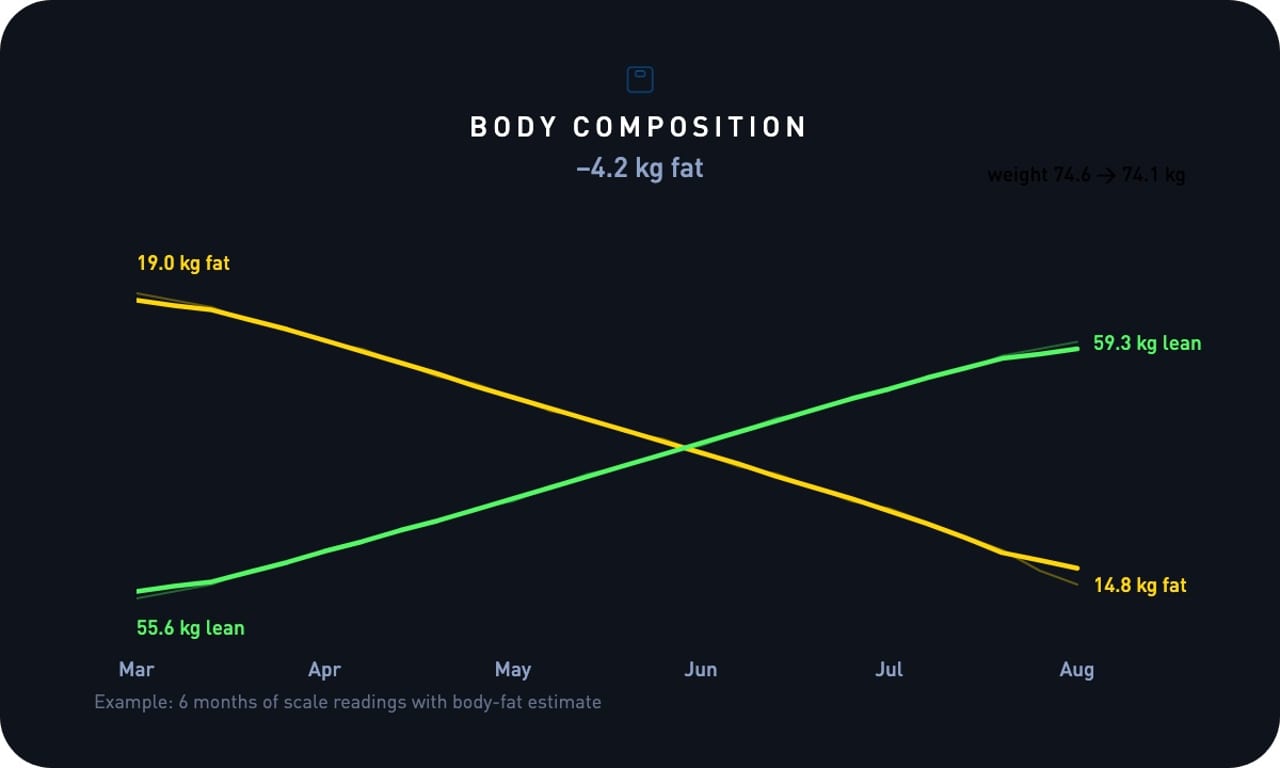
The chart above is six months of what a good change looks like: fat mass 19 down to 14.8 kg, lean mass 55.6 up to 59.3, and total weight barely moved, 74.6 to 74.1. That is the whole reason the number is split.
Home scales estimate body fat from an electrical signal, and the estimate jumps around with hydration. Read the monthly trend, not the day, and weigh at the same time each morning.
Why it matters for your goals
If you want to lose weight
The goal is never a lower number; it is less fat and the same muscle. A diet that takes both is a diet you will have to repeat. The shape to look for is the fat line trending down while the lean line holds or rises, and that shape is invisible on a bathroom scale. Someone watching only weight would have quit the chart above in month two.
If you want to live longer
Lean mass is the reserve you draw on when you are ill, injured, or old, and it is far easier to keep than to rebuild. Watching the lean line through a cut is how you make sure a weight-loss win is not a muscle-loss loss.
If you are training
This is the chart that shows a recomposition: fat down, lean up, total weight barely moving. Without it, months of good training read as a flat line and feel like failure.
Where people land
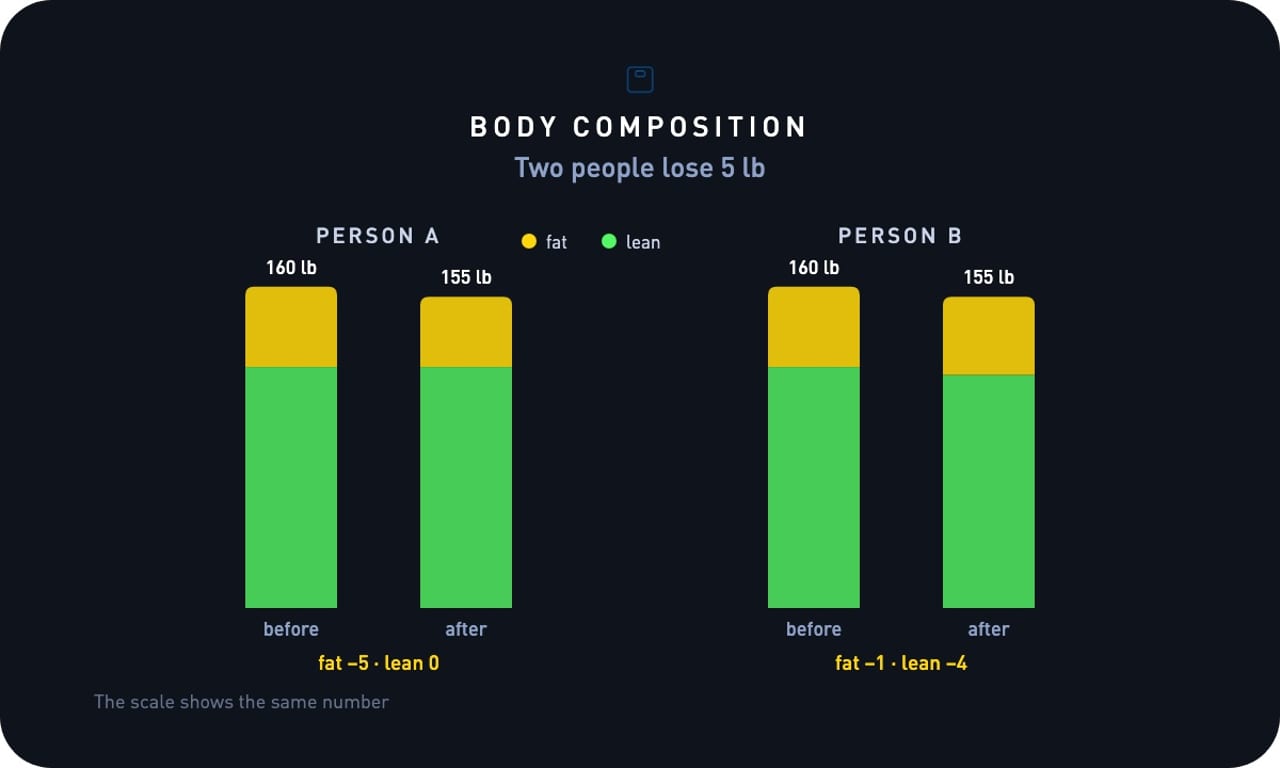
| Person A, 160 to 155 lb | Fat down 5, lean unchanged |
|---|---|
| Person B, 160 to 155 lb | Fat down 1, lean down 4 |
| What the scale shows | The same five pounds for both |
Scales from different makers disagree on body fat by several points, so the number itself is not worth comparing with anyone else. The direction of your own two lines, on the same scale, over months, is what matters.
What the research found
What keeps the lean line up during a diet has been tested directly, in meta-analyses of resistance training and protein, and in a controlled trial of sleep.
A 2025 meta-analysis found that adding resistance training to a diet preserved more fat-free mass, increased fat loss, and improved strength, without materially changing total weight lost. (Binmahfoz et al., BMJ Open Sport & Exercise Medicine, 2025). If you are dieting, lift. Same weight lost, but it comes out of the fat line instead of the lean one.
Across 49 resistance-training trials with 1,863 participants, extra protein produced small additional gains in strength and lean mass, and the benefit plateaued at about 1.6 grams of protein per kilogram of body weight per day. (Morton et al., British Journal of Sports Medicine, 2018). Around 1.6 grams of protein per kilo a day is enough; the drift below it happens by accident during a cut.
Dieters who slept 5.5 hours instead of 8.5 lost 55% less fat on the same calories, and lost more lean mass instead. (Nedeltcheva et al., Annals of Internal Medicine, 2010). Short sleep changes where the weight comes from. If the lean line is falling faster than the fat line, check the nights first.
What moves it
Fat down, lean held, over months. A modest calorie deficit. Resistance training two or three times a week. Enough protein at each meal. Seven or more hours of sleep. Walking on the days between sessions.
Lean down, within weeks. A large deficit with no lifting. Weeks of short sleep. Very low protein. Illness or a long layoff from training. Rapid weight loss of any kind, including the first weeks of a GLP-1 prescription without strength work.
This week. Weigh every morning after the bathroom and before breakfast, and change nothing else. A week of same-time readings is the baseline the trend is built on. Then add two strength sessions and read the lean line a month later.
Everything known to move it
Body composition is two lines, and most levers move one without the other. Lowers and raises here refer to fat mass unless the lever is about the lean line, where it says so.
Training
| Resistance training | lowers | Added to a diet, it preserved more fat-free mass and increased fat loss; same weight lost, different body. Binmahfoz et al., BMJ Open Sport & Exercise Medicine, 2025 |
|---|---|---|
| Walking between sessions | lowers | Widens the deficit without the appetite rebound of hard cardio, and leaves the lean line alone. |
| Long layoff from training | raises | Lean mass starts to fall within weeks of stopping; the scale may not move while the split does. |
| Progressive overload | steadies | Keeps the lean line rising instead of flat; the same weights for a year maintain, they do not build. |
Sleep
| Short sleep while dieting | raises | Dieters sleeping 5.5 hours lost 55% less fat on the same calories and lost more lean mass instead. Nedeltcheva et al., Annals of Internal Medicine, 2010 |
|---|---|---|
| Short sleep generally | raises | Raises hunger and cravings for dense food, which pushes the fat line up over weeks. Spiegel et al., Annals of Internal Medicine, 2004 |
Nutrition
| Enough protein | steadies | Around 1.6 grams per kilo a day protected lean mass across 49 trials; the drift below it happens by accident during a cut. Morton et al., British Journal of Sports Medicine, 2018 |
|---|---|---|
| A modest deficit | lowers | Fat comes off and muscle stays; large deficits take both. |
| A large deficit | mixed | Fat falls fast but so does lean mass; rapid weight loss of any kind shows the same split. |
| Ultra-processed food | raises | About 500 extra calories a day on the same appetite, and none of it builds muscle. Hall et al., Cell Metabolism, 2019 |
| Alcohol | raises | Empty calories plus worse sleep, which hits recovery from the lifting that protects the lean line. |
| Fiber and whole food | lowers | Filling per calorie; the pattern that keeps the fat line down over years. |
Lifestyle and environment
| Same scale, same morning | steadies | Scales disagree by several points; the direction of your own two lines is the only readable signal. |
|---|---|---|
| Hydration on weigh-in day | mixed | Impedance scales read body fat higher when you are dehydrated; a morning after drinks or a flight will look worse than it is. |
| Consistent tracking | lowers | Self-monitoring was associated with weight loss in every study reviewed, and the split follows. Burke, Wang and Sevick, Journal of the American Dietetic Association, 2011 |
Supplements and medical
| Creatine | mixed | Raises lean mass on the scale in the first weeks through water in muscle, and supports strength work after that. |
|---|---|---|
| GLP-1 medication | lowers | Drops both lines fast; the first weeks without strength work take a lot of muscle. Talk to a doctor about pairing it with lifting. |
| Illness | raises | A bad week in bed costs lean mass quickly; it comes back with training once you are well. |
| Hormones and age | raises | Lean mass falls slowly every decade without resistance training; the lever that holds it is the same at every age. |
Gyroscope runs these correlations on your own data: the two lines sit next to protein, sleep and strength sessions, so a falling lean line points at what changed.
Targets to aim for
| Good | Fat line trending down over a month while the lean line holds |
|---|---|
| Great | Fat down and lean up with total weight barely moving, the recomposition shape |
| Watch | Both lines falling together, which means the diet is taking muscle |
| See a doctor | Lean mass falling with no diet or training change, or any rapid unexplained loss |
Practical ways to improve it
- Lift two or three times a week while you diet. It is the single biggest lever for keeping the lean line up.
- Put protein at every meal; about 1.6 grams per kilo of body weight a day is where the benefit levels off.
- Keep the deficit modest. A few hundred calories a day preserves muscle; a crash diet does not.
- Sleep seven or more hours. The same deficit on short nights comes out of muscle instead of fat.
- Weigh at the same time every morning and read the month, not the day. Hydration moves a home scale's body-fat estimate by a point or two.
How to track it
Body composition needs a scale or scan that reports body fat, not just weight. A smart scale at home gives a daily estimate that is noisy but trends well. A DEXA scan is far more accurate but is a lab visit, so it is a checkpoint every few months rather than a daily reading.
A plain bathroom scale cannot feed this trend. If that is what you have, track body weight instead and add a tape measurement at the waist, which moves with fat more than with muscle.
| Withings scale | Direct integration in Settings; fat and lean mass fill in on their own |
|---|---|
| Other smart scales | Through Apple Health, if the scale's app writes body fat there |
| DEXA scan | Log the fat and lean numbers from the report manually |
| Plain scale | Not enough on its own; track body weight and waist instead |
How Gyroscope tracks it
Connect a Withings scale in Settings, or a scale that writes body fat to Apple Health, and step on it in the morning. Gyroscope turns each weigh-in into fat mass and lean mass and charts them as two lines against your own baseline. Past weigh-ins come in with the connection, so the history is there on the first day.
On the Trends tab the two lines sit next to weight, energy balance, and workouts, which is where the explanation for a moving line usually is. Ask the coach why lean is slipping and it reads those together with your sleep and protein.
It needs about a month of morning weigh-ins before the trend is readable, because the daily body-fat estimate swings with hydration.
Works with Withings, Apple Health scales, DEXA.
Questions people ask
- How accurate is a home scale's body fat?
- Not very on any single day; hydration moves it by a point or two. Over a month on the same scale, the direction is real. Use DEXA for an accurate checkpoint every few months.
- Why does the scale say I am losing weight but the chart looks bad?
- Because both lines are falling. Weight loss that takes muscle along with fat is the pattern to fix: add resistance training and protein, and check your sleep.
- Can I gain muscle and lose fat at the same time?
- Yes, especially if you are new to training or returning after a break. It shows as the recomposition shape: fat down, lean up, total weight flat. The scale alone would tell you nothing happened.
- Do I need to weigh every day?
- Most mornings, at the same time. The trend is built from many noisy readings, so a daily habit beats a careful weekly one.
Track your Body composition
This is one of the advanced trends in Gyroscope One, along with the AI coach that reads it for you every morning.
Unlock with Gyroscope OneGet the app