

Energy Balance
Calories in against your estimated burn, on one chart, and why most deficits are not.
Most people who think they are cutting are eating at maintenance. Not because they are lying to themselves, but because the two numbers that matter, what went in and what went out, live in two apps that never agree, and the weekend rarely gets counted.
Energy balance is the difference between the two, every day, on one chart. It is the single number that decides whether the scale moves, and it is almost never the number people are watching.
What it is
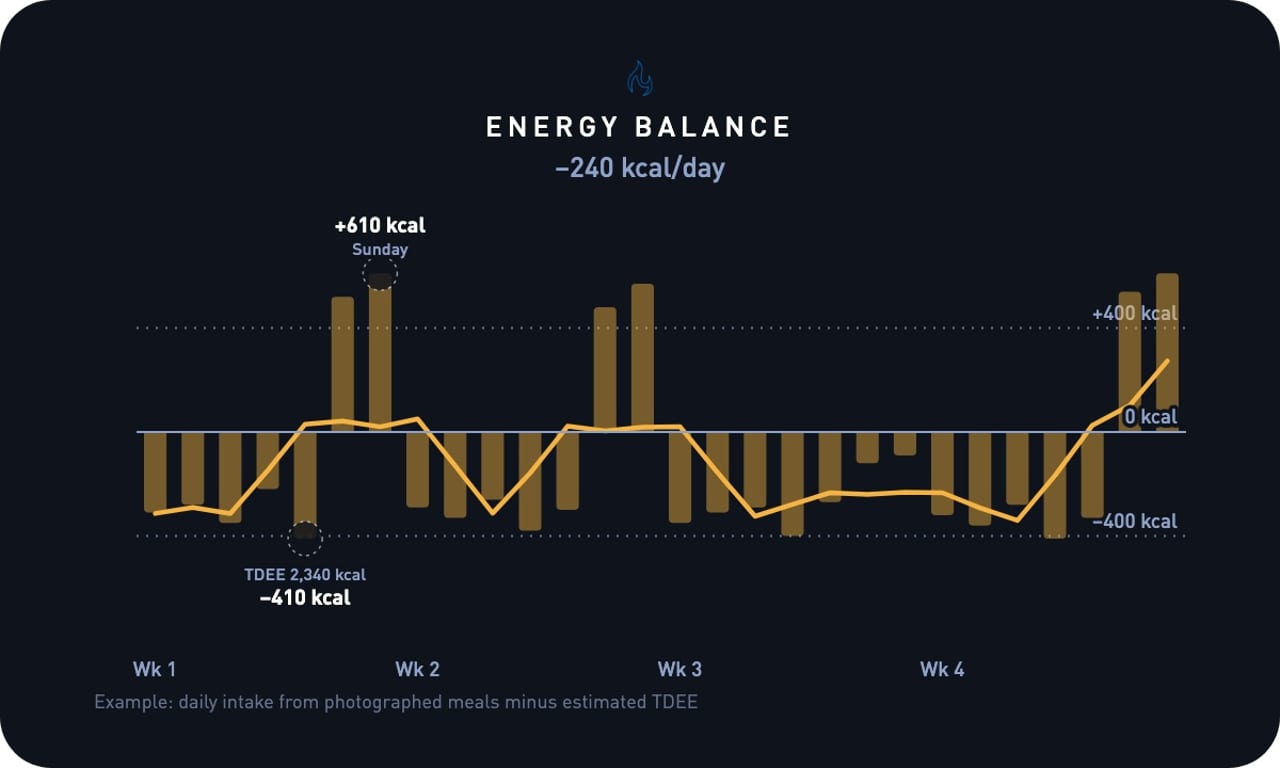
Four numbers work together. TDEE is your total daily burn, estimated from your actual movement rather than a one-size calculator. The bars are the difference between intake and TDEE each day: below the line is a deficit, above is a surplus. Food Grade and Fitness Grade are the daily report cards underneath.
Intake comes from the meals you photograph. The estimate on any one meal is rough, usually within about 20%, but over two weeks the roughness averages out and the weekly line is honest.
The chart above is the pattern we see constantly: 300 to 400 under on weekdays, 500 to 600 over on the weekend. The person running it believes they are in a steady deficit. The weekly average says they are barely in one.
Why it matters for your goals
If you want to lose weight
This is the chart that settles it. A deficit of 300 to 400 a day on weekdays and a surplus of 500 to 600 on Saturday and Sunday nets out to about 240 under per day: a real deficit, but half what you think you are running. Two weekend days undo four weekdays. Seeing the week as one shape is what fixes it.
If you want more energy and focus
Big swings in either direction cost you. A deep deficit for days leaves you flat and under-recovered; a large surplus late in the evening shows up as a worse night. A balance that stays within a few hundred calories of zero, day to day, is the steadiest way to feel the same every morning.
If you are training
Burn goes up on heavy days and intake usually does not follow, which is how a training block quietly turns into an unplanned cut. Reading balance next to the workout chart shows whether you are fueling the work or borrowing from it.
Where people land
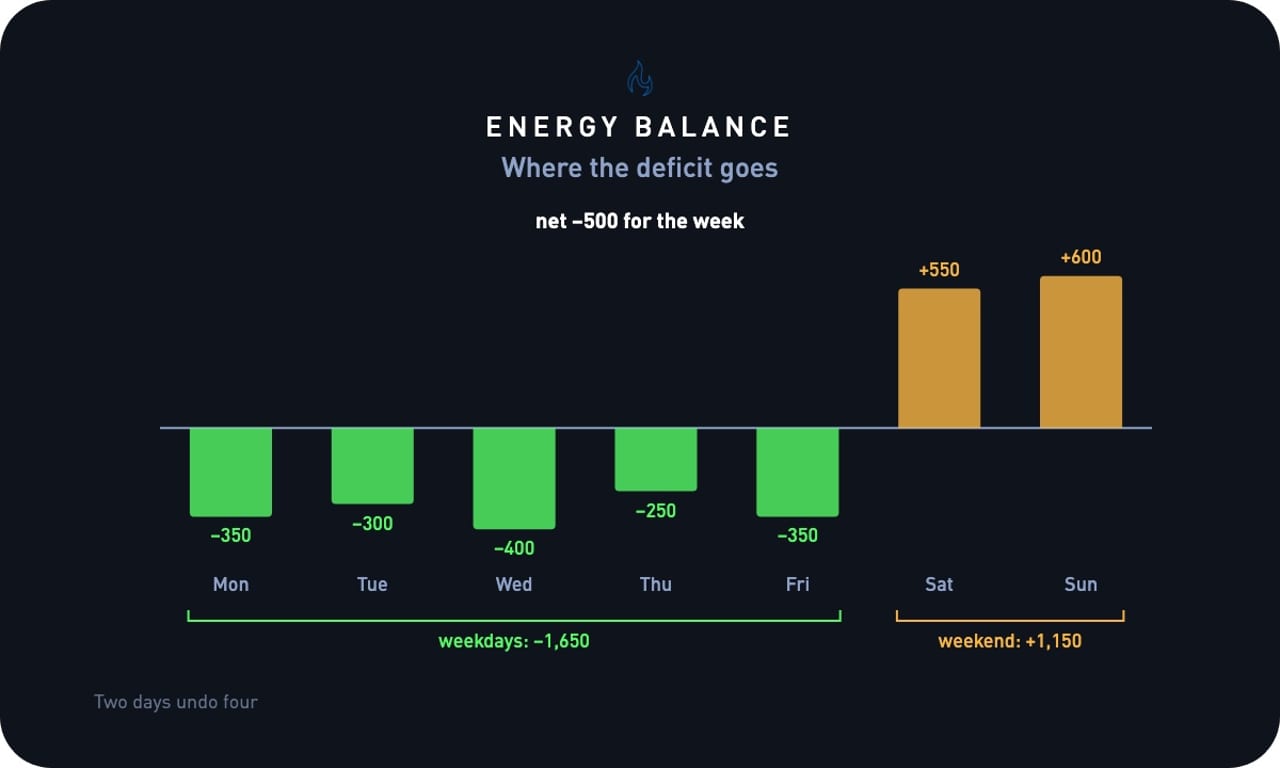
| Typical weekday | 300 to 400 under |
|---|---|
| Typical weekend day | 500 to 600 over |
| Net for that week | about 500 under, roughly 240 a day less than it feels |
There is no population range for energy balance; the useful comparison is your own week against the week before. A pattern that nets to zero over seven days is maintenance, however strict the weekdays felt.
What the research found
The reasons a deficit slips are well measured: the food itself, the nights, and whether the log includes the days you would rather not count.
In a 2019 NIH inpatient trial, 20 adults offered an ultra-processed menu ate about 508 more calories a day than the same people on a matched unprocessed menu, and gained weight over the two weeks. (Hall et al., Cell Metabolism, 2019). If your deficit is not showing on the chart, it is usually the food, not willpower. Photograph the weekend too.
In a trial of 1,685 adults, people who kept food records six or more days a week lost about twice as much weight as people who kept them one day a week or less. (Hollis et al., American Journal of Preventive Medicine, 2008). The chart is only as honest as the log. Most days beats perfect days.
Dieters who slept 5.5 hours instead of 8.5 lost 55% less fat on the same calories, and lost more lean mass instead. (Nedeltcheva et al., Annals of Internal Medicine, 2010). The same deficit on short sleep comes out of muscle instead of fat. Read balance next to the sleep chart.
What moves it
Toward deficit, over weeks. More protein and fiber at each meal, which keeps you full on fewer calories. Walking more, which raises the burn side without raising hunger much. Finishing eating earlier in the evening. Logging the weekend, which is where most surpluses hide.
Toward surplus, within a day. Restaurant meals and drinks, which are easy to underestimate by several hundred calories. Ultra-processed snacks. A short night, which raises hunger the next day. A rest day with no change in intake.
This week. Photograph every meal for seven days, including Saturday and Sunday, and do nothing else differently. Then read the weekly net. Most people find the fix in the weekend bars before they change a single weekday.
Everything known to move it
Balance is intake minus burn, so raises means toward surplus and lowers means toward deficit. Neither is good on its own; the levers below are what moves the weekly net, and most of them are not food.
Nutrition
| Ultra-processed food | raises | On an ultra-processed menu people ate about 508 more calories a day than the same people on a matched unprocessed menu. Hall et al., Cell Metabolism, 2019 |
|---|---|---|
| Protein and fiber at each meal | lowers | Fullness per calorie; the cheapest way to shrink intake without feeling it. |
| Restaurant meals and drinks | raises | Easy to underestimate by several hundred calories, and they cluster on the weekend. |
| Finishing eating earlier | lowers | Closes the window where most unplanned calories live; a 10-hour window alone lost about 3% of body weight in 12 weeks. Wilkinson et al., Cell Metabolism, 2020 |
| Logging the weekend | lowers | People who kept food records six or more days a week lost about twice as much as those who rarely did; the missing days are the surplus days. Hollis et al., American Journal of Preventive Medicine, 2008 |
Training
| Daily steps | lowers | Raises the burn side without raising hunger much; mortality risk fell with more steps and leveled off around 6,000 to 8,000 a day for people over 60 and 8,000 to 10,000 for younger adults. Paluch et al., The Lancet Public Health, 2022 |
|---|---|---|
| Resistance training during a cut | steadies | Adding lifting to a diet preserved more fat-free mass and increased fat loss for the same total weight lost. Binmahfoz et al., BMJ Open Sport & Exercise Medicine, 2025 |
| Heavy training days without more food | lowers | Burn goes up and intake usually does not follow, which is how a training block becomes an unplanned deficit. |
| Rest days at training intake | raises | The same plate on a day with half the burn lands above the line. |
Sleep
| Short sleep | raises | Two nights of four hours cut leptin, raised ghrelin, and raised hunger ratings by about 24%. Spiegel et al., Annals of Internal Medicine, 2004 |
|---|---|---|
| Dieting on short sleep | mixed | Same deficit, worse result: dieters on 5.5 hours lost 55% less fat on the same calories and more lean mass instead. Nedeltcheva et al., Annals of Internal Medicine, 2010 |
Lifestyle and environment
| Weekends | raises | The pattern we see most: 300 to 400 under on weekdays, 500 to 600 over on Saturday and Sunday, netting to about 240 under a day. |
|---|---|---|
| Self-monitoring | lowers | Consistent self-monitoring was significantly associated with weight loss in every one of the 15 studies reviewed. Burke, Wang and Sevick, Journal of the American Dietetic Association, 2011 |
| Stress and long work days | raises | Less movement and more convenient food on the same day; the balance bar shows both. |
| Cold and heat | mixed | Both nudge burn up a little; neither is large enough to plan around. |
Supplements and medical
| Caffeine | lowers | A small, short-lived lift in burn and appetite suppression; not enough to offset a late cup that costs sleep. |
|---|---|---|
| Alcohol | raises | Calories with no fullness attached, plus a worse night that raises hunger the next day. |
| Thyroid and some medications | mixed | Thyroid levels, steroids and some antidepressants shift burn or appetite; a persistent unexplained change is worth a doctor visit. |
Gyroscope runs these correlations on your own data: intake from your photographed meals sits against your measured burn, and the coach reads the weekend bars for you.
Targets to aim for
| Good | A weekly net that matches your goal: a few hundred under for a cut, near zero for maintenance |
|---|---|
| Great | Weekend days within a couple of hundred calories of weekdays, so the week is one shape |
| Watch | Weekdays far under and weekends far over, which nets to nothing and feels like a diet |
| See a doctor | A deep, sustained deficit with fatigue, hair loss, or missed periods |
Practical ways to improve it
- Photograph the weekend. Four clean weekdays tell you nothing if Saturday and Sunday are missing.
- Anchor each meal on protein and vegetables; they fill you up for the fewest calories.
- Walk after meals. It raises the burn side of the ledger without raising appetite the way hard training does.
- Treat restaurant meals and drinks as 20% bigger than they look. That is usually closer to the truth.
- Keep the deficit modest. A few hundred under per day, held for months, beats a thousand under that collapses on Friday.
How to track it
Energy balance needs both sides of the ledger. The burn side comes from a wearable that tracks your movement and heart rate through the day. The intake side has no device: it comes from logging what you eat, which in Gyroscope means a photo of each meal.
Without a wearable, the phone's step count gives a rougher burn estimate that still shows the direction. Without a food log there is no intake side, so this is the one trend where the manual part is not optional.
| Apple Watch | Burn comes through Apple Health automatically |
|---|---|
| Oura, Garmin, Fitbit | Direct integration in Settings |
| Whoop and most others | Through Apple Health |
| Meals | Photograph each meal in the app; the calories are estimated for you |
| No wearable | Phone steps give a rough burn estimate |
How Gyroscope tracks it
Gyroscope estimates your TDEE from your real activity on the wearable, reads intake from the meals you photograph, and charts the difference for every day. Set the Trends tab to month to see the weekday and weekend shape at once.
Food Grade and Fitness Grade sit underneath the balance chart as the daily report cards, so a bad bar always has its reason next to it. Ask the coach about a week that did not move and it reads balance, sleep, and the meal log together.
It needs about two weeks of logged meals before the weekly line means anything, because single-meal estimates are rough and need time to average out.
Works with Apple Watch, Oura, Whoop, Garmin, Fitbit.
Questions people ask
- How accurate is the calorie estimate from a photo?
- Any single meal is rough, usually within about 20%. Over two weeks the errors average out, and the weekly line is good enough to act on.
- Do I need a wearable?
- For the burn side, yes, or you get a rougher estimate from phone steps. For the intake side you need to photograph meals; no device can do that part.
- Why is my deficit smaller than I expected?
- Almost always the weekend. Two days of surplus can erase four days of deficit. Set the chart to month and look at the Saturday and Sunday bars.
- How big should a deficit be?
- A few hundred calories a day, held for months, is what most people can keep. A large deficit tends to collapse by Friday and nets out to nothing.
Track your Energy balance
This is one of the advanced trends in Gyroscope One, along with the AI coach that reads it for you every morning.
Unlock with Gyroscope OneGet the app