

Sleep Duration
Why seven hours in the middle beats nine broken ones, and why the hours and the score so often disagree.
Across 16 studies and about 1.38 million people, the people with the lowest long-term risk slept around seven to eight hours a night. Regular short sleepers carried roughly 12% higher risk of death over follow-up, and regular long sleepers about 30% higher.
That is a population curve, not a rule for any single night. But it puts a number on something most people feel: the middle of the range wins, and the outliers in either direction are where the interesting story is.
Sleep duration is the simplest sleep number there is, which is exactly why it is worth charting next to the sleep score. They disagree more often than you would think, and the disagreement is the useful part.
What it is
Sleep duration is the time you actually spent asleep, not the time you were in bed. A watch or ring estimates it from movement and heart rate, subtracting the minutes awake in the middle and at the edges.
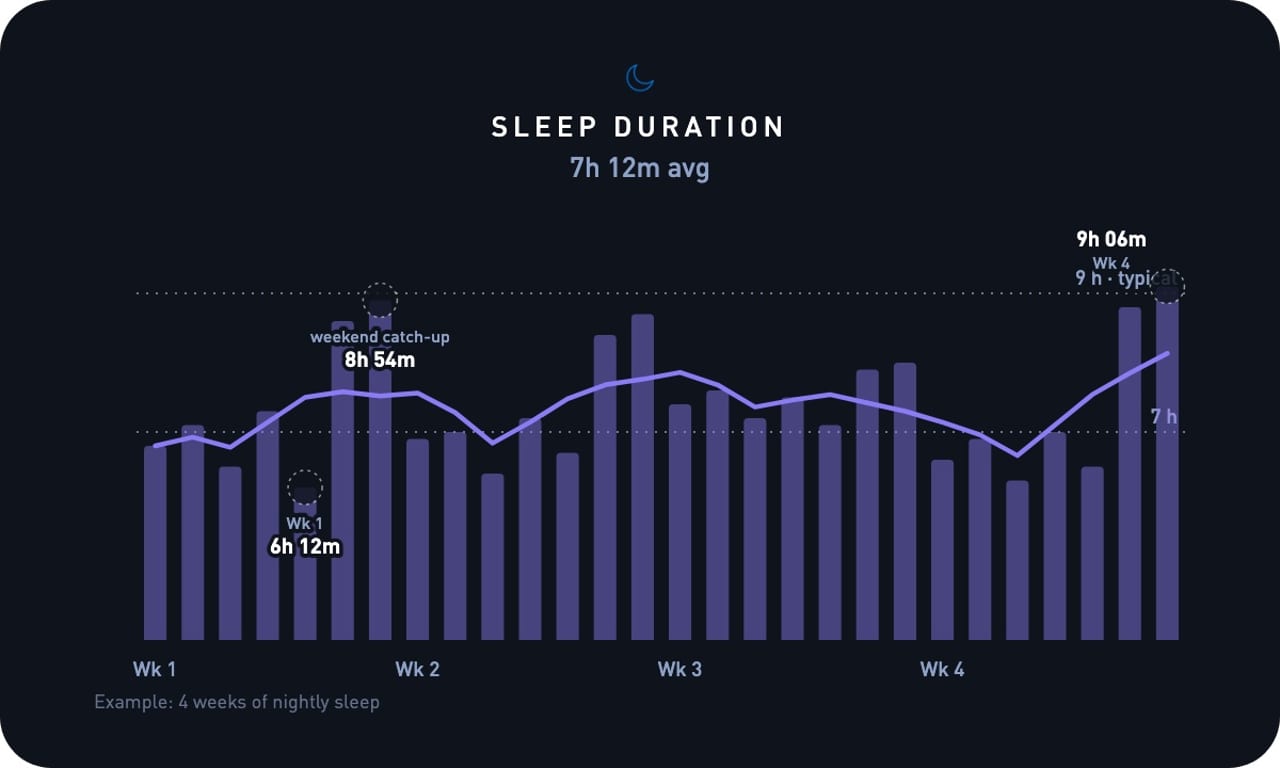
The chart above is four fairly normal weeks: six and a half to seven hours on weeknights, closer to nine on weekends. That weekend catch-up feels good, but it is also the shape that pushes bedtime later on Sunday and makes Monday short.
Nine hours of broken, restless sleep can score lower than seven clean ones. That is why the hours sit next to the score rather than replacing it: the hours say how much, the score says how well.
Why it matters for your goals
If you want to lose weight
Short nights change what you want to eat. Two nights of four hours of sleep cut leptin by 18%, raised ghrelin by 28%, and raised hunger by about 24%, with the strongest cravings for sweets and starch. In a diet study, people sleeping 5.5 hours instead of 8.5 lost 55% less fat on the same calories. If the scale is stuck, the hours are the first place to look.
If you want more energy and focus
Sleep debt is invisible from the inside. Two weeks of six-hour nights produced the same cognitive deficit as two full nights without sleep, while people rated themselves only slightly sleepy. The chart counts what you cannot feel.
If you want to live longer
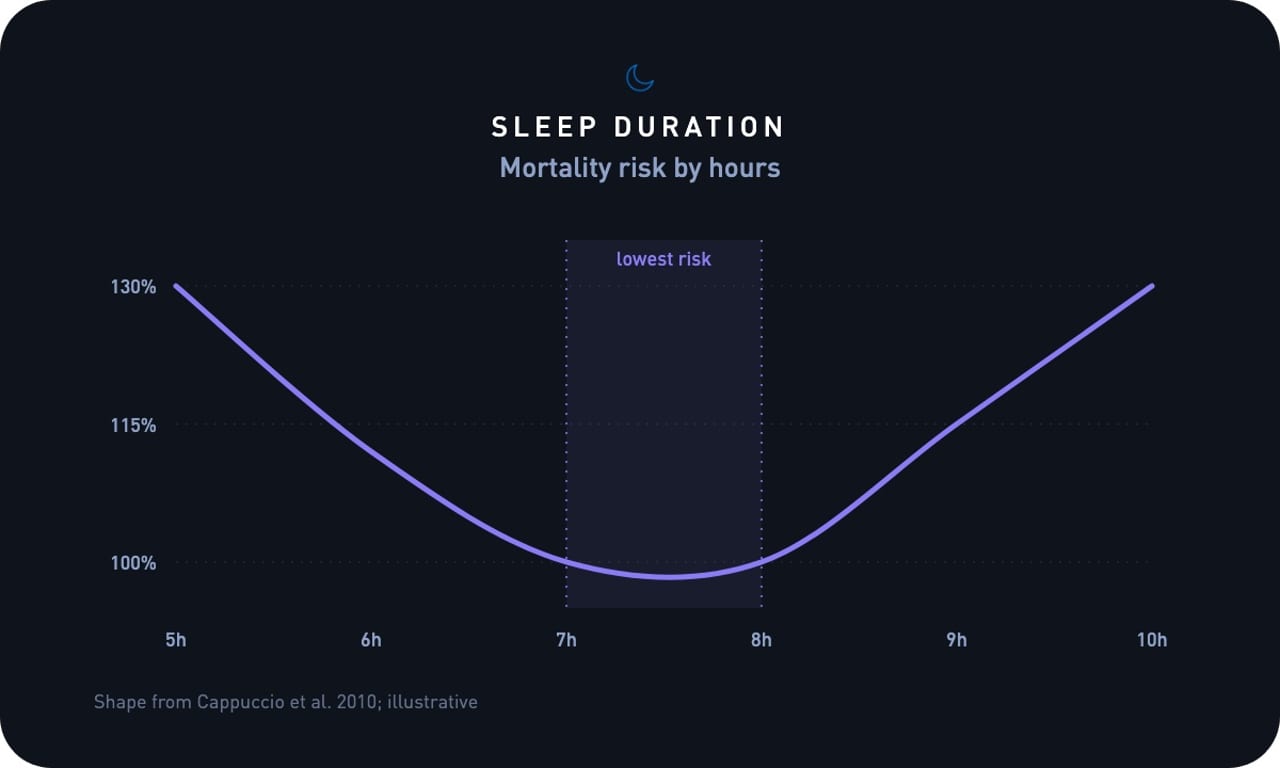
The big pooled studies show a U-shape: regular short sleepers and regular long sleepers both carry higher long-term risk than people around seven to eight hours. Long sleep is often a marker of something else going on rather than a cause, which is why a sudden run of ten-hour nights is worth noticing too.
Where people land
| Under 6 hours, regularly | roughly 12% higher long-term risk |
|---|---|
| 7 to 8 hours | lowest risk in the pooled studies |
| Over 9 hours, regularly | about 30% higher risk, often a marker of something else |
The curve is drawn from 1.38 million people and says nothing about one night. What matters is your own weekly average and how far the outliers drift from it. A weekday average creeping from 7.2 to 6.4 hours over a month is the signal, not one short Tuesday.
What the research found
Sleep duration is one of the most studied numbers in medicine, both in very large populations and in small, tightly controlled lab experiments. The two kinds of study agree.
A 2010 meta-analysis of 16 studies covering about 1.38 million people found that regular short sleepers had roughly 12% higher risk of death over follow-up, and long sleepers about 30% higher, compared with people sleeping around seven to eight hours. (Cappuccio et al., Sleep, 2010). Aim for the middle of the range most nights and read the score next to the hours. The outliers matter more than the average.
In a controlled study of 48 adults, restricting time in bed to 4 or 6 hours per night for two weeks produced accumulating cognitive performance deficits. Participants did not fully recognize how much their performance had declined. (Van Dongen et al., Sleep, 2003). A week of 6.5-hour nights feels fine and is not. The chart is the only honest witness.
Two nights of four hours of sleep cut leptin by 18%, raised ghrelin by 28%, and raised hunger ratings by about 24%, with the strongest cravings for sweets and starchy foods. (Spiegel et al., Annals of Internal Medicine, 2004). If the afternoon cravings arrive after a short week, the night before is the explanation, not your willpower.
What moves it
Up, over weeks. A fixed wake time, seven days a week. A cool, dark room. No caffeine after early afternoon. An earlier, lighter dinner. Screens off before bed. Most people gain sleep by protecting the front of the night, not by sleeping in.
Down, within a night. Late caffeine: 400mg six hours before bed cut measured sleep by about an hour, and people did not notice. Alcohol, which fragments the second half of the night. A late, large meal. A bright screen for hours before bed. Stress, travel, a sick child.
This week. Pick the wake time you can keep on Saturday and set it every day. Let bedtime move earlier on its own. Read the weekly average, not Tuesday.
Everything known to move it
Most of what shortens a night happens in the evening before it, and most of what lengthens one is a schedule. These are the levers with the best evidence, grouped by where they live in your day.
Sleep
| Fixed wake time | raises | The biggest lever. Bedtime drifts earlier on its own once the wake time stops moving, and the weekly average climbs with it. Windred et al., Sleep, 2024 |
|---|---|---|
| Weekend catch-up of two hours or more | mixed | Adds hours to Saturday and takes them back from Sunday and Monday nights by pushing bedtime later. |
| Daytime naps | mixed | A short early nap is neutral; a long or late one lowers sleep pressure and shortens the night. |
| Phone in bed | lowers | Phone use after lights-out was linked to later bedtimes, shorter sleep, and more daytime fatigue. Exelmans and Van den Bulck, Social Science and Medicine, 2016 |
Nutrition
| Caffeine within eight hours of bed | lowers | 400mg taken six hours before bed cut measured sleep by about an hour, and people did not notice. Drake et al., Journal of Clinical Sleep Medicine, 2013 |
|---|---|---|
| Alcohol in the evening | lowers | Sleep arrives faster but the second half of the night fragments, and the total comes in shorter. Ebrahim et al., Alcoholism: Clinical and Experimental Research, 2013 |
| Late large meal | lowers | Digestion delays sleep onset and disturbs the first hours; a small snack is usually neutral. Kinsey & Ormsbee, Nutrients, 2015 |
| Fluids late in the evening | lowers | A full bladder is the most common reason a night is split in two; the lost minutes add up. |
Training
| Regular exercise | raises | Builds sleep pressure through the day, so sleep comes faster and runs longer. |
|---|---|---|
| Hard session late at night | lowers | Core temperature and heart rate stay high into the first hour in bed; earlier in the day removes the effect. |
Lifestyle and environment
| Bright screen for hours before bed | lowers | Four hours of screen reading delayed sleep onset and cut melatonin compared with a printed book. Chang et al., PNAS, 2015 |
|---|---|---|
| Warm bath or shower before bed | raises | One to two hours before bed it helped people fall asleep about 10 minutes faster across 17 studies. Haghayegh et al., Sleep Medicine Reviews, 2019 |
| Cool, dark, quiet room | raises | Heat, light and noise each wake you a little earlier than you would have woken on your own. |
| Morning light | steadies | Light in the first hour of waking anchors the body clock, which makes the next bedtime arrive on time. |
| Stress, travel, a sick child | lowers | The common reasons a week runs short; the chart shows the pattern before you feel it. Van Dongen et al., Sleep, 2003 |
Supplements and medical
| Melatonin | steadies | Useful for shifting timing after travel more than for adding hours; follow the label and keep it occasional. |
|---|---|---|
| Nicotine | lowers | A stimulant; evening use delays sleep and overnight withdrawal can wake you early. |
| Sleep apnea and chronic pain | lowers | Both fragment the night and shorten the total. Weeks of short, broken sleep with no lifestyle cause are worth raising with a doctor. |
Gyroscope runs these correlations on your own data: open the trend, tap a short night, and the coach reads the evening before it.
Targets to aim for
| Good | A weekly average of 7 hours or more, with weeknights and weekends within an hour of each other |
|---|---|
| Great | 7 to 8 hours most nights, with a sleep score that agrees with the hours |
| Watch | A weekday average sliding under 6.5 hours, or a weekend catch-up of two hours or more every week |
| See a doctor | Sleep that stays unusually short or broken for weeks, or a sudden shift to very long nights with no clear cause. Bring the chart. |
Practical ways to improve it
- Anchor the wake time first. A consistent wake time matters more than a consistent bedtime, and bedtime follows it within a couple of weeks.
- Finish caffeine by early afternoon. A standard coffee needs about 8.8 hours on average to clear enough not to shorten the night.
- Keep the room cool and dark. A warm bath or shower one to two hours before bed helped people fall asleep about 10 minutes faster across 17 studies.
- Move the last drink and the last big meal earlier. Both cost you the second half of the night, which is where the hours get lost.
- If you are going to catch up on the weekend, catch up by one hour, not two. Two hours shifts your whole week.
How to track it
Any watch or ring you sleep in records sleep duration automatically. The phone can do it too: if it sits on the nightstand, Gyroscope reads the gap between the last use at night and the first in the morning as an estimate, which is rougher but tracks the trend.
With no device at all, a two-number manual log works: the time you turned the light off and the time you got up. It is noisier than a wearable because it counts time in bed rather than time asleep, but the weekly average over a month is still real.
| Apple Watch | Automatic through Apple Health |
|---|---|
| Oura, Garmin, Fitbit, Withings | Direct integration in Settings |
| Whoop and most other wearables | Through Apple Health |
| Phone only | Estimated from phone use, no setup |
| No device | Log lights-out and wake time manually |
How Gyroscope tracks it
Wear your watch or ring to bed and the hours arrive each morning. Gyroscope takes the night from Apple Watch, Oura, Whoop, Garmin, Fitbit, or Withings, subtracts the awake minutes, and charts the total against your own baseline. Existing history comes in with the first sync, so the trend is there on day one.
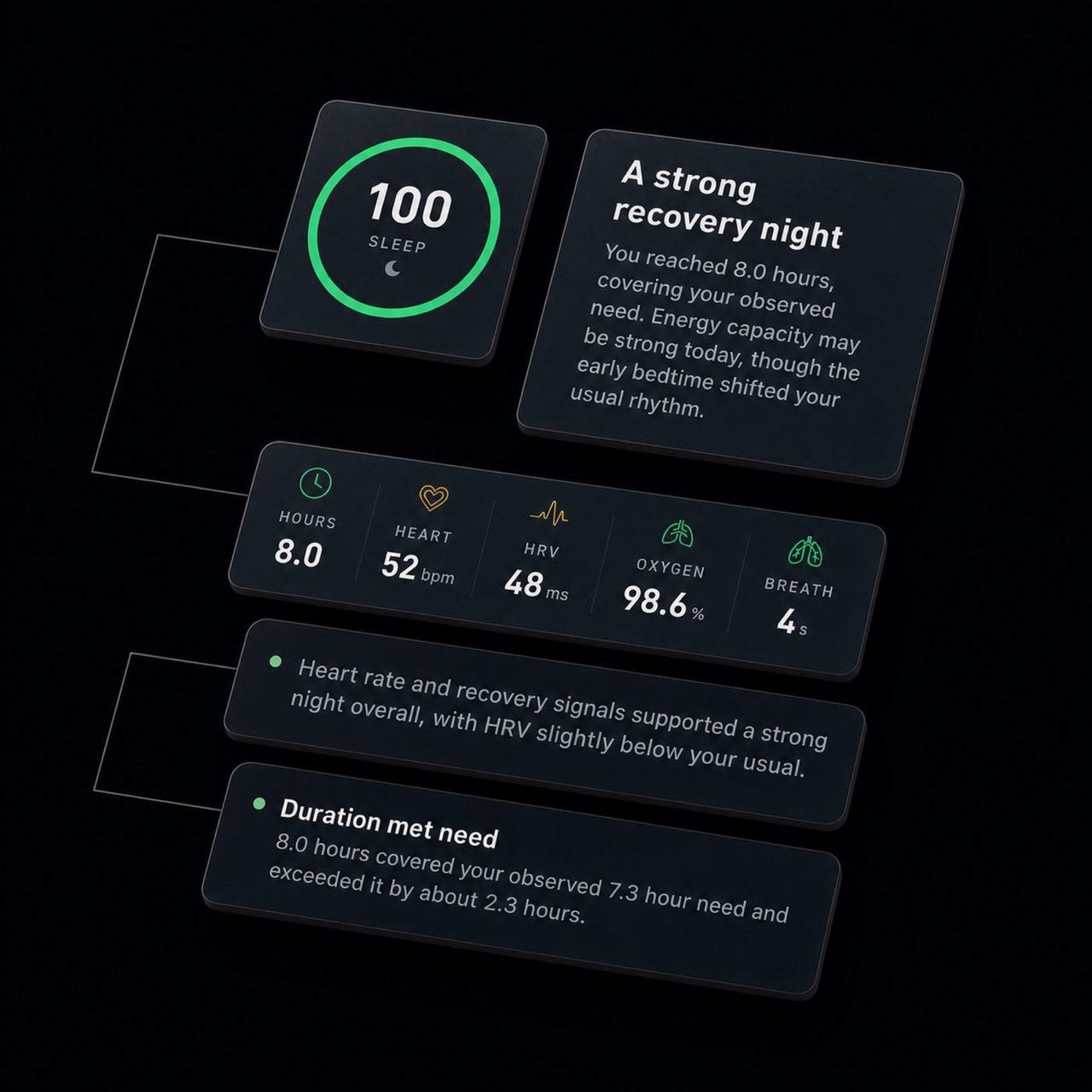
Each morning the hours show in your Sleep Score with context: on target, short for you, or long for you. On the Trends tab, Sleep Duration is charted next to the score, sleep timing, and alcohol, which is where the explanation usually lives. Ask the coach about a short week and it reads those together.
The weekly average becomes meaningful after about two weeks. Devices disagree on the awake minutes by ten or twenty a night, so compare yourself over time rather than against a friend on a different watch.
Works with Apple Watch, Oura, Whoop, Garmin, Fitbit, Withings.
Questions people ask
- How much sleep do I actually need?
- The pooled studies put the lowest long-term risk around seven to eight hours. Your own need shows up as the number of hours after which your score, resting heart rate, and mood stop improving. Gyroscope estimates it from your history.
- Is nine hours too much?
- Occasionally, no. Regularly sleeping over nine hours is associated with higher long-term risk in the big studies, but long sleep is usually a marker of something else, like illness or debt from a short week, rather than a cause.
- Why is my score low when I slept eight hours?
- Because the hours are only half the story. Broken sleep, a high resting heart rate, or a late bedtime can pull the score down on a long night. Read the two together.
- Can I catch up on the weekend?
- Partly. One extra hour helps. Two or more shifts your schedule enough to make Monday short again, and the regularity studies suggest the shift itself carries a cost.
Track your Sleep duration
Included in the free app. Download Gyroscope, connect your device, and the trend builds itself.
Get Gyroscope