
Macro Split
Your calories have a shape. Two people can eat the same 2,000 and end up in different bodies.
Two people can eat the same 2,000 calories and end up in different bodies because of what those calories were made of. This is the chart that shows it.
Across 49 resistance-training trials, extra protein produced additional gains in strength and lean mass, and the benefit plateaued at about 1.6 grams per kilogram of body weight a day. Most people are under that without knowing it.
Macro split turns every meal you photograph into three shares, protein, carbs, and fat, week by week.
What it is
Macro split is the share of your calories that came from protein, carbohydrate, and fat. Each photographed meal is read for grams of each, and the week is summed into three percentages.
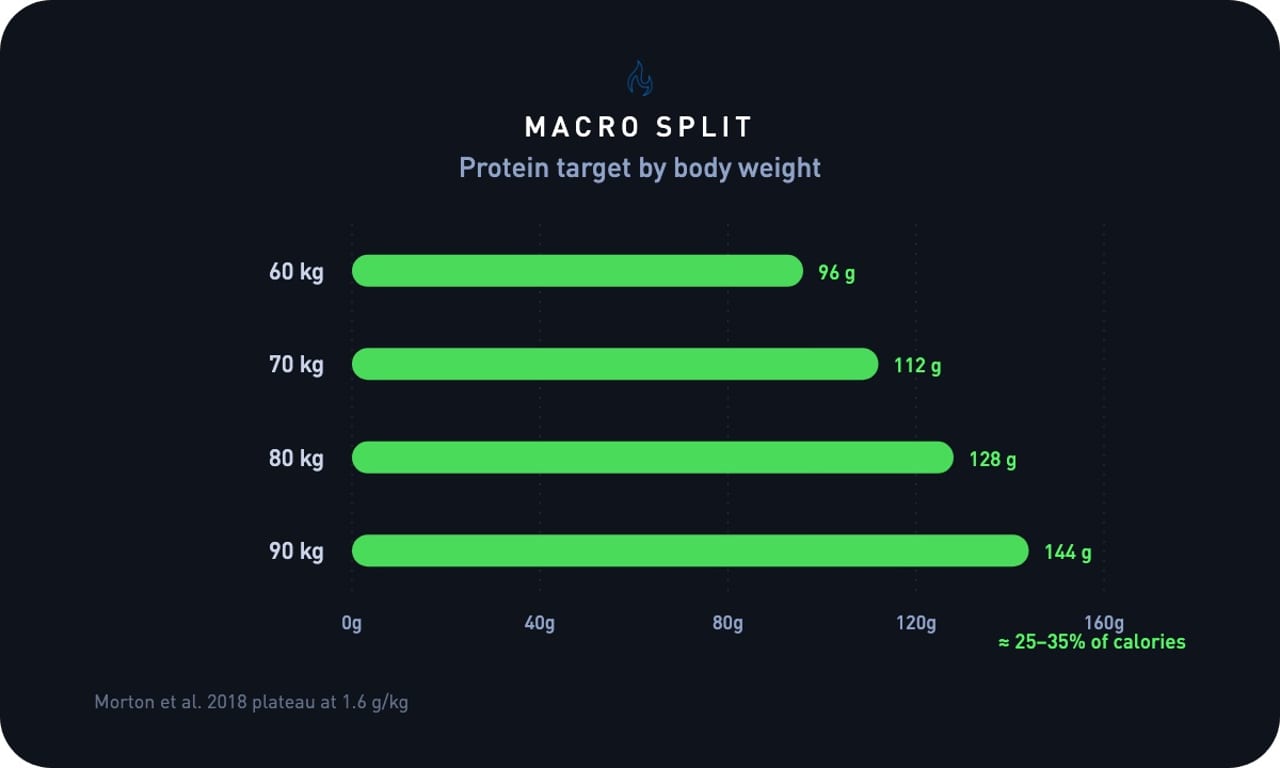
There is no perfect percentage; it depends on total calories, training, and goal. But protein is the share to watch, because it is the material for keeping and building muscle, and it drifts down without anyone deciding it should. The research puts the useful amount around 1.6 grams per kilogram of body weight a day; for most people that works out to a protein share of roughly 25 to 35% of calories.
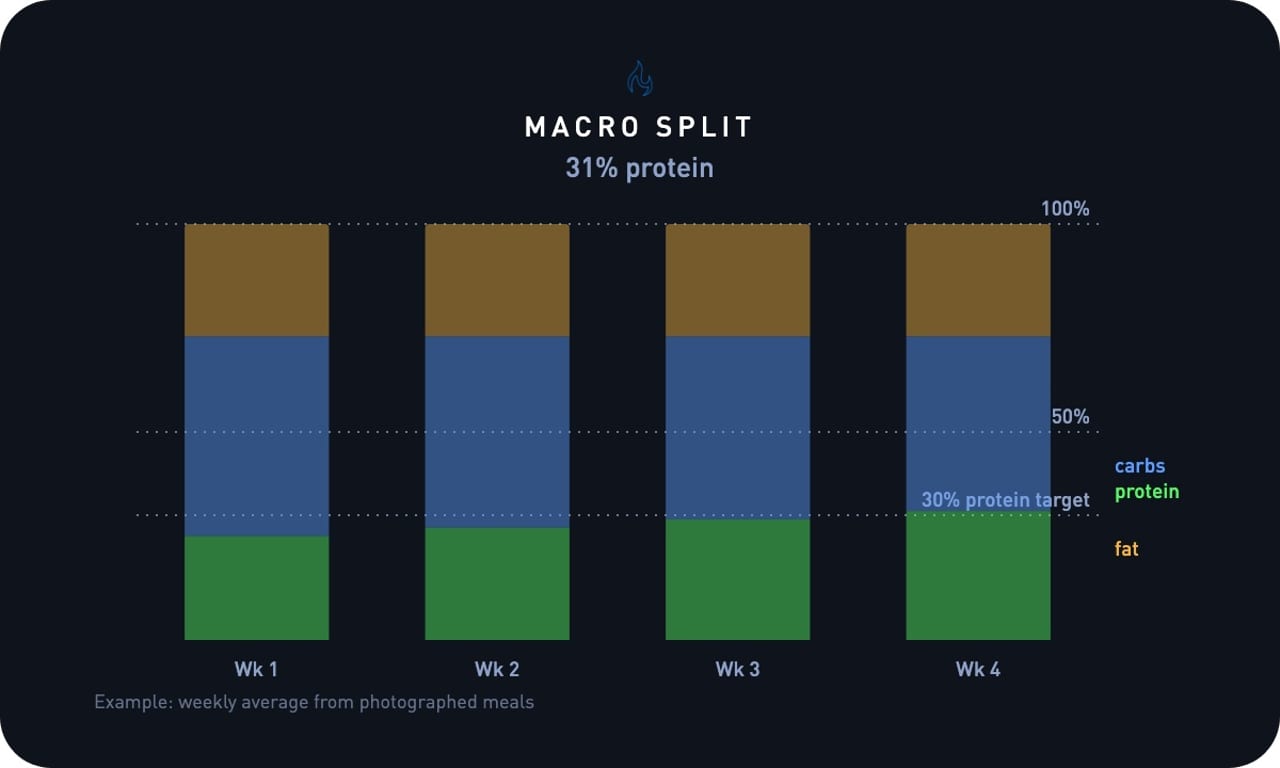
The chart above is four weeks of someone deliberately raising it: 25% to 31%, mostly by swapping the carbs, not adding calories. That is about what a real month of "more protein at breakfast" looks like.
Why it matters for your goals
If you want to lose weight
When weight comes off, protein decides how much of it is fat. Adding resistance training to a diet preserved more fat-free mass and increased fat loss without changing total weight lost, and protein is what that training is built from. A diet with the protein share held up loses the right thing.
If you want to build muscle
Lean mass gains from training plateau at about 1.6 grams of protein per kilogram a day. Below that, the lifting is underpaid. The weekly protein bar is the fastest check on whether the food matches the training.
If you want more energy and focus
A day that is mostly carbs and fat swings harder between meals. Protein at breakfast is the usual fix, and it shows up in the split within a week.
Where people land
| Protein | roughly 25 to 35% of calories; about 1.6 g per kg of body weight a day is where the benefit plateaus |
|---|---|
| Carbs and fat | fill the rest, in whatever balance fits your training and taste |
| Typical untracked week | protein drifts toward the low 20s |
Percentages depend on total calories. At 1,800 calories, 1.6 g per kg for a 75 kg person is about 120 g of protein, which is 27% of the day; at 2,800 calories the same grams are 17%. Grams are the target; the share is the habit check.
What the research found
Protein has been studied in dozens of controlled training trials, and the quality of calories in a tightly controlled inpatient study.
Across 49 resistance-training trials with 1,863 participants, extra protein produced small additional gains in strength and lean mass, and the benefit plateaued at about 1.6 grams of protein per kilogram of body weight per day. (Morton et al., British Journal of Sports Medicine, 2018). About 1.6 g per kg a day is the target. The weekly protein share is the quickest way to see whether you are near it.
A 2025 meta-analysis found that adding resistance training to a diet preserved more fat-free mass, increased fat loss, and improved strength, without materially changing total weight lost. (Binmahfoz et al., BMJ Open Sport & Exercise Medicine, 2025). Same weight lost, better body. Protein is what makes the training count during a diet.
In a 2019 NIH inpatient trial, 20 adults offered an ultra-processed menu ate about 508 more calories a day than the same people on a matched unprocessed menu, and gained weight over the two weeks. (Hall et al., Cell Metabolism, 2019). Two menus with the same macros, 508 calories a day apart. The split is one axis; what the food is made of is the other.
What moves it
Protein down, without deciding it. Toast or cereal breakfasts. Snacks that are all carbs and fat. Eating out, where protein is the expensive part. Skipping meals and making it up with whatever is near.
Protein up, this week. Add protein to the meal that has the least of it, usually breakfast. Swap one carb side for a protein one. Keep a protein snack in reach.
How to read it. Photograph everything for a week, including snacks; the split is only as good as the log. Then check the weekly bar, not the daily one, since single days swing a lot.
Everything known to move it
The share to watch is protein, so here raises means more of the day from protein and lowers means it drifting down, usually toward carbs and fat. Most of these levers are about what the first and last meals of the day are made of.
Nutrition
| Protein at breakfast | raises | The meal with the least protein for most people; fixing it moves the weekly share within a week. |
|---|---|---|
| Hitting about 1.6 g per kg a day | raises | Across 49 training trials, extra protein added strength and lean mass up to roughly that amount, then plateaued. Morton et al., British Journal of Sports Medicine, 2018 |
| Ultra-processed food | lowers | Cheap calories are mostly carbs and fat; on an ultra-processed menu people ate about 508 more calories a day than on a matched unprocessed one. Hall et al., Cell Metabolism, 2019 |
| Snacks that are all carbs and fat | lowers | Crackers, chips, pastries and bars dilute the share without feeling like a meal. |
| Eating out | lowers | Protein is the expensive part of a restaurant plate; sides and sauces fill the rest. |
| A protein snack in reach | raises | Yogurt, eggs, jerky, or a shake at the moment the day would otherwise go to carbs. |
| Logging every meal | steadies | The split is only as good as the log; people who kept records most days lost about twice as much as those who rarely did. Hollis et al., American Journal of Preventive Medicine, 2008 |
Training
| Resistance training | raises | It raises both the need and the appetite for protein; adding lifting to a diet preserved more fat-free mass and increased fat loss. Binmahfoz et al., BMJ Open Sport & Exercise Medicine, 2025 |
|---|---|---|
| Endurance blocks | lowers | Long sessions push carbohydrate up for fuel; the protein share falls unless grams go up with it. |
Sleep
| Short sleep | lowers | Four-hour nights raised hunger by about 24% with the strongest cravings for sweets and starch, which is carbs, not protein. Spiegel et al., Annals of Internal Medicine, 2004 |
|---|---|---|
| Dieting on short sleep | lowers | Dieters on 5.5 hours lost 55% less fat on the same calories and more lean mass instead, the tissue protein is meant to protect. Nedeltcheva et al., Annals of Internal Medicine, 2010 |
Lifestyle and environment
| Skipped meals | lowers | The meal that replaces a skipped one is whatever is near, and that is rarely protein. |
|---|---|---|
| Travel and weekends | lowers | Breakfast becomes pastry and dinner becomes a restaurant plate; the share dips and recovers Monday. |
Supplements and medical
| Protein powder | raises | A simple way to add 20 to 30 grams to a meal that lacks it; whole food works the same. |
|---|---|---|
| Creatine | steadies | Does not change the split, but supports the strength work that gives the protein somewhere to go. |
| Kidney disease | mixed | Protein targets are set differently; follow a doctor rather than the general 1.6 g per kg figure. |
Gyroscope runs these correlations on your own data: the weekly split is read from your photographed meals, and the coach can name the meal that keeps pulling the protein share down.
Targets to aim for
| Good | Protein share holding at 25% or above, week after week |
|---|---|
| Great | Around 1.6 g of protein per kg of body weight a day, with the share steady through weekends |
| Watch | Protein share drifting under 20% for more than a week |
| Talk to a doctor | Before a high-protein diet if you have kidney disease, or before any large macro shift while on medication |
Practical ways to improve it
- Add protein to the meal that has the least of it. For most people that is breakfast.
- Swap, do not add. Raising protein by replacing some carbs keeps the calories where they were.
- Photograph snacks too. An untracked afternoon is usually carbs and fat, and it lowers the share.
- Read the weekly bar. Daily splits swing by 10 points on a normal day.
- If you train, aim for grams first and use the share as the habit check.
How to track it
Macro split is computed from meal photos. Gyroscope reads each photo for protein, carbs, and fat in grams, and sums the week. No wearable is involved.
The log needs to be reasonably complete to mean anything. Photograph every meal and snack for a week before you trust the bar.
| Meal photos in Gyroscope | Photograph every meal and snack; macros are read automatically |
|---|---|
| Manual entry | Adjust a meal or add one from the food tab when the photo missed something |
| Apple Health nutrition | Food logged in other apps can feed in through Apple Health |
| No phone camera | Log meals by description from the food tab |
How Gyroscope tracks it
Photograph your meals and Gyroscope estimates protein, carbs, and fat for each one, then shows the week as three stacked shares on the Trends tab, with your protein target drawn in.
It sits next to energy balance, nutrient density, and body composition, which is where a macro change eventually shows. Ask the coach which meal is dragging the protein share down and it can name it from your log.
One full week of logging gives a real bar. Four weeks shows whether a change stuck.
Works with iPhone camera, Apple Health.
Questions people ask
- What should my macro split be?
- There is no single right answer. Protein is the share to watch; about 1.6 g per kg of body weight a day is where the research benefit plateaus, which is roughly 25 to 35% of calories for most people.
- Are carbs bad?
- No. The useful question is whether protein is high enough and whether the calories come from whole or ultra-processed food. Carbs and fat fill in around that.
- How accurate is a photo?
- Good enough for the weekly share, which is what the trend reads. Single meals can be off; a week of them averages out.
- Do I need a wearable?
- No. Macro split comes entirely from logged meals.
Track your Macro split
This is one of the advanced trends in Gyroscope One, along with the AI coach that reads it for you every morning.
Unlock with Gyroscope OneGet the app