
Deep Sleep
The stage you never remember and lose first to a late coffee or a glass of wine.
Deep sleep is the part of the night you have no memory of. Your heart rate drops to its lowest, breathing slows, and the body does most of its physical repair. It is front-loaded: most of it happens in the first half of the night.
That timing is why it is so easy to lose without noticing. 400mg of caffeine taken six hours before bed cut measured sleep by about an hour in a controlled trial, and the participants did not notice the difference themselves. Alcohol raises heart rate and lowers HRV in the first hours of sleep at every dose measured, which is exactly when deep sleep should be happening.
Wearables estimate the minutes from heart rate and movement, and they disagree with each other by a wide margin. So the number to chase is not anyone else's; it is your own, over weeks.
What it is
Deep sleep, also called slow-wave sleep, is the stage with the slowest brain waves, the lowest heart rate, and the hardest waking. It arrives early in the night, in long blocks during the first two cycles, and thins out toward morning as REM takes over.
A watch or ring cannot see brain waves. It estimates the stage from heart rate, its variability, breathing, and stillness. That works well enough for a trend and poorly enough that two devices on the same person can report very different minutes.
Read it the way you read resting heart rate: a baseline, a weekly average, and outliers that each have a story. The story is almost always in the evening before.
Why it matters for your goals
If you want to lose weight
Deep sleep is when the body does its repair work, and a diet that cuts sleep costs you fat instead of weight: dieters sleeping 5.5 hours instead of 8.5 lost 55% less fat on the same calories and more lean mass instead. Protecting the first half of the night protects the part of the night that protects muscle.
If you want more energy and focus
The late coffee that "does not affect you" mostly takes deep sleep, the kind you do not feel losing until the afternoon after. A run of short deep-sleep nights feels like a run of short nights, even when the hours look fine.
If you train
Deep sleep is the recovery stage. After a hard session it usually rises, and on a night after drinks it usually falls along with HRV. If your deep-sleep minutes and resting heart rate move together on the chart, you are looking at recovery from two angles.
What the research found
Deep sleep is hard to measure outside a lab, so the strongest evidence is about what removes it. Controlled trials on caffeine, alcohol, screens, and temperature all land on the first half of the night.
400mg of caffeine taken six hours before bed cut measured sleep by about an hour, and participants did not notice the difference themselves. (Drake et al., Journal of Clinical Sleep Medicine, 2013). The afternoon coffee takes an hour you cannot feel. Finish caffeine eight hours before bed and watch the deep-sleep minutes recover.
A 2018 analysis of 4,098 nights from 246 adults found that alcohol raised heart rate and lowered HRV during the first hours of sleep at every dose measured, including low intake, and the effect grew with the amount. It held across ages and fitness levels. (Pietilä et al., JMIR Mental Health, 2018). Alcohol hits the first hours of sleep hardest, which is where deep sleep lives. Two dry nights against two wine nights is the experiment.
Across 17 studies, a warm bath or shower one to two hours before bed helped people fall asleep about 10 minutes faster and improved sleep quality. (Haghayegh et al., Sleep Medicine Reviews, 2019). A warm shower an hour or two before bed cools the body afterwards, and a cooler body drops into sleep faster.
What moves it
Up, over weeks. A consistent bedtime, so the first cycles land at the same hour. Caffeine finished by early afternoon. Fewer drinks in the evening. A cool, dark room. Regular exercise, especially earlier in the day. A warm bath or shower one to two hours before bed.
Down, within a night. Caffeine within eight hours of bed. Alcohol, even a small amount. A late, large meal. A hot room. A bright screen for hours before bed. Stress and a racing mind at lights-out.
This week. Move the last coffee earlier by two hours and keep everything else the same. Read the deep-sleep minutes over the week, not the first night.
Everything known to move it
Deep sleep lives in the first half of the night, so the levers are mostly about the evening before. The strongest evidence is about what removes it.
Nutrition
| Caffeine within eight hours of bed | lowers | Across 58 studies caffeine cut deep sleep in particular, and the effect grew with dose and closeness to bedtime. Clark and Landolt, Sleep Medicine Reviews, 2017 |
|---|---|---|
| Alcohol in the evening | mixed | The first hours look deeper on the chart while heart rate runs higher and the second half of the night fragments. Ebrahim et al., Alcoholism: Clinical and Experimental Research, 2013 |
| Late large meal | lowers | Digestion keeps the body working through the hours where deep sleep should be. Kinsey & Ormsbee, Nutrients, 2015 |
| Eating earlier in the evening | raises | A finished dinner three hours before bed lets the first cycles run uninterrupted. |
Sleep
| Consistent bedtime | raises | Deep sleep is front-loaded and clock-timed; a bedtime that holds lands the first cycles in the right place. Windred et al., Sleep, 2024 |
|---|---|---|
| Sleep debt | raises | After short nights the body rebounds with more deep sleep first. A high reading after a bad week is recovery, not a win. |
| Late or long nap | lowers | Spends some of the sleep pressure that deep sleep runs on. |
| Fragmented night | lowers | Every wake-up resets the descent; a child, a pet or a full bladder cost minutes of the deepest stage. |
Lifestyle and environment
| Cool room | raises | Deep sleep is the stage most sensitive to heat; a hot room is a reliable way to lose it. |
|---|---|---|
| Warm bath or shower before bed | raises | One to two hours before bed it helped people fall asleep about 10 minutes faster and improved sleep quality. Haghayegh et al., Sleep Medicine Reviews, 2019 |
| Bright screen for hours before bed | lowers | Delayed sleep onset and suppressed melatonin compared with a printed book, pushing the first cycles later. Chang et al., PNAS, 2015 |
| Stress and a racing mind | lowers | A body under load sleeps lighter in the first hours, where the deep minutes should be. |
| Noise | lowers | Sounds that do not wake you still pull you out of the deepest stage. |
Training
| Regular exercise | raises | Builds sleep pressure, which is what deep sleep spends; earlier in the day is better. |
|---|---|---|
| Hard session close to bedtime | lowers | Heat and a high heart rate at lights-out delay the first deep block. |
Supplements and medical
| Magnesium | mixed | Widely used for sleep; the evidence is modest and mostly in people who were low to begin with. Follow the label. |
|---|---|---|
| Nicotine | lowers | A stimulant at bedtime and overnight withdrawal both lighten the first hours. |
| Sedative sleep aids | mixed | Many add sleep that the staging algorithm does not count as deep. Talk to a doctor before changing a prescription. |
| Sleep apnea | lowers | Breathing pauses pull you up out of deep sleep all night; low deep sleep with loud snoring and low oxygen is the pattern to show a doctor. |
Gyroscope runs these correlations on your own data: open the trend, tap a low night, and the coach reads the evening before it.
Targets to aim for
| Good | Deep-sleep minutes at or above your own monthly average most nights |
|---|---|
| Great | A steady weekly average with outliers explained by the evening before |
| Watch | A weekly average sliding below your usual with no clear cause, or deep sleep collapsing on nights with drinks |
| See a doctor | Persistently low deep sleep alongside loud snoring, low overnight oxygen, or waking unrefreshed for weeks. Bring the chart. |
Practical ways to improve it
- Finish caffeine eight hours before bed. It is the most common reason deep sleep runs short, and you will not feel it happening.
- Try two alcohol-free nights a week and compare them with two that are not. The first hours of the night are where the difference shows.
- Take a warm bath or shower one to two hours before bed. Across 17 studies it helped people fall asleep about 10 minutes faster and improved sleep quality.
- Keep the bedroom cool and dark. Deep sleep is the stage most sensitive to heat.
- Screens off in the last hour. Four hours of a bright screen before bed delayed sleep and cut REM in a controlled trial; paper does neither.
How to track it
Deep sleep needs sleep staging, so it needs a watch or ring that estimates stages and that you wear to bed. Apple Watch, Oura, Whoop, Garmin, Fitbit, and most recent wearables do. Older bands that report only total sleep will not give it to you.
There is no manual fallback; you cannot feel deep sleep to log it. Without a staging device, Sleep Duration and Sleep Timing still work from any device or a two-line log, and the same levers on this page improve them.
| Apple Watch | Automatic through Apple Health, stages on |
|---|---|
| Oura, Garmin, Fitbit | Direct integration in Settings |
| Whoop and most other wearables | Through Apple Health |
| No staging device | Not available; track duration and timing instead |
How Gyroscope tracks it
If your device reports sleep stages, Gyroscope reads the night from Apple Watch, Oura, Whoop, Garmin, or Fitbit, adds up the deep-sleep minutes, and charts them against your own baseline. History comes in with the first sync.
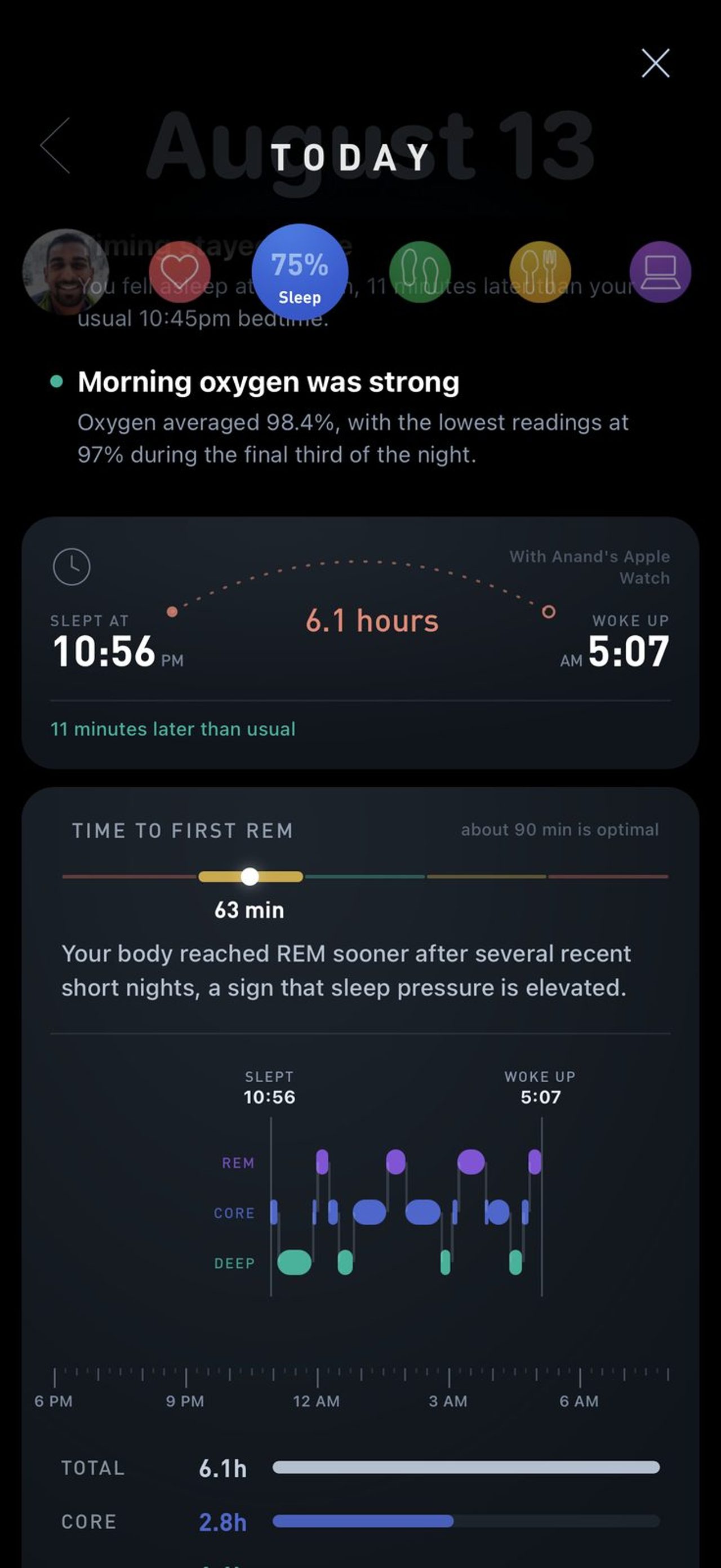
Each morning the Sleep Score breaks the night into stages on a timeline, with the deep blocks visible in the first hours. On the Trends tab, Deep Sleep sits next to caffeine timing, alcohol, HRV, and resting heart rate, so the late coffee and the short deep-sleep night are on one screen. Ask the coach why recovery was weak and it reads those together.
It needs about two weeks of staged nights before your baseline means anything. Devices stage differently, so compare yourself over time rather than against someone on a different watch.
Works with Apple Watch, Oura, Whoop, Garmin, Fitbit.
Questions people ask
- How much deep sleep do I need?
- There is no universal number, and wearables disagree with each other by a wide margin. Use your own monthly average as the target and treat a slide below it as the signal.
- Why did my deep sleep drop after one glass of wine?
- Alcohol raises heart rate and lowers HRV in the first hours of sleep at every dose measured, and those are the hours deep sleep happens in. The effect grows with the amount.
- Does afternoon coffee really matter if I fall asleep fine?
- Yes. 400mg taken six hours before bed cut measured sleep by about an hour, and people did not notice. Falling asleep is not the part it takes.
- Is my watch accurate at this?
- Accurate enough for a trend, not for a diagnosis. It estimates the stage from heart rate and movement. Read the weekly average and your own outliers.
Track your Deep sleep
This is one of the advanced trends in Gyroscope One, along with the AI coach that reads it for you every morning.
Unlock with Gyroscope OneGet the app