
Alcohol
What one drink does to the night, in a 4,000-night study, charted next to your own heart rate.
Two glasses of wine at dinner and your heart beats about 15,000 extra times before morning. That is what a 6 to 8 beat-per-minute rise over a night adds up to, and it happens at every dose measured, on nights that feel like a full sleep.
In an analysis of 4,098 nights, even low intake raised heart rate and lowered HRV during the first hours of sleep, and the effect grew with the amount. It held across ages and fitness levels.
Alcohol has its own trend, charted next to overnight resting heart rate on purpose, so the pairing is one chart instead of a guess.
What it is
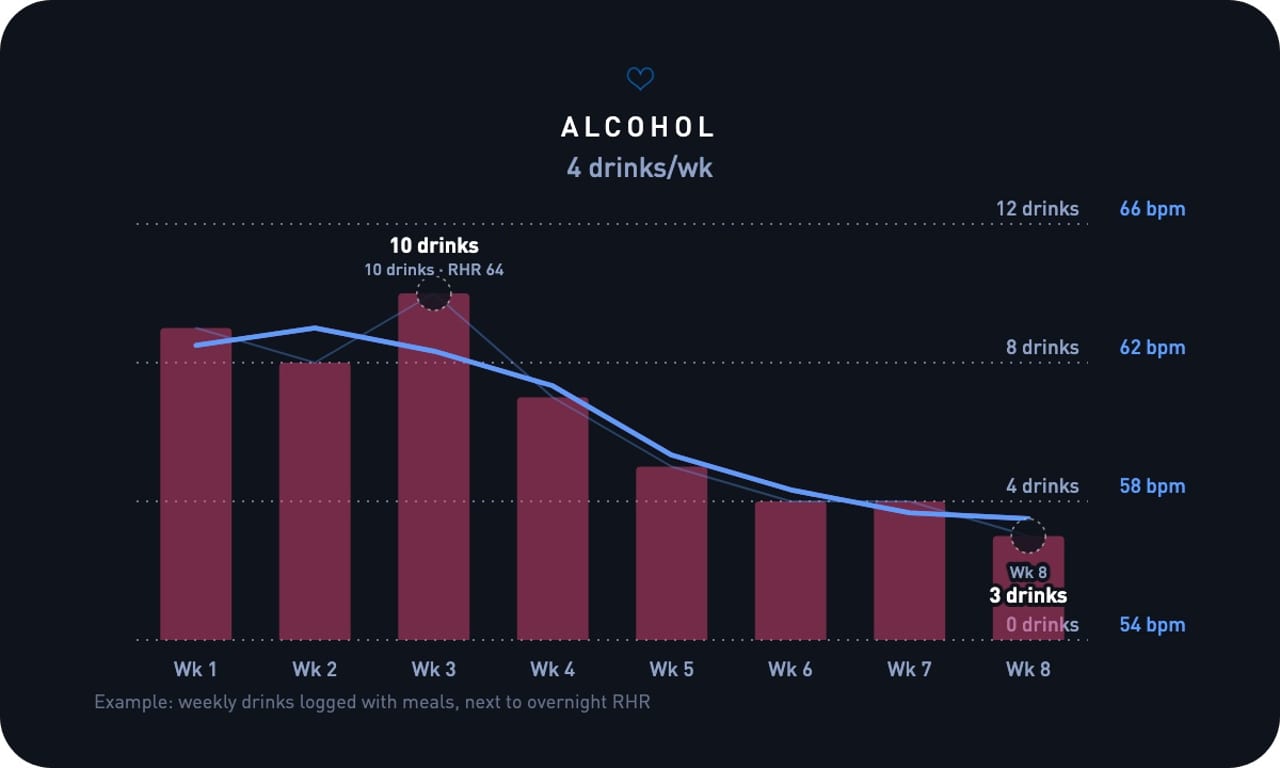
The trend is the number of drinks you log each day, summed by week, drawn against the same week's average overnight resting heart rate.
Even one drink in the evening raises heart rate and lowers HRV during the first hours of sleep, and it does so in a dose-dependent way: more drinks, and drinks later, mean a bigger effect. It also pushes REM later and shortens it, which is why a night after wine can feel like a full sleep and still leave you flat.
The chart above is eight weeks for someone cutting back from nine or ten drinks a week to three or four. The bars are drinks; the blue line is average overnight resting heart rate the same week: 64 down to 57. That is not fitness improving in eight weeks. That is the alcohol.
Why it matters for your goals
If you want to lose weight
Alcohol is calories with no fullness attached, and it costs the sleep that a diet depends on: dieters who slept 5.5 hours instead of 8.5 lost 55% less fat on the same calories. Two dry nights a week is often worth more than any change to the food.
If you want more energy and focus
The morning after drinks, resting heart rate is up and HRV is down, and the afternoon is where you pay. Seeing the night charted makes the cost concrete, which is what makes the second glass easier to skip.
If you want to live longer
Each 10 beats of resting heart rate tracks with about 9% higher risk of death across 1.2 million adults. Alcohol is one of the few things that moves that number 6 to 8 beats in a single night, and the weekly line shows whether it is moving your baseline too.
What the research found
Alcohol and sleep have been measured in thousands of real nights with wearables, not just in the lab.
A 2018 analysis of 4,098 nights from 246 adults found that alcohol raised heart rate and lowered HRV during the first hours of sleep at every dose measured, including low intake, and the effect grew with the amount. It held across ages and fitness levels. (Pietilä et al., JMIR Mental Health, 2018). There is no free dose. One drink moves the night; the question is how much, and the chart answers it for you.
A 2016 meta-analysis of 46 studies and about 1.2 million adults: each 10 beats-per-minute increase in resting heart rate was associated with roughly 9% higher risk of death from any cause, and 8% higher risk of cardiovascular death. (Zhang et al., CMAJ, 2016). The 6 to 8 beats a night of drinking adds is the same scale the mortality studies measure in. Cutting back is a real move on that number.
What moves it
Up, within a night. Any drinks in the evening, more with each one and more the later they are. Wine with a late dinner. Drinks on an empty stomach. Drinks plus a short night.
Down, over weeks. Fewer drinks a week. Finishing the last one earlier. Alcohol-free nights in a row so the baseline can settle. The weekly resting heart rate line follows within a month.
This week. Two dry nights, then two with your usual drinks. Compare the mornings: resting heart rate, HRV, and how you feel. Most people find their own threshold within a month, and it is usually lower than they expected.
Everything known to move it
Alcohol is a dose story. Here raises means a bigger hit to the night and the weekly baseline, lowers means less of one, and steadies means the night recovers faster. There is no free dose; these are the things that change the size of it.
Nutrition
| Number of drinks | raises | Heart rate up and HRV down in the first hours of sleep at every dose measured, and more with each drink. Pietilä et al., JMIR Mental Health, 2018 |
|---|---|---|
| Drinking late | raises | A drink at 10pm is still being cleared when you fall asleep; the same drink at 6pm mostly is not. |
| Finishing earlier | lowers | Moving the last drink up by two or three hours gives the body a head start before the first sleep cycle. |
| Drinking on an empty stomach | raises | Faster absorption means a higher peak and a harder first half of the night. |
| Water alongside | steadies | Limits the dehydration that adds extra beats to an already elevated overnight rate. |
| Dry nights in a row | lowers | Several alcohol-free nights let the weekly resting heart rate line settle back to your real baseline. |
Sleep
| REM in the first half of the night | lowers | Alcohol cuts REM early in the night at every dose and pushes it later, which is why a full night after wine still feels flat. Ebrahim et al., Alcoholism: Clinical and Experimental Research, 2013 |
|---|---|---|
| Short night plus drinks | raises | Two nights of short sleep raised hunger by about 24% and favored sweets and starch; alcohol on top makes the morning worse. Spiegel et al., Annals of Internal Medicine, 2004 |
| Consistent bedtime | steadies | A regular schedule blunts how far one evening out moves the week. Windred et al., Sleep, 2024 |
Training
| Hard session the same day | raises | Recovery and alcohol both ask for the same overnight resources; the next morning reads worse than either alone. |
|---|---|---|
| Regular aerobic fitness | steadies | A lower baseline heart rate means the same 6 to 8 beat rise starts from a better place and clears sooner. |
Lifestyle and environment
| Social weekends | raises | Most weekly totals are decided on two nights; the weekly bar shows which ones. |
|---|---|---|
| Hot rooms and travel | raises | Heat and jet lag already raise overnight heart rate; alcohol stacks on top. |
| Tracking the count | lowers | Logging itself lowers intake for most people; the weekly bar is the feedback. |
Medical
| Beta blockers and heart medication | mixed | They change the heart rate response, so compare only to your own baseline on the medication and ask your doctor about alcohol with it. |
|---|---|---|
| Sleep apnea | raises | Alcohol relaxes the airway and worsens overnight breathing; loud snoring after drinks is worth raising with a doctor. |
Gyroscope runs these correlations on your own data: drinks are charted against the same week of overnight resting heart rate, so your threshold shows up as a number, not a feeling.
Targets to aim for
| Good | Most nights alcohol-free, with drinks finished early on the nights you do |
|---|---|
| Great | A week where resting heart rate the morning after a drink is within a couple of beats of your dry nights |
| Watch | Morning resting heart rate 5 or more beats above baseline after drinks, most weeks |
| Talk to a doctor | Drinking that you have tried to cut and cannot, or if you are tracking blood pressure; bring the chart |
Practical ways to improve it
- Look at the week, not the night. Then look at the specific nights: resting heart rate and HRV the morning after two drinks versus none.
- Try two alcohol-free nights in a row each week and read the mornings after. This is the fastest experiment in the app.
- Finish the last drink earlier. Drinks late in the evening hit the first hours of sleep hardest.
- Eat before you drink and drink water alongside. Both blunt the overnight heart rate rise.
- If you are tracking blood pressure for a doctor, this chart is worth bringing along.
How to track it
Drinks are logged, not sensed, so the trend needs you to record them. In Gyroscope that is the same photo you take of a meal: snap the glass, or add a drink from the food tab when there is no photo.
The heart rate side comes from any watch or ring you sleep in. Without a wearable, the trend still shows your drinks by week, and you can read it against morning energy.
| Meal photos in Gyroscope | Photograph the drink with dinner; it is counted automatically |
|---|---|
| Manual entry | Add drinks from the food tab |
| Apple Watch, Oura, Whoop, Garmin, Fitbit | Supply the overnight heart rate it is charted against |
| No wearable | Log drinks and compare against your morning energy rating |
How Gyroscope tracks it
Log drinks with your meals and Gyroscope sums them by week and draws the week's average overnight resting heart rate on the same chart. The pairing is deliberate: drinks alone is a diary, drinks next to your heart is an experiment.
On the Trends tab it sits beside resting heart rate, HRV, and sleep score. Ask the coach about a high morning and it reads the drinks line first, because that is usually the answer.
Two or three weeks of logging is enough to see the pattern. Compare specific mornings, then the weekly line.
Works with Apple Watch, Oura, Whoop, Garmin, Fitbit.
Questions people ask
- Does one drink really matter?
- In 4,098 measured nights, yes: heart rate rose and HRV fell during the first hours of sleep at every dose, including low intake. The effect is smaller at one drink, not zero.
- I sleep fine after wine. Why is my heart rate up?
- Alcohol makes falling asleep easy and the first hours of sleep worse. The night feels full because you were out quickly; the heart rate and HRV say what actually happened.
- How many drinks a week is OK?
- The chart is built to answer that for you rather than quote a number. Compare mornings after none, one, and two, and find where your own heart stops noticing.
- Do I need a wearable?
- Not to log drinks. A watch or ring adds the overnight heart rate so the chart can show the effect.
Track your Alcohol
This is one of the advanced trends in Gyroscope One, along with the AI coach that reads it for you every morning.
Unlock with Gyroscope OneGet the app