
HRV
The gaps between your heartbeats change all night, and how much they change is the fastest readout of stress and recovery your body gives off.
Your heart is not a metronome. The gap between one beat and the next changes all night, by tens of milliseconds, and how much it changes is one of the fastest readouts of stress and recovery your body gives off, hours before you would name the feeling.
Heart rate variability, or HRV, is the measure of that variation. It is read overnight from a watch or ring, so there is nothing to log. The number itself means little on its own; the direction of your own line over a week means a lot.
What it is
HRV is the variation in time between heartbeats, measured in milliseconds. More variation generally means your nervous system is relaxed and recovered. Less, a heartbeat ticking almost evenly, usually means something is asking your body to stay on alert: short sleep, alcohol, illness, a hard training block, stress.
There is no healthy number to hit. HRV depends on age, fitness, and how the device measures it, so a 25-year-old runner at 90 and a 50-year-old at 40 can both be fine. What matters is your own baseline and which way it is moving.
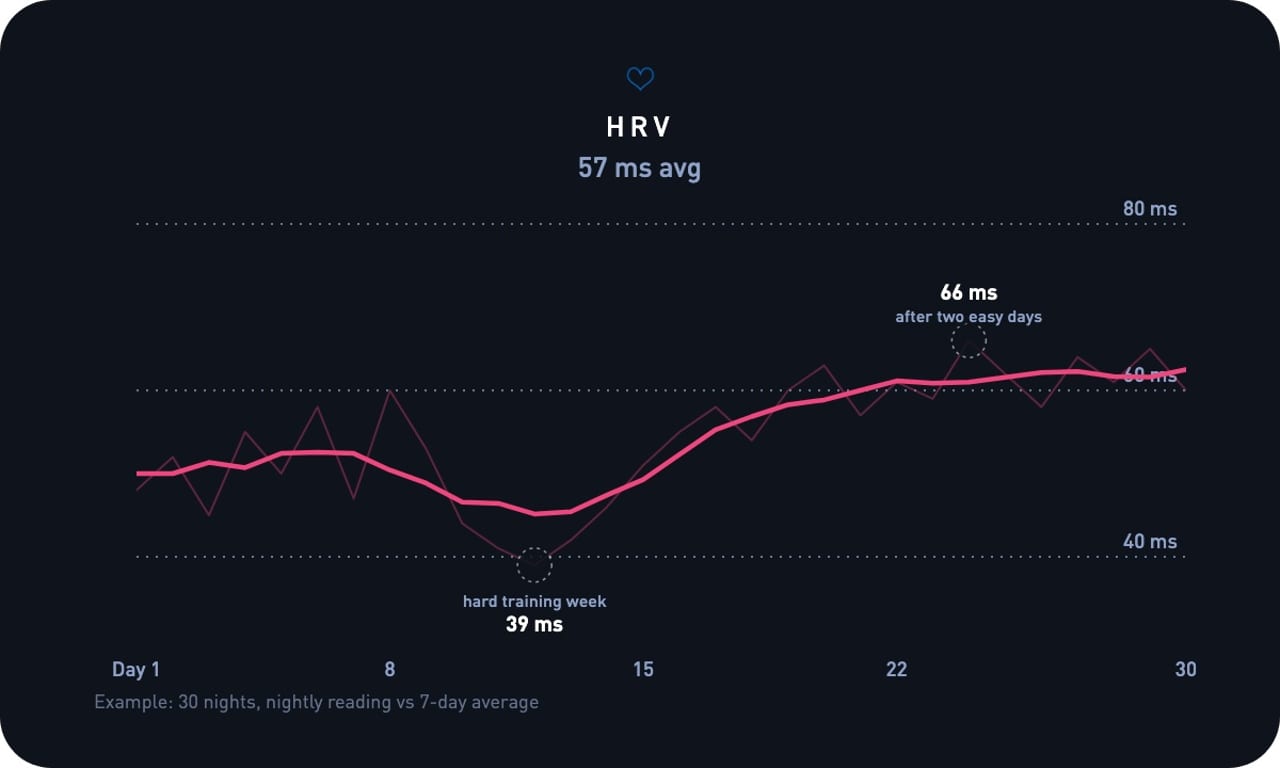
In the chart above, the nightly reading is faint and the seven-day average is bold: 48 up to 60 ms over a month. The average is the one to read. The nightly points swing 20 ms for reasons that have nothing to do with your health.
Why it matters for your goals
If you want to lose weight
A diet is a stress, and HRV shows how well you are carrying it. When the weekly line sinks during a cut, you are under-recovered, and under-recovered people get hungrier and skip training. A steady line on fewer calories is the sign the deficit is one you can keep.
If you want more energy and focus
A low morning reading is the earliest honest answer to the question "is today a day for hard things". It drops the night after drinks, after a short night, and a day or two before a cold. Seeing it lets you schedule the deep work for the mornings your body is ready for it.
If you train
HRV is the recovery signal coaches use to decide between a hard day and an easy one. A hard block pushes it down for a few days; a rebound after two easy days is the recovery you can trust. Runners who let that morning reading set the day improved more than runners on a fixed plan.
If you want to live longer
HRV tracks the balance of your nervous system: more variation when the rest-and-digest side is in charge, less when the body is on alert. Keeping that balance over years is what consistent sleep, easy aerobic work, and less alcohol buy you, and the chart shows each of them working.
Where people land
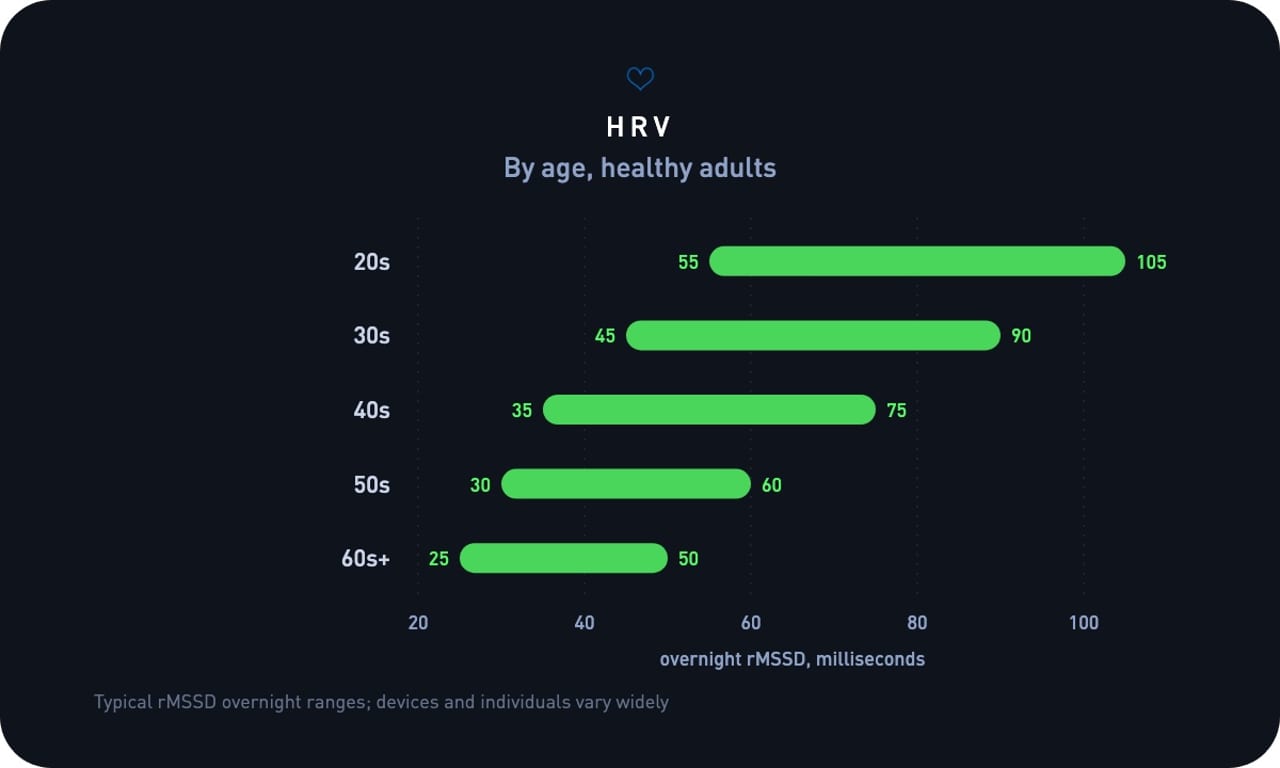
| 20s | 55 to 105 ms |
|---|---|
| 30s | 45 to 90 ms |
| 40s | 35 to 75 ms |
| 50s | 30 to 60 ms |
| 60s and up | 25 to 50 ms |
These are typical overnight rMSSD ranges for healthy adults, and they are wide on purpose. Devices and individuals vary a lot, and a ring and a watch will give different numbers for the same night. Use the table to see that your number is plausible, then stop comparing and watch your own weekly average.
What the research found
HRV has been studied most in athletes, because it is the measurement that answers the question "hard day or easy day" before the session starts.
In a four-week trial of 26 men, training guided by daily HRV measurements improved maximal running speed more than a predefined schedule, while the difference in peak oxygen uptake gains between groups was not significant. (Kiviniemi et al., European Journal of Applied Physiology, 2007). Read the seven-day line, not the night. If it is trending down for a week, ease off; if it is up after rest, that is recovery you can trust.
A 2018 analysis of 4,098 nights from 246 adults found that alcohol raised heart rate and lowered HRV during the first hours of sleep at every dose measured, including low intake, and the effect grew with the amount. It held across ages and fitness levels. (Pietilä et al., JMIR Mental Health, 2018). Alcohol is the fastest way to watch your own HRV drop. Two nights with drinks, two without, and the mornings tell you the price.
A 2016 systematic review of 56 studies found that simple self-reported wellness measures reflected changes in training load with better sensitivity and consistency than the common objective measures like heart rate and HRV. (Saw et al., British Journal of Sports Medicine, 2016). HRV is one input, not the verdict. A morning rating of how you feel, logged the same way every day, belongs next to it.
What moves it
Down, within a night. Alcohol and short sleep are the two fastest ways to see it drop; most people can watch it happen the morning after. A cold, often a day or two before you feel it. A hard training block. A late, large meal. Heat, jet lag, a stressful day that follows you to bed.
Up, over weeks. Consistent sleep and wake times. Easy aerobic work you can talk through. A few slow breaths before bed. Fewer drinks. A rebound after two easy days following a hard week is a good sign, not a bad one.
This week. Pick one lever and read the mornings after. Two alcohol-free nights is the quickest experiment. Give any lasting change three or four weeks before reading a trend into it, and never compare across devices.
Everything known to move it
HRV answers to almost everything you do in the twelve hours before bed, which is why it is the fastest feedback loop in the app. Lowers is the body under load; raises is recovery. Everything here is relative to your own baseline.
Training
| Easy aerobic base | raises | Months of conversational-pace work raise the baseline; this is the slow lever that moves the seven-day line the most. Mandsager et al., JAMA Network Open, 2018 |
|---|---|---|
| Hard session or block | lowers | Drops for a night or two after a very hard day; a week-long slide means the block is outrunning recovery. Kiviniemi et al., European Journal of Applied Physiology, 2007 |
| Easy days after hard days | raises | Runners who let the morning reading pick the day improved more than a fixed plan; the rebound after rest is the signal working. Kiviniemi et al., European Journal of Applied Physiology, 2007 |
| Strength training | mixed | A heavy session dips it that night; the long-run effect is neutral to slightly positive. |
Sleep
| Short or broken sleep | lowers | A late night reads lower the same morning, and the debt carries into the next one. Van Dongen et al., Sleep, 2003 |
|---|---|---|
| Regular bed and wake time | raises | Consistent timing narrows the night-to-night swings and lifts the average. Windred et al., Sleep, 2024 |
| Screens in bed | lowers | Through later bedtimes and less REM more than any direct effect. Chang et al., PNAS, 2015 |
Nutrition
| Alcohol | lowers | Lowered HRV in the first hours of sleep at every dose measured; the more drinks, the bigger the drop. Pietilä et al., JMIR Mental Health, 2018 |
|---|---|---|
| Caffeine late in the day | lowers | Coffee in the afternoon shortens and lightens sleep, and the morning reading shows it. Gardiner et al., Sleep Medicine Reviews, 2023 |
| Late large meals | lowers | Digestion keeps the heart busy through the first hours of the night, when the overnight number is measured. Kinsey & Ormsbee, Nutrients, 2015 |
| Dehydration | lowers | Less blood volume means a faster, steadier beat; a hot day or a long flight can show up as a low night. |
Lifestyle and environment
| Slow breathing and meditation | raises | Raises it sharply while you do it; the overnight gain comes mostly through falling asleep calmer. |
|---|---|---|
| Stress and jet lag | lowers | Sympathetic load shows overnight a day before you would describe yourself as stressed. |
| Illness | lowers | One of the earliest signs of a cold is a low night a day or two before symptoms. |
| Heat and altitude | lowers | A hot bedroom or a new altitude lowers it until you acclimatize. |
| Sauna and cold exposure | mixed | Both stress the system in the moment; most people read slightly higher the following nights once the habit settles. |
Supplements and medical
| Nicotine and stimulants | lowers | Anything that raises heart rate narrows the gaps between beats while it is active. |
|---|---|---|
| Beta blockers | raises | Slow the heart and usually raise HRV; compare only against your own baseline on the medication. |
| Magnesium and melatonin | steadies | Neither acts on HRV directly; any effect comes through easier sleep, and the evidence is modest. |
Gyroscope runs these correlations on your own data: open the HRV trend, tap a low night, and the coach reads the evening before against it.
Targets to aim for
| Good | A weekly average that holds steady or drifts up over months |
|---|---|
| Great | Small night-to-night swings and a quick rebound after hard days or late nights |
| Watch | A weekly average down for a week or more with no obvious cause, or every hard session followed by a slow recovery |
| See a doctor | A sustained drop alongside a resting heart rate that stays high, chest symptoms, or an irregular rhythm on the device |
Practical ways to improve it
- Keep bedtime and wake time within an hour, seven days a week. Regular nights are the biggest lever most people have not pulled.
- Two or three alcohol-free nights a week. Alcohol lowers HRV at every dose, so the nights off are where the weekly average recovers.
- Three or four easy aerobic sessions a week at a pace you can hold a conversation through. Easy work raises it; only hard work pushes it down.
- Five minutes of slow breathing before bed, about six breaths a minute. It is the one lever that works the same night.
- When the weekly line is down after a hard block, take the easy days instead of pushing through. The rebound is the training effect arriving.
How to track it
HRV is an overnight measurement, so it needs a device you sleep in. Any watch or ring that records heart rate through the night will produce it. Chest straps and gym wearables that come off at night will not give you an overnight value.
As of V10.11, Oura and Garmin connect directly in Settings, so their HRV comes in even though it does not pass through Apple Health. Apple Watch readings arrive through Apple Health as before, and most other devices that write HRV to Apple Health work the same way.
| Apple Watch | Automatic through Apple Health |
|---|---|
| Oura, Garmin | Direct integration in Settings, new in V10.11 |
| Whoop, Fitbit, Polar, most others | Through Apple Health, if the device writes HRV there |
| No wearable | Not available. HRV is an overnight measurement and needs a device you sleep in. |
How Gyroscope tracks it
Wear your watch or ring to bed and Gyroscope does the rest. It takes the overnight HRV from Apple Watch, Oura, Whoop, Garmin, or Fitbit, charts each night against your own baseline, and draws the seven-day average in bold so the trend is readable at a glance. Existing history comes in with the device, so the trend is often there on the first morning.
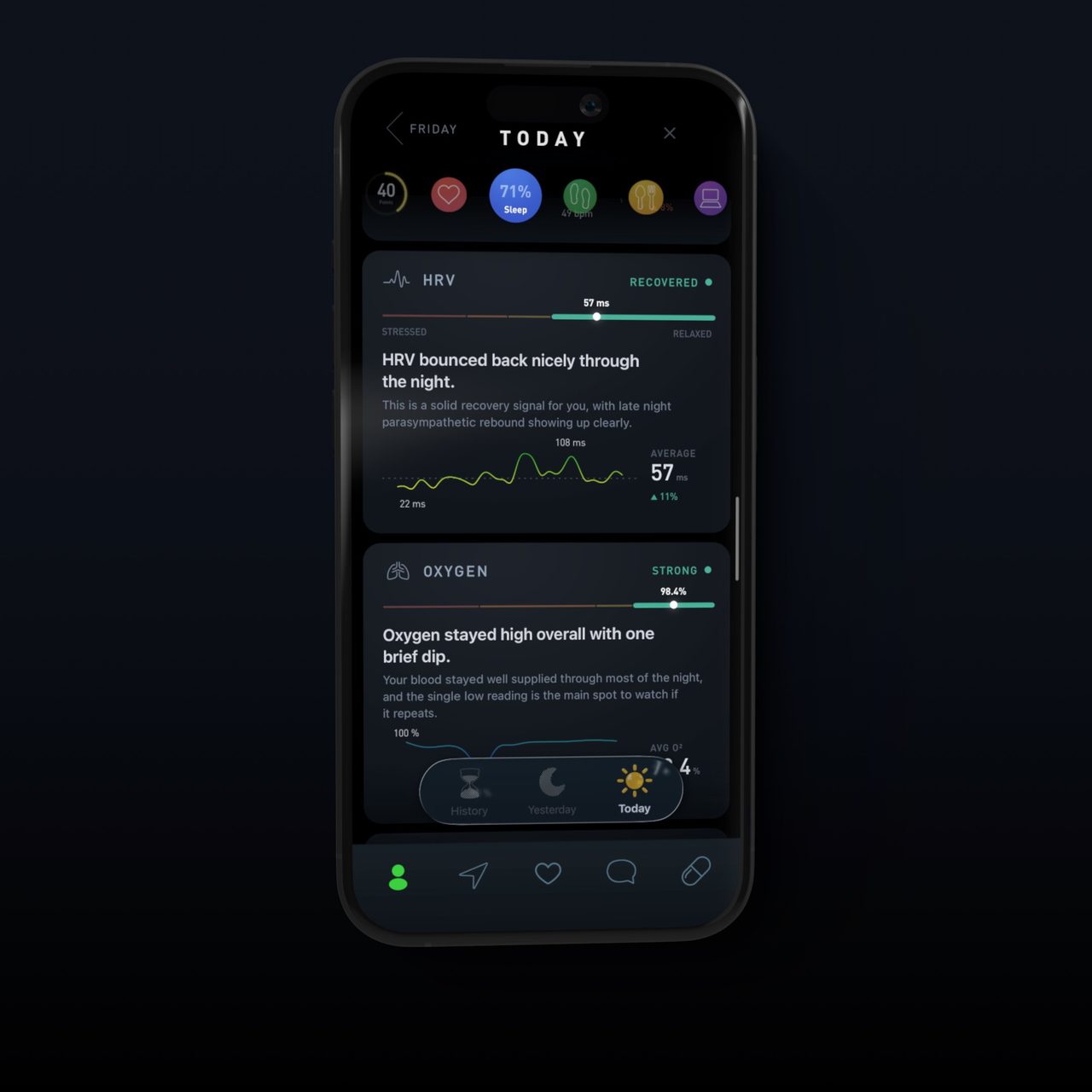
You do not have to read the number. HRV is analyzed as part of your Sleep Score against your own baseline, so the morning report just tells you recovered, normal, or stressed, and what most likely moved it. If you want the chart, the raw overnight values sit on the daily report and on the Trends tab next to sleep, resting heart rate, and alcohol, which is where the explanation usually is.
Give it three or four weeks before reading a trend into it. Different devices measure it differently, so compare yourself over time rather than against someone on a different watch.
Works with Apple Watch, Oura, Whoop, Garmin, Fitbit.
Questions people ask
- What is a good HRV?
- There is no single good number. It depends on age, fitness, and the device. A healthy 50-year-old can sit at 40 ms and a 25-year-old runner at 90 ms. Your own weekly average, and which way it is moving, is what to read.
- Why is mine so different from my friend's?
- Age and fitness explain most of it, and the device explains the rest. A ring and a watch give different numbers for the same night. Never compare across people or devices; compare yourself over weeks.
- How many nights before it means anything?
- Three or four weeks. Single nights swing 20 ms for ordinary reasons. Read the seven-day average.
- Does a low night mean something is wrong?
- Usually it means last night: drinks, a short sleep, a hard session, or a cold on the way. One low night is information about yesterday. A weekly average that stays down with no cause is the pattern worth acting on.
Track your Heart rate variability
This is one of the advanced trends in Gyroscope One, along with the AI coach that reads it for you every morning.
Unlock with Gyroscope OneGet the appWant the long version? Read The complete guide to Heart Rate Variability.