
Caffeine Timing
Why a 4pm coffee is still working at midnight, and where a cutoff should sit for you.
Half of a 3pm coffee is still in your blood at 8pm, and a quarter of it at 1am. You will fall asleep fine and get less deep sleep, which is why people who "can drink espresso after dinner" usually cannot; they just do not notice.
In a controlled study, 400mg of caffeine taken six hours before bed cut measured sleep by about an hour, and the participants did not feel the difference themselves. The coffee you forgot you drank is the one that matters.
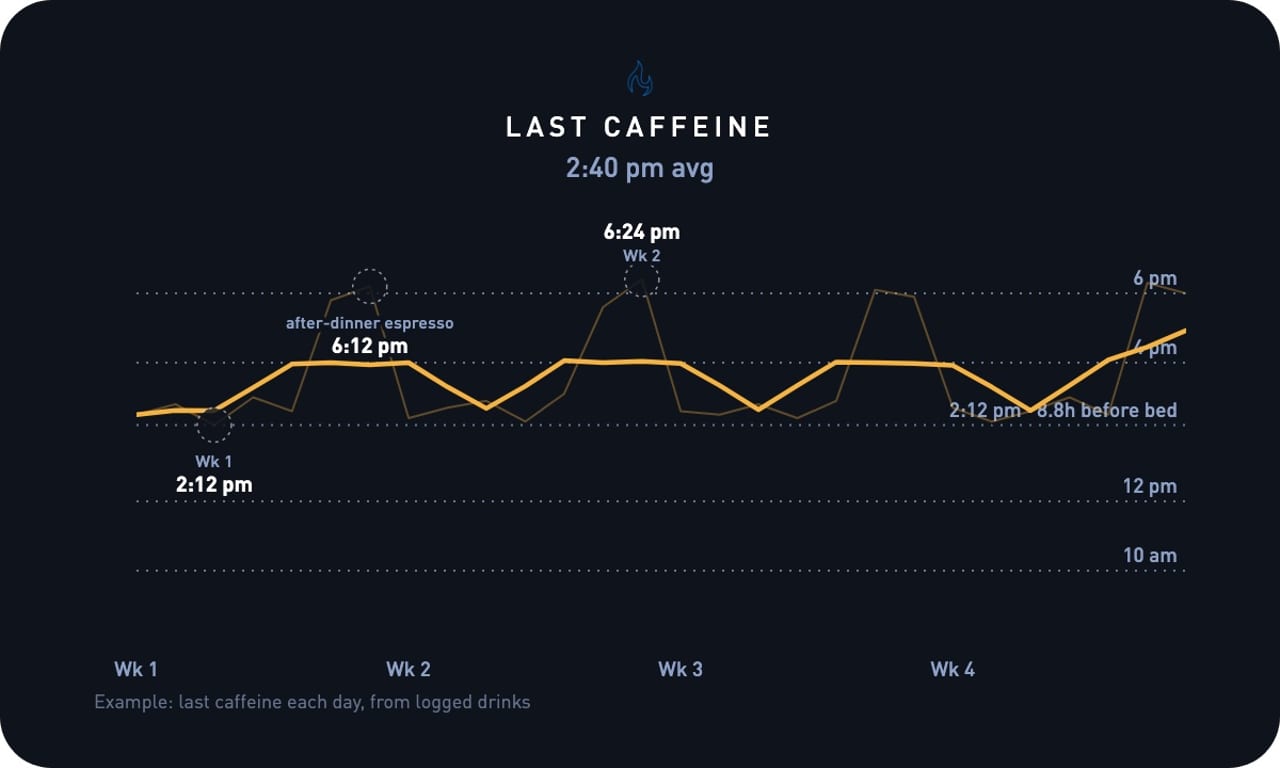
Caffeine timing is the time of your last caffeine each day, charted next to how you slept that night, so the connection is one chart instead of a guess.
What it is
Caffeine timing is simply the clock time of the last caffeinated thing you had: coffee, espresso, tea, an energy drink, a pre-workout, a large dark chocolate. The trend is that time, day after day, read against the night that followed.
Caffeine's half-life is around five hours for most people, and much longer for some; a slow metabolizer can carry a lunchtime coffee into the night. The sleep it costs is mostly deep sleep, the kind you do not feel losing until the afternoon after.
In the chart above, a typical month: last coffee around 2:30 on weekdays, and two days a week an after-dinner espresso at 6:30 or later. The green band is where the research puts the cutoff for an 11pm bedtime: about 8.8 hours before, so around 2pm.
Why it matters for your goals
If you want to lose weight
Late caffeine costs deep sleep, and short sleep changes appetite: two nights of four hours raised hunger ratings by about 24% with the strongest cravings for sweets and starch. A caffeine cutoff is one of the cheapest ways to protect the sleep that makes a diet work.
If you want more energy and focus
The afternoon coffee that gets you through 4pm is often the reason 4pm is hard the next day. Caffeine taken late trims deep sleep, you wake a little less restored, and you reach for the afternoon coffee again. Moving the last cup earlier breaks that loop within a week.
If you want to sleep better
Most people judge caffeine by whether they fall asleep, and that is the wrong test. The damage shows up in deep sleep and in how you feel at 3pm, not at 11pm. The trend puts last-caffeine time next to sleep score so you can see the real cost.
Where people land
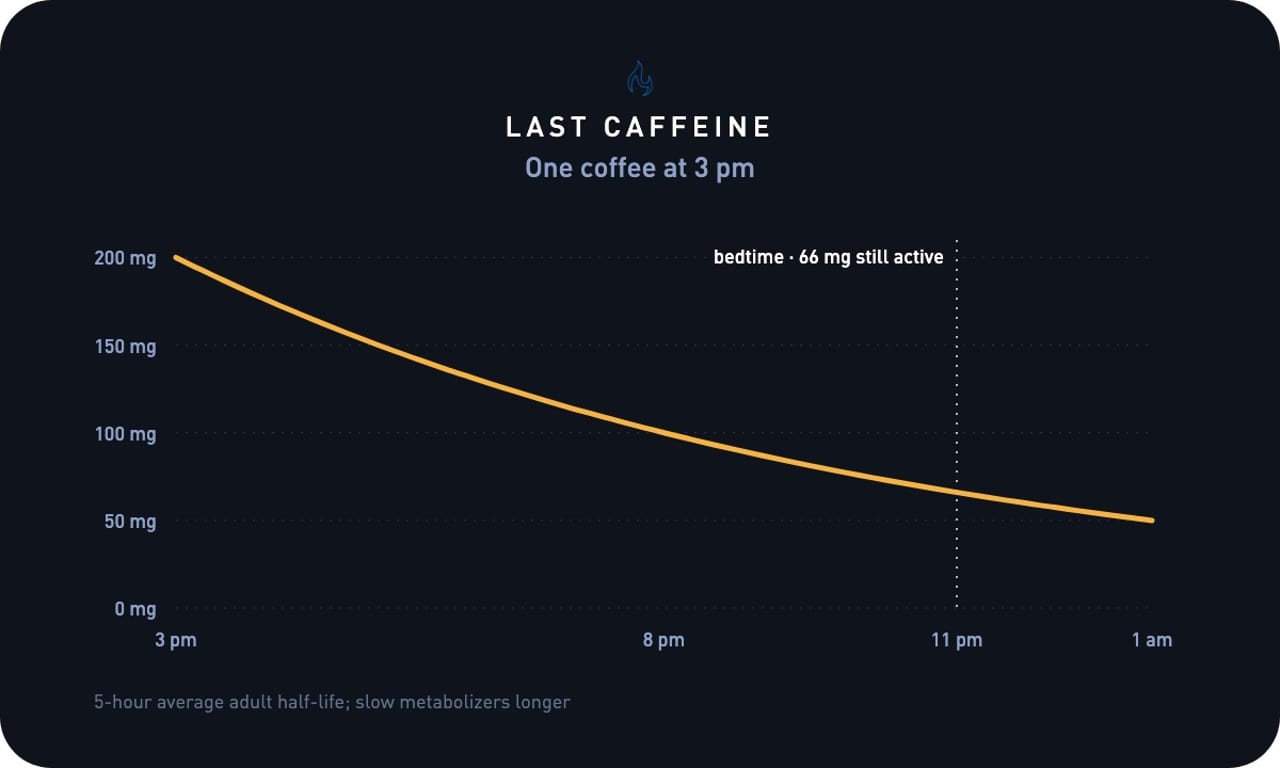
| 3pm coffee at 8pm | about half still active |
|---|---|
| 3pm coffee at 1am | about a quarter still active |
| Typical half-life | around 5 hours |
| Slow metabolizers | much longer; a lunch coffee can reach the night |
| Cutoff for an 11pm bedtime | about 2pm, per the research |
Half-life varies a lot from person to person, so the only cutoff that matters is yours. Find it by moving the last cup earlier and reading the nights that follow.
What the research found
Caffeine and sleep have been studied in the lab, where both the dose and the sleep are measured rather than reported.
A 2023 systematic review and meta-analysis estimated that a standard coffee should be finished about 8.8 hours before bed, on average, to avoid reducing total sleep time. (Gardiner et al., Sleep Medicine Reviews, 2023). For an 11pm bedtime that is a 2pm cutoff. Most people's last coffee is later than that.
400mg of caffeine taken six hours before bed cut measured sleep by about an hour, and participants did not notice the difference themselves. (Drake et al., Journal of Clinical Sleep Medicine, 2013). An hour of sleep lost without noticing is exactly the kind of thing a chart catches and a feeling does not.
What moves it
Later, without noticing. An afternoon meeting coffee. Green tea or matcha after lunch. Pre-workout before an evening session. Dark chocolate after dinner. Most sodas and energy drinks. Decaf, which is not caffeine-free.
Earlier, this week. A hard cutoff eight to ten hours before your target bedtime. Switch the afternoon cup to decaf or herbal tea. Move the workout coffee to morning sessions only.
The four-night experiment. Set a cutoff and hold it for four nights. Watch how fast you fall asleep and your time to first REM the next mornings. If sleep improves, you found a lever. If it does not, you ruled one out, which is also useful.
Everything known to move it
Later is the direction that costs sleep, so here lowers means an earlier last dose or a smaller one, and raises means caffeine reaching further into the night. The levers are grouped by where they live in your day.
Nutrition
| A hard afternoon cutoff | lowers | The biggest lever. A standard coffee finished about 8.8 hours before bed, on average, avoids cutting total sleep. Gardiner et al., Sleep Medicine Reviews, 2023 |
|---|---|---|
| Dose of the last cup | lowers | 400mg six hours before bed cut measured sleep by about an hour; a smaller last dose clears earlier. Drake et al., Journal of Clinical Sleep Medicine, 2013 |
| Hidden sources after lunch | raises | Green tea, matcha, dark chocolate, most sodas and decaf all add caffeine to the evening without feeling like coffee. |
| Energy drinks and pre-workout | raises | Often 150 to 300mg in one serving, usually taken late in the day when the effect reaches the night. |
| Front-loading the day | lowers | Morning caffeine works on a rested brain and is mostly cleared by bedtime; a third cup after lunch is the one that costs. |
Training
| Evening sessions with pre-workout | raises | A stimulant before a 7pm workout is in effect a 7pm coffee, with a hard session on top. |
|---|---|---|
| Morning training | lowers | Moves the coffee that fuels the workout to the one time of day it does not reach the night. |
Sleep
| Short sleep the night before | raises | Tired days pull the last cup later, and the later cup trims the next night; the loop feeds itself. |
|---|---|---|
| Consistent bedtime | lowers | A fixed bedtime makes the cutoff a fixed clock time instead of a moving target. Windred et al., Sleep, 2024 |
| Screens after the cutoff | raises | Not caffeine, but it stacks: light at night delays sleep on top of what the coffee already did. Chang et al., PNAS, 2015 |
Lifestyle and environment
| Long work afternoons | raises | The 3pm meeting coffee is the most common late dose, and the one people forget they had. |
|---|---|---|
| Travel and jet lag | raises | A new time zone moves bedtime but not the habit, so the same cup lands closer to sleep. |
| A warm shower before bed | steadies | Does not clear caffeine, but helped people fall asleep about 10 minutes faster across 17 studies. Haghayegh et al., Sleep Medicine Reviews, 2019 |
Supplements and medical
| Slow caffeine metabolism | raises | Genetics and some medications, including oral contraceptives, can stretch the half-life, so a lunch coffee reaches the night. |
|---|---|---|
| Nicotine and other stimulants | raises | They extend alertness in the evening and compound the sleep cost of late caffeine. |
| Pregnancy | raises | Caffeine clears far more slowly; the usual cutoff moves several hours earlier, and a doctor should set the limit. |
Gyroscope runs these correlations on your own data: the last-caffeine time sits next to that night, so a tap on a bad night shows the cup behind it.
Targets to aim for
| Good | Last caffeine 8 or more hours before bed on most days |
|---|---|
| Great | Last caffeine before 2pm every day, including the hidden sources |
| Watch | Caffeine within 6 hours of bed more than twice a week |
| Talk to a doctor | Needing caffeine to function through the day, or palpitations and anxiety that track with it |
Practical ways to improve it
- Pick a cutoff eight to ten hours before your usual bedtime and put it on the clock, not in your head.
- Count the hidden sources: green tea, dark chocolate, pre-workout, and most sodas.
- Front-load it. The first coffee of the day is the one that helps; the third is the one that costs.
- Swap the afternoon cup for decaf or herbal tea for four nights and read the mornings after.
- If you fall asleep fine after late coffee, check deep sleep and how you feel at 3pm instead. That is where the cost shows.
How to track it
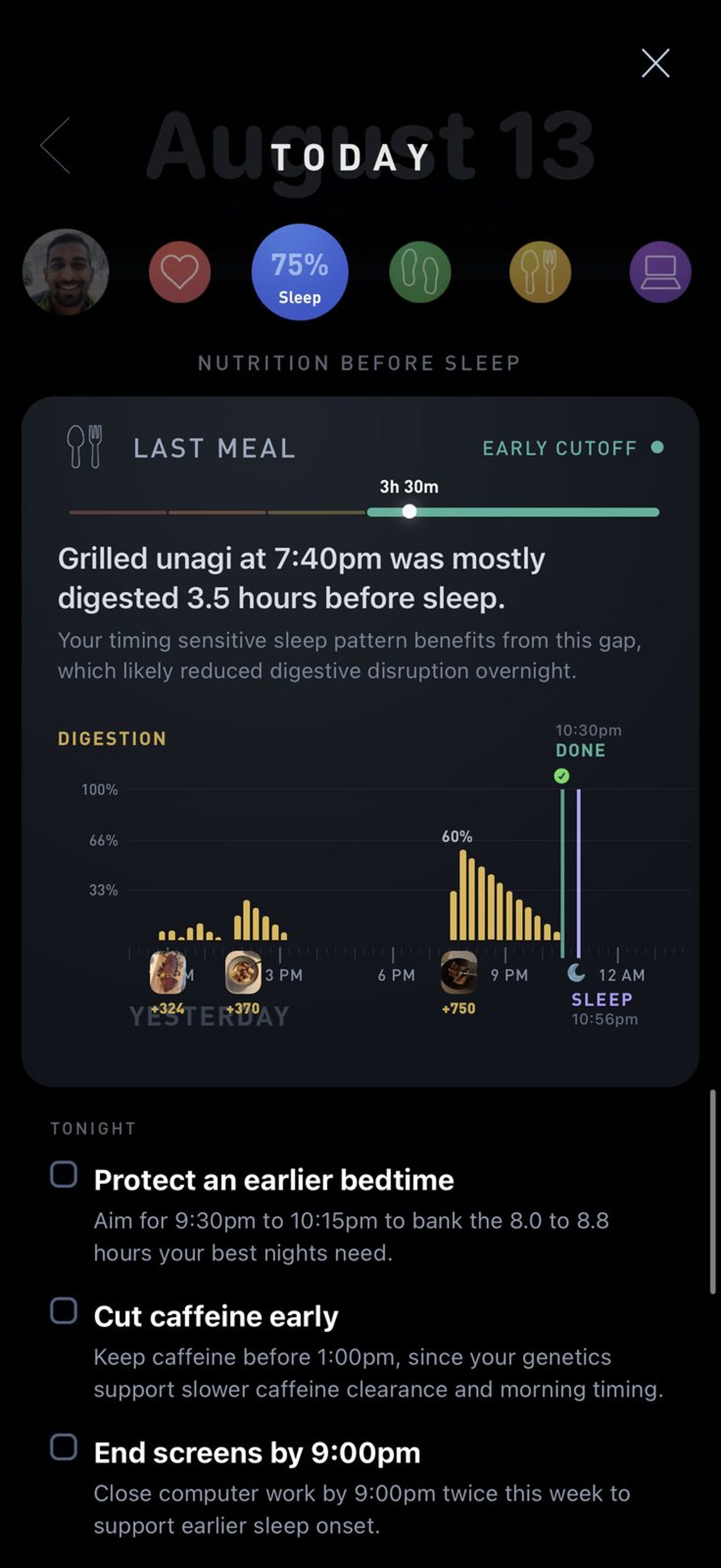
Caffeine timing comes from what you log, so it needs a record of when you drink it. In Gyroscope that is the meal photo or a quick caffeine entry; a coffee snapped at 2:40pm becomes a 2:40pm last-caffeine time for that day unless something later replaces it.
The sleep side comes from any watch or ring you sleep in. Without a wearable, the trend still shows your timing, and you can read it against how you felt in the morning.
| Meal photos in Gyroscope | Photograph the coffee or tea; the time is logged automatically |
|---|---|
| Manual entry | Add caffeine from the food tab when there is no photo |
| Apple Watch, Oura, Whoop, Garmin, Fitbit | Supply the sleep it is charted against |
| No wearable | Log caffeine and compare against your morning energy rating |
How Gyroscope tracks it
Log caffeine the way you log food: snap the cup. Gyroscope takes the latest caffeine each day and plots it as your last-caffeine time, with the research cutoff for your own bedtime drawn as a band.
On the Trends tab it sits next to sleep score, time to first REM, and resting heart rate, which is where the answer usually is. Ask the coach about a rough night and it reads the caffeine line with the rest.
Give it two weeks of logging before you read the weekly line. One late espresso is a data point; a pattern of them is a lever.
Works with Apple Watch, Oura, Whoop, Garmin, Fitbit.
Questions people ask
- I fall asleep fine after coffee. Does this apply to me?
- Probably. The cost of late caffeine is mostly in deep sleep and next-day energy, not in how fast you fall asleep. In the lab, people lost about an hour of sleep without noticing.
- How early should my cutoff be?
- The research average is about 8.8 hours before bed for a standard coffee, so about 2pm for an 11pm bedtime. Slow metabolizers need earlier. Test it over four nights.
- Does tea count?
- Yes. Green and black tea, matcha, most sodas, energy drinks, pre-workout, and dark chocolate all count. Decaf has a little too.
- Do I need a wearable?
- Not for the timing itself, which comes from what you log. A watch or ring adds the sleep side so the chart can show the effect.
Track your Caffeine timing
This is one of the advanced trends in Gyroscope One, along with the AI coach that reads it for you every morning.
Unlock with Gyroscope OneGet the app