
Steps
10,000 steps was a 1965 pedometer name, not a study. The research found a different number.
The 10,000-step goal on your watch was never a finding. It was a product name. In 1965 a Japanese company sold a pedometer called manpo-kei, roughly "10,000-step meter," partly because the character for 10,000 looks a bit like a walking person.
The research that came later found a different number, and a lower one. The benefit of walking rises quickly and then flattens, for most adults somewhere between 6,000 and 10,000 depending on age. Below 5,000 is where extra walking does the most.
What it is
Steps are the count of strides your phone or watch detects in a day. They are the simplest measure of how much you move outside of workouts: commuting, errands, pacing on calls, the walk after dinner.
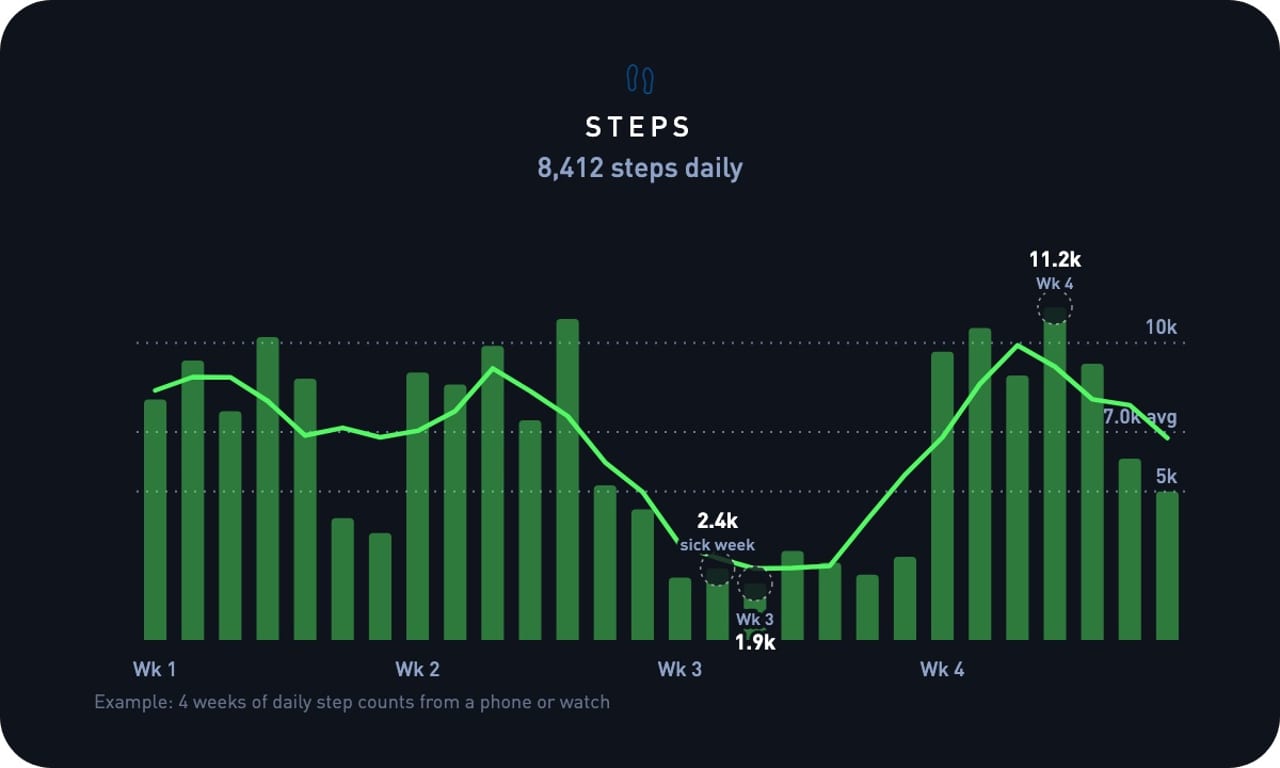
The chart above is four weeks of a fairly typical life: eight to ten thousand on weekdays, less on weekends, and one sick week that shows exactly why a monthly average is more useful than any single day.
The count is an estimate. A phone in a bag misses steps and a watch on the wrist counts a few while you type. Neither matters much; the trend over weeks is accurate even when a single day is not.
Why it matters for your goals
If you want to lose weight
Steps are the largest piece of daily energy burn that you control without a workout. Going from 4,000 to 8,000 a day is a real change in what you burn, every day, without adding a session you might skip. It is also the part of a diet that does not make you hungrier.
If you want more energy and focus
Walking is the break that actually resets attention. A ten-minute walk after lunch does more for the afternoon than a third coffee, and the hourly breakdown of your steps shows whether you sat for six straight hours or moved through the day.
If you want to live longer
In a pooled analysis of 47,471 adults, mortality risk fell steadily with more daily steps until it levelled off. Steps are the fitness measure that needs no equipment, no plan, and no recovery day, and the return is biggest for the people currently walking least.
If you want a better mood
A walk outside in daylight is one of the few things that helps sleep, mood, and focus in the same hour. The trend shows whether the low weeks on the chart line up with the low weeks in your mood log, and for many people they do.
Where people land
| Under 5,000 | Where extra walking does the most |
|---|---|
| 6,000 to 8,000 | Where the benefit flattens for adults 60 and older |
| 8,000 to 10,000 | Where the benefit flattens for younger adults |
| Above 10,000 | Fine, but the health return is mostly already banked |
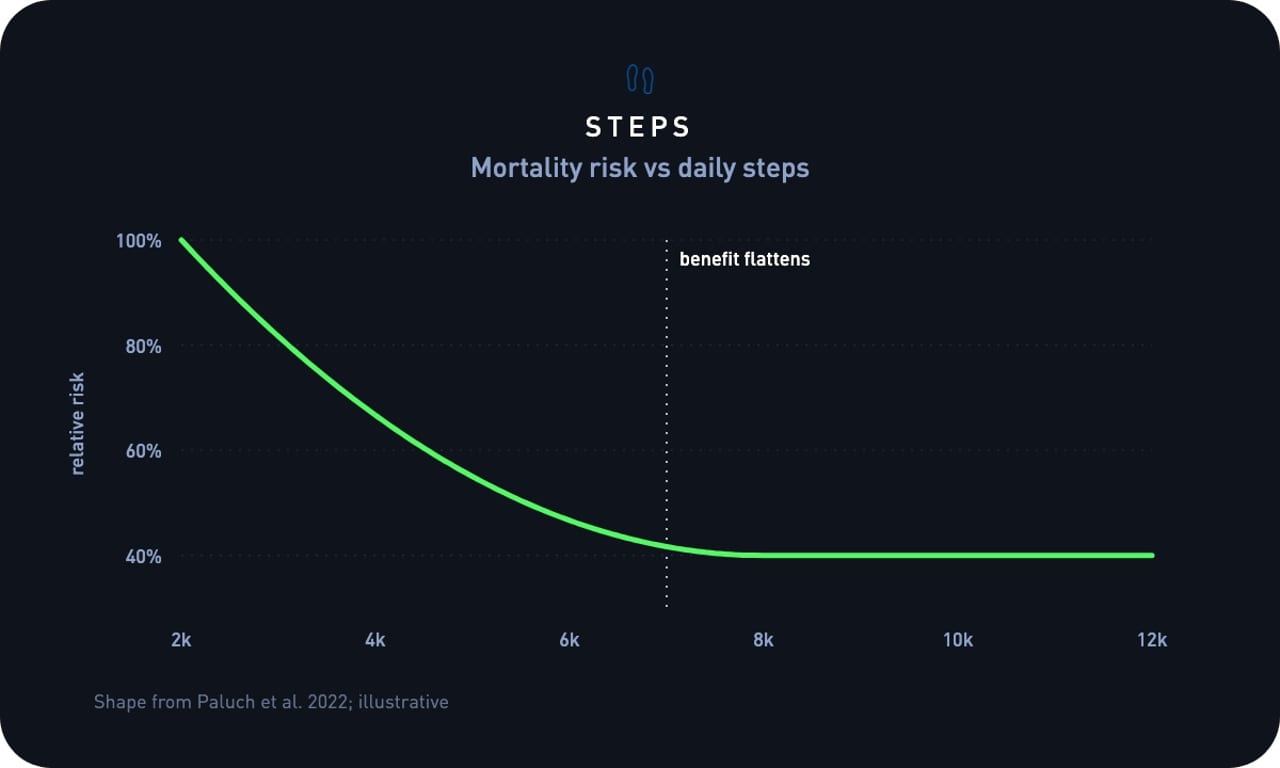
The curve above is the shape of the finding: steep at the low end, flat past 7,000 or 8,000. The useful comparison is not against a round number but against your own last month. Aim for a bit more than that and the trend shows whether it is happening.
What the research found
Steps have been counted on tens of thousands of people and followed for years, which is why the flattening point is one of the better-established numbers in health.
A 2022 pooled analysis of 15 studies and 47,471 adults found that mortality risk fell with more daily steps and then leveled off: around 6,000 to 8,000 steps a day for people 60 and older, and around 8,000 to 10,000 for younger adults. (Paluch et al., The Lancet Public Health, 2022). Below 5,000 is where extra walking does the most; past 8,000 or so, more is fine but the health return flattens.
In a 2018 study of 122,007 adults who did a treadmill fitness test at the Cleveland Clinic, the fittest group had the lowest mortality, and the risk associated with low fitness was comparable to or greater than smoking, diabetes, or heart disease. (Mandsager et al., JAMA Network Open, 2018). Steps are the entry point to fitness. The people who gain most from walking more are the ones currently in the least-fit group.
A meta-analysis of 138 studies found that prompting people to monitor their progress made them more likely to reach their goal, with bigger effects when progress was recorded or reported. (Harkin et al., Psychological Bulletin, 2016). A step count you actually look at moves more than one you do not. The Monday review is where the monthly average gets read.
What moves it
Up, this week. Walk the first and last part of a commute. Take calls standing and moving. A ten-minute walk after dinner. A reminder to break up sitting every hour or so at a desk. Each is worth a thousand or two, and they stack.
Down, without noticing. Working from home. A sick week. Travel days spent sitting. A new car, a new desk, a bad month. The monthly average catches the drift that a daily goal hides.
The target. A bit more than last month rather than a round number. If you are under 5,000, every extra thousand is the best return in health; past 8,000, walk because you like it.
Everything known to move it
Steps are the most forgiving number in the app: almost nothing lowers them except the shape of your day, and almost anything that gets you off a chair raises them. Raises is good up to a point, and the research found where that point is.
Training
| A walk after dinner | raises | Ten minutes is worth about a thousand steps, and it is the easiest one to make daily. |
|---|---|---|
| Walking part of the commute | raises | Getting off one stop early or parking further away adds a thousand or two without scheduling anything. |
| Running or hiking | raises | A single session can equal a whole desk day; the weekly average is where it shows. |
| Moving below 5,000 | raises | Mortality risk fell fastest with each extra thousand at the low end and leveled off past the middle. Paluch et al., The Lancet Public Health, 2022 |
| Going far past 8,000 | steadies | The health return flattens; walk more because you like it, not for the number. Paluch et al., The Lancet Public Health, 2022 |
Sleep
| Short sleep | lowers | Tired days are sedentary days; a run of short nights lowers the step count before you notice. |
|---|
Nutrition
| Alcohol the night before | lowers | A slower morning and a longer sit; the step count the day after drinks is usually low. |
|---|---|---|
| Large evening meals | lowers | Mostly through skipping the walk that would have followed a lighter dinner. |
Lifestyle and environment
| Working from home | lowers | The commute, the walk to lunch and the trips between meetings disappear together; this is the most common silent drop. |
|---|---|---|
| Standing and walking calls | raises | A phone call taken on foot is free steps; a day of them is thousands. |
| Hourly reminders to break up sitting | raises | Short walks through a desk day add up and also help the numbers steps sit next to. |
| Travel days and sick weeks | lowers | A flight or a cold drops a week to a fraction; expect it, and read the monthly average instead. |
| A dog, a walkable neighborhood, stairs | raises | Environment does more than willpower; the people with the highest averages rarely plan their steps. |
| Looking at the number | raises | Monitoring progress made people more likely to reach a goal, and the effect was bigger when it was reported or made visible. Harkin et al., Psychological Bulletin, 2016 |
| Phone in the other room | lowers | A phone left on the desk does not count steps; wear a watch or carry it if the count looks low on active days. |
Supplements and medical
| Injury and joint pain | lowers | The most common reason a high average drops for months; an easier surface or a bike keeps fitness while it heals. |
|---|---|---|
| Caffeine | raises | A mild nudge toward moving more on the days you have it; small, and not a reason to drink more. |
Gyroscope runs these correlations on your own data: the steps trend shows which weekdays, cities and weeks carry your average, and the coach points at the one that dropped.
Targets to aim for
| Good | Above 6,000 most days, and a monthly average higher than the one before |
|---|---|
| Great | Around 8,000 to 10,000 on a typical weekday, with weekends not far behind |
| Watch | A monthly average sliding under 5,000, or weeks that disappear when work gets busy |
| See a doctor | Steps are not a medical number, but if walking itself has become hard, painful, or leaves you breathless, that is the conversation to have |
Practical ways to improve it
- Walk the first and last part of the commute. Getting off one stop early is the most reliable thousand steps there is.
- Take phone calls standing and walking. An hour of calls is an hour of steps.
- Ten minutes after dinner, every night. It helps the meal, the sleep, and the count.
- Break up sitting every hour at a desk. A lap of the office or the block is enough.
- Aim for a bit more than last month, not a round number. The monthly average is the one to beat.
How to track it
Steps are the easiest trend to start: the phone in your pocket already counts them, and Gyroscope reads that count automatically. A watch or band on the wrist counts the steps the phone misses, and the two are merged so the day is not double counted.
No wearable is needed. If you carry your phone, you have the data. A watch adds the hours when the phone is on a desk, which for most people is a meaningful share of the day.
| iPhone | Automatic from the phone's motion sensor |
|---|---|
| Apple Watch | Automatic through Apple Health |
| Oura, Garmin, Fitbit | Direct integration in Settings |
| Whoop, Withings, most others | Through Apple Health |
How Gyroscope tracks it
Carry your phone or wear your watch and Gyroscope counts the day. It merges steps from the phone, Apple Watch, Oura, Garmin, or Fitbit without double counting, shows the hourly breakdown of the day, and charts the monthly average against your own history so a slow slide is visible.
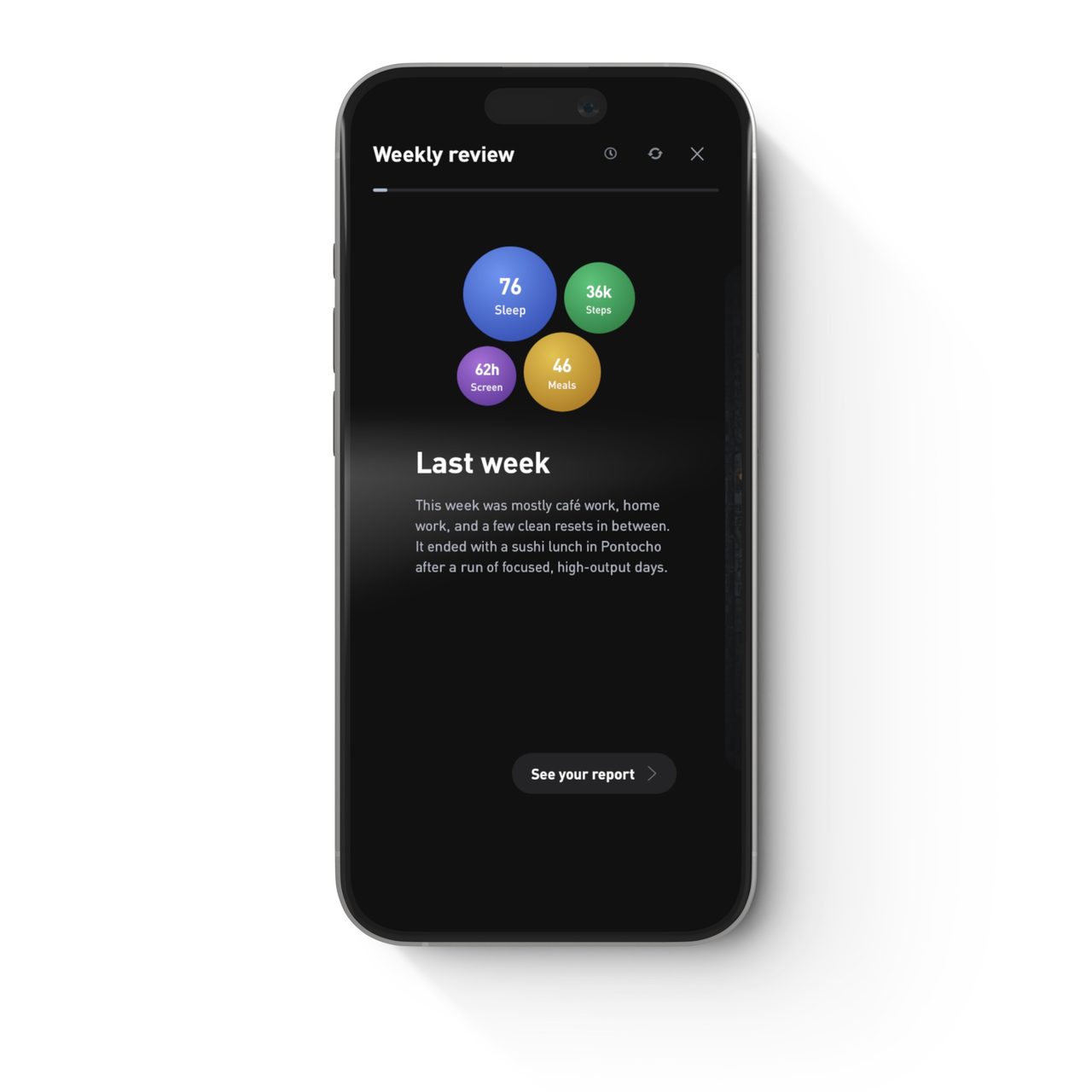
Steps are on your day card and in the Weekly Review every Monday, next to sleep, meals, and screen time. The coach reads them with the rest: a low-step week next to a low-mood week, or a sitting-heavy workday next to a poor night, is the kind of pattern it points out.
Because the count starts from the phone, the history is usually years deep on the first day. Read the monthly average rather than any single day.
Works with iPhone, Apple Watch, Oura, Garmin, Fitbit.
Questions people ask
- Do I really need 10,000 steps?
- No. That number was a 1965 pedometer brand. The pooled research found the benefit flattening around 6,000 to 8,000 for adults over 60 and around 8,000 to 10,000 for younger adults.
- Do I need a watch?
- No. The phone in your pocket counts steps. A watch adds the hours the phone is on a desk, which for a desk worker can be a third of the day.
- Why do my phone and watch disagree?
- Each counts what it sees. The phone misses steps while it sits on a desk; the watch counts a few while you type. Gyroscope merges them so the day is not double counted. The trend over weeks is accurate even when one day is not.
- Does a walk count if it is not a workout?
- Yes, and that is the point. The research counted all steps, not exercise. Errands, commutes, and pacing on calls are where most people's steps come from.
Track your Daily steps
Included in the free app. Download Gyroscope, connect your device, and the trend builds itself.
Get Gyroscope