Gyroscope Benchmarks / Strength
How long can you stand on one leg?
An eyes-closed single-leg stand measures how well your nervous system maintains a stable position without visual feedback.
Why it matters
Standing on one leg is what your body does every time you take a step, climb a stair, pull on a sock, or step out of the shower. The other foot is in the air for a moment and the standing side has to hold you. With your eyes closed, the job falls to the inner ear and to the sensors in your ankles, knees, and hips, the systems that catch you when you clip a curb in the dark or turn your head while walking on ice. A long hold means those systems are talking to your muscles quickly and clearly.
This is one of the capacities that fades earliest. In the Springer data below, the average time falls from about 15 seconds in the twenties and thirties to about 8 seconds in the fifties and under 5 seconds in the sixties. Nobody feels that happening, because daily life rarely asks for ten full seconds on one foot with no visual reference. A fall is usually the first moment the loss shows itself, and by then it has been building for years. Balance also responds to practice quickly, at any age, which makes it worth measuring.
How steady you feel is a poor guide. You compensate with your eyes, a hand on the rail, a wider step, without noticing. A stopwatch, the same protocol, the same leg, once a month, gives you a number that compensation cannot flatter, and a line over time that tells you whether the practice is working.
What this test measures
Balance combines information from vision, the vestibular system in the inner ear, and position sensors in muscles and joints. Closing your eyes removes visual feedback, making this test more sensitive to the other systems and much harder than an eyes-open stand.
Springer and colleagues tested 549 healthy adults using a barefoot, arms-crossed protocol. Mean eyes-closed time fell from 15.2 seconds at ages 18–39 to 1.9 seconds at ages 80–99. The study found no significant difference between men and women, so its pooled age references apply to both.
Springer, Journal of Geriatric Physical Therapy, 2007
This is a sensitive physical benchmark, not a diagnostic exam. An individual result can change with fatigue, practice, footwear, surface, pain, medication, or the exact stopping rule.
Do the test right now
- 1Stand barefoot on a firm, level surface beside a wall or sturdy counter. Keep one hand within reach, and begin with your eyes open if you are at all unsteady.
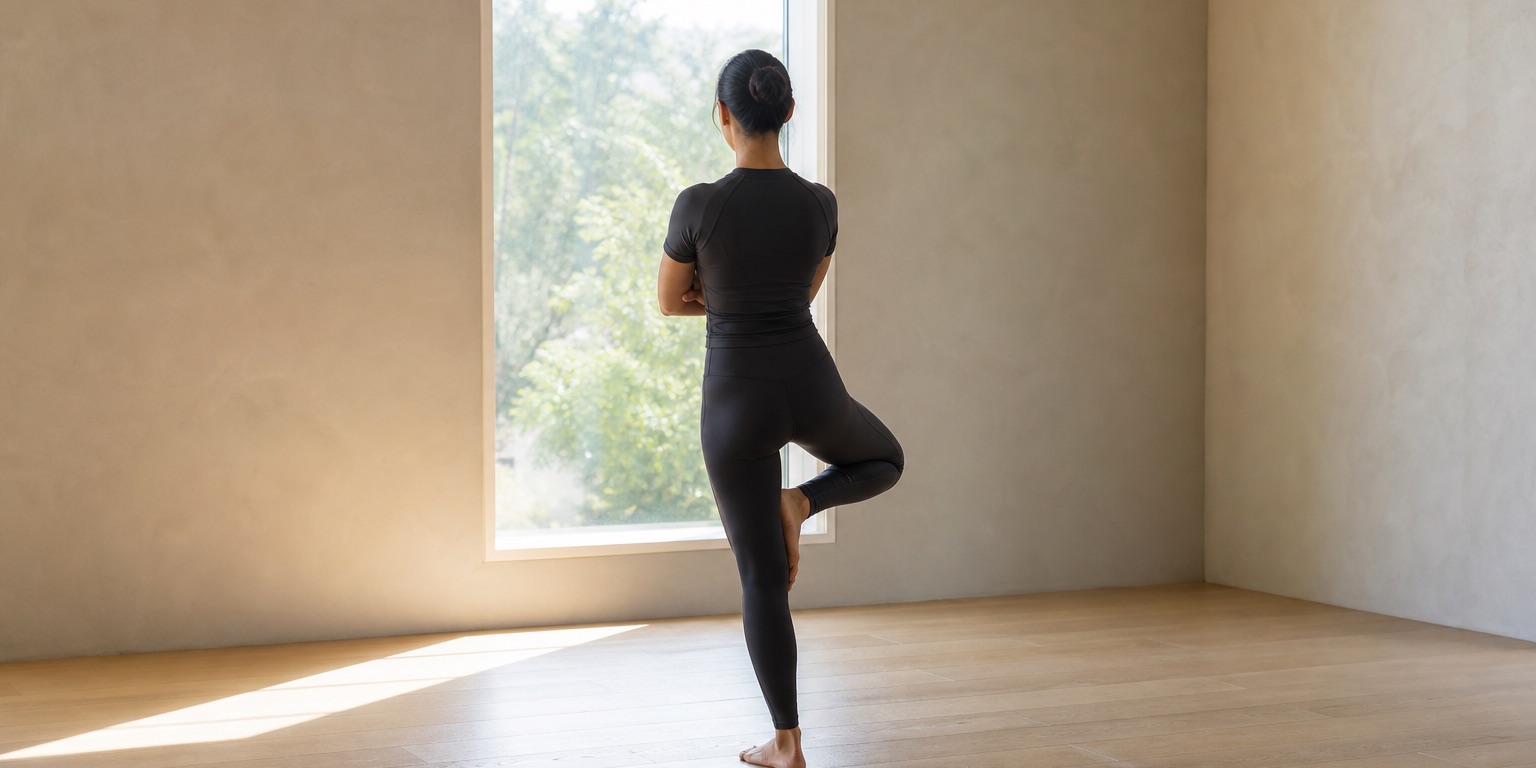
- 2Put a phone stopwatch in a pocket or ask a partner to operate it. Cross your arms over your chest and lift one foot to the standing leg's mid-calf without pressing against it.
- 3Close your eyes and start the timer. Stop when the raised foot touches down, the standing foot hops or shifts, your arms uncross, or you open your eyes.
- 4Take two or three attempts on each side with a short rest. Record the best completed time in seconds and cap every attempt at 60 seconds.
Have another person nearby if falling is a concern. Clear obstacles and stop immediately if you feel dizzy or unsafe. An eyes-open attempt is the better test when the closed-eye setup is not safe.
Reference bands
The published protocol used bare feet, crossed arms, the best of three trials, and a 45-second ceiling. Gyroscope caps the app entry at 60 seconds, so a result above 45 seconds extends beyond this study's measurement range.
| Age | Mean eyes-closed time |
|---|---|
| 18–39 | 15.2 sec |
| 40–49 | 12.7 sec |
| 50–59 | 8.3 sec |
| 60–69 | 4.4 sec |
| 70–79 | 3.1 sec |
| 80–99 | 1.9 sec |
Springer, Journal of Geriatric Physical Therapy, 2007. Values are pooled best-of-three means.
A separate cohort study used an easier eyes-open test in 1,702 adults ages 51–75. In that sample, 20.4 percent could not complete a 10-second stand. Over a median follow-up of 7 years, 4.6 percent of those who passed and 17.5 percent of those who failed died. After adjustment, failure was associated with a hazard ratio of 1.84 and a 95 percent confidence interval of 1.23–2.78.
Araujo, British Journal of Sports Medicine, 2022
The cohort finding does not make this eyes-closed test a mortality screen, and it does not show that poor balance caused the deaths. The different visual conditions also mean its pass or fail result is not interchangeable with the times in the table.
How to improve
What changes this score is practice of the exact skill, plus strength in the ankle and hip that make the small corrections. A few minutes a day, most days, does more than one long session a week.
- Stand on one foot while you do something else. Brushing your teeth, waiting for the kettle, standing in a line. Thirty seconds a side, a few times a day, is more balance practice than most adults get in a month.
- Earn the eyes-closed hold. Get to a comfortable 30 seconds with your eyes open first. Then close them for five seconds at a time, open to reset, and lengthen the closed intervals as they get easy.
- Start on the weaker side. Most people have one leg that is clearly worse. Give it the first set and the last set so the gap closes instead of widening.
- Strengthen the ankle and hip. Single-leg calf raises, split squats, and side-lying hip raises build the muscles that steady you. Slow, controlled reps do more than heavy ones here.
- Add one challenge at a time. A folded towel underfoot, a slow head turn, or a higher lift of the raised knee, each on its own. Two new variables at once teach you less and risk more.
- Keep support within reach, always. Train beside a counter or a wall. If you get dizzy, take medication that affects balance, or have fallen in the past year, ask your doctor first.
Retest the same way each time: barefoot, arms crossed, same leg first, rested rather than straight after a hard workout, best of three attempts. Once a month is enough, and it keeps the line comparable, so a jump or a dip means something changed in you and not in the setup.
Track it
Log it in the app.
Download Gyroscope and run Balance in about a minute. See how you compare to your peers, to the studies, and to your own baseline over time.
Download the appExplore membershipsBenchmarks are included in all premium memberships.