Gyroscope Benchmarks / Strength
How long should you be able to hold a plank?
A front-plank hold measures how long your trunk can keep a rigid position as fatigue builds.
Why it matters
Your trunk is the link between everything your legs do and everything your arms do. Carrying a suitcase up a flight of stairs, holding a toddler on one hip, pulling a stuck door, getting up off the floor: each one asks the muscles around your spine to hold a rigid shape while the limbs work. A plank measures exactly that, how long you can keep your midsection braced once it starts to burn. When that endurance is there, your back is protected on the hundredth lift of the day, not only the first.
Trunk endurance fades earlier than most people expect. Desk hours shorten it, a long break from training shortens it, and the slide is easy to miss because a sagging plank does not hurt until it does. In the survey on this page, men with good isometric back endurance had less first-time low-back trouble over the following year. That was an extensor test, not a plank, but the direction is the same: a trunk that can hold on tends to hold up.
Judging your core by feel does not work, because it feels fine right up until you are on the floor. Sixty seconds counted the same way, elbows under shoulders, hips level, timer stopped at the first sag, is a number you can put next to last month's. The app scores it against people like you and against your own baseline, so a five-second gain shows as a gain and a slow slide shows up before it reaches your back.
What this test measures
A forearm plank challenges the front and side of the trunk to stabilize the spine while the shoulders and hips share the load. The score is time under correct tension, not simply time between starting and dropping to the floor.
Published front-plank norms are narrow. Strand and colleagues tested 471 healthy college-age participants to technique or voluntary failure. Men averaged 124 seconds with a 72-second standard deviation, while women averaged 83 seconds with a 63-second standard deviation. The authors cautioned against generalizing the sample to other populations.
Strand, Journal of Human Kinetics, 2014
Trunk endurance is also studied in relation to back function. In a prospective survey of 449 men and 479 women, good isometric back-muscle endurance was associated with lower first-time low-back trouble in men over the following year. That was an extensor test, not a front plank, so it supports the value of trunk endurance without making the two scores interchangeable.
Do the test right now
- 1After a short warm-up, place your phone face-up on the floor below your line of sight and open its stopwatch.
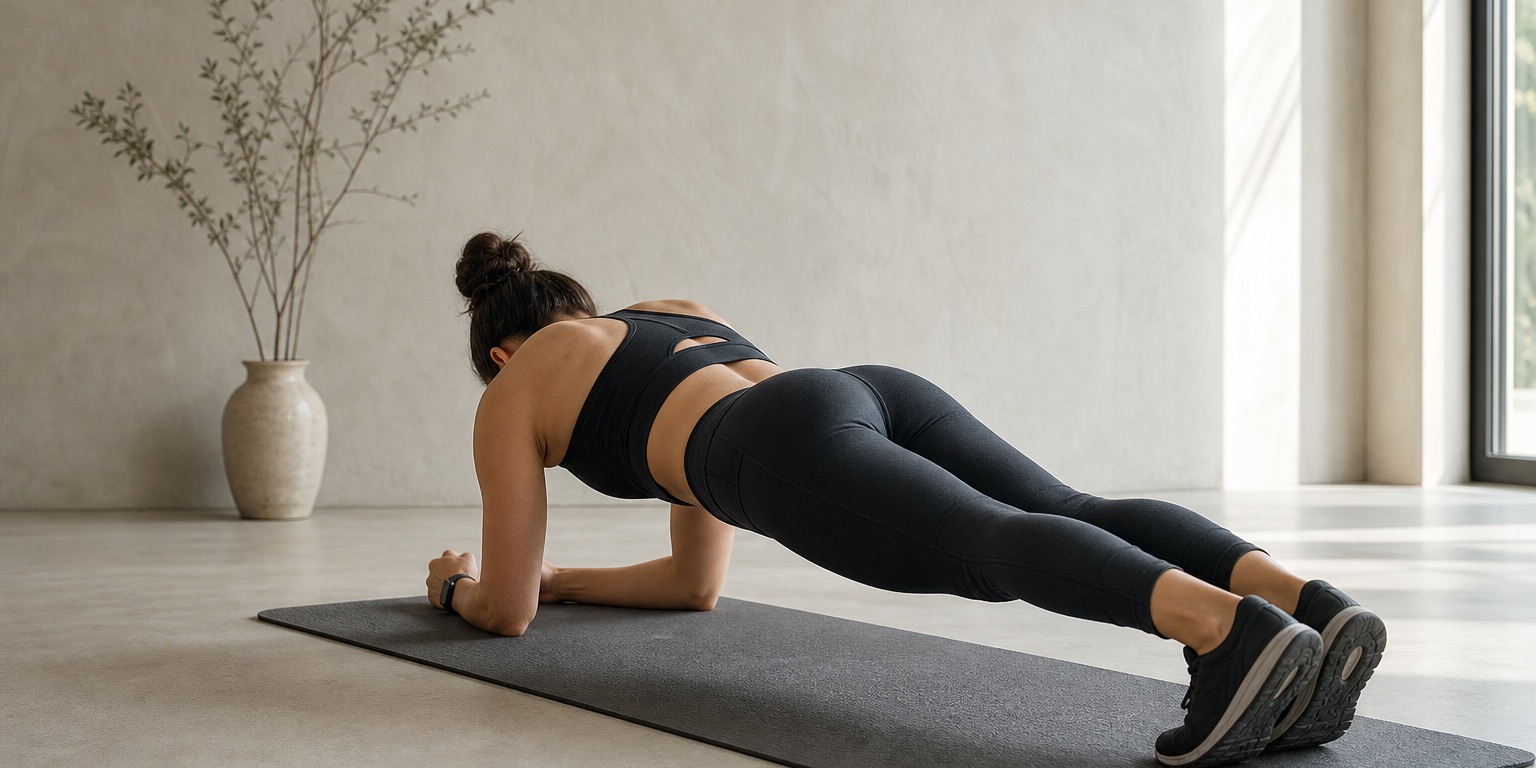
- 2Set your forearms down with elbows under shoulders. Extend both legs, squeeze glutes and abs, and make one straight line from head to heels.
- 3Start the timer once the position is set. Breathe normally without letting the hips drift.
- 4Stop the timer the moment your hips sag, pike, or rotate, or when you leave the position. Record that time in seconds. Use one attempt so repeated fatigue does not blur the result.
Reference bands
Broad published norms are thin outside young-adult samples. These first bands are Gyroscope's practical categories for a correctly held front plank, not clinical cutoffs or population percentiles.
| Hold time | Practical band |
|---|---|
| Under 30 s | Needs work |
| 30–60 s | Fair |
| 60–120 s | Good |
| Over 120 s | Strong |
Gyroscope practical bands for the app's front-plank benchmark. Published college-age comparison: Strand, Journal of Human Kinetics, 2014.
The published anchor below comes from participants with mean ages of 20.4 years for men and 20.2 years for women. It describes that college-age sample, not what every adult should reach.
Strand, Journal of Human Kinetics, 2014
| College-age sample | Men | Women |
|---|---|---|
| Mean hold | 124 s | 83 s |
| Standard deviation | 72 s | 63 s |
How to improve
A plank gets longer when the position gets cheaper to hold. Train the brace itself, build the muscles that share the load, and stop every practice hold before form breaks, so your body only rehearses the shape you will be scored on.
- Practice short, crisp holds. Three or four sets of 20 to 40 seconds with ribs down, glutes tight and a long neck teach more than one long sag. Add ten seconds a week while every set still looks like the test.
- Learn to breathe inside the brace. Slow breaths through the nose with the abs still tight let the hold go long without holding your breath. Practice it in a kneeling plank first if the full one runs out too fast.
- Train the sides and the back. Side planks, bird dogs and dead bugs build control in the directions a front plank ignores, and a trunk that is strong all round keeps the front shape longer.
- Strengthen shoulders and hips. Push-ups, rows and glute bridges take work off the midsection, so the shoulders stop being the part that quits first.
- Press the floor away. Push the forearms down and spread the shoulder blades to lift the chest, then think of pulling the elbows toward the toes. The tension goes to the abs instead of the lower back.
- Stop when form changes. A hold that continues with sagging hips trains the wrong pattern and loads the spine. If planks bring on back pain, see a physio before adding time.
Retest once a month, rested, on the same protocol: phone on the floor, elbows under shoulders, one attempt, timer stopped at the first sag. Keeping the rules identical means the line in the app compares planks with planks, and a gain shows as one.
Track it
Log it in the app.
Download Gyroscope and run Core Strength in about a minute. See how you compare to your peers, to the studies, and to your own baseline over time.
Download the appExplore membershipsBenchmarks are included in all premium memberships.