Gyroscope Benchmarks / Strength
Grip strength test: how long can you hang?
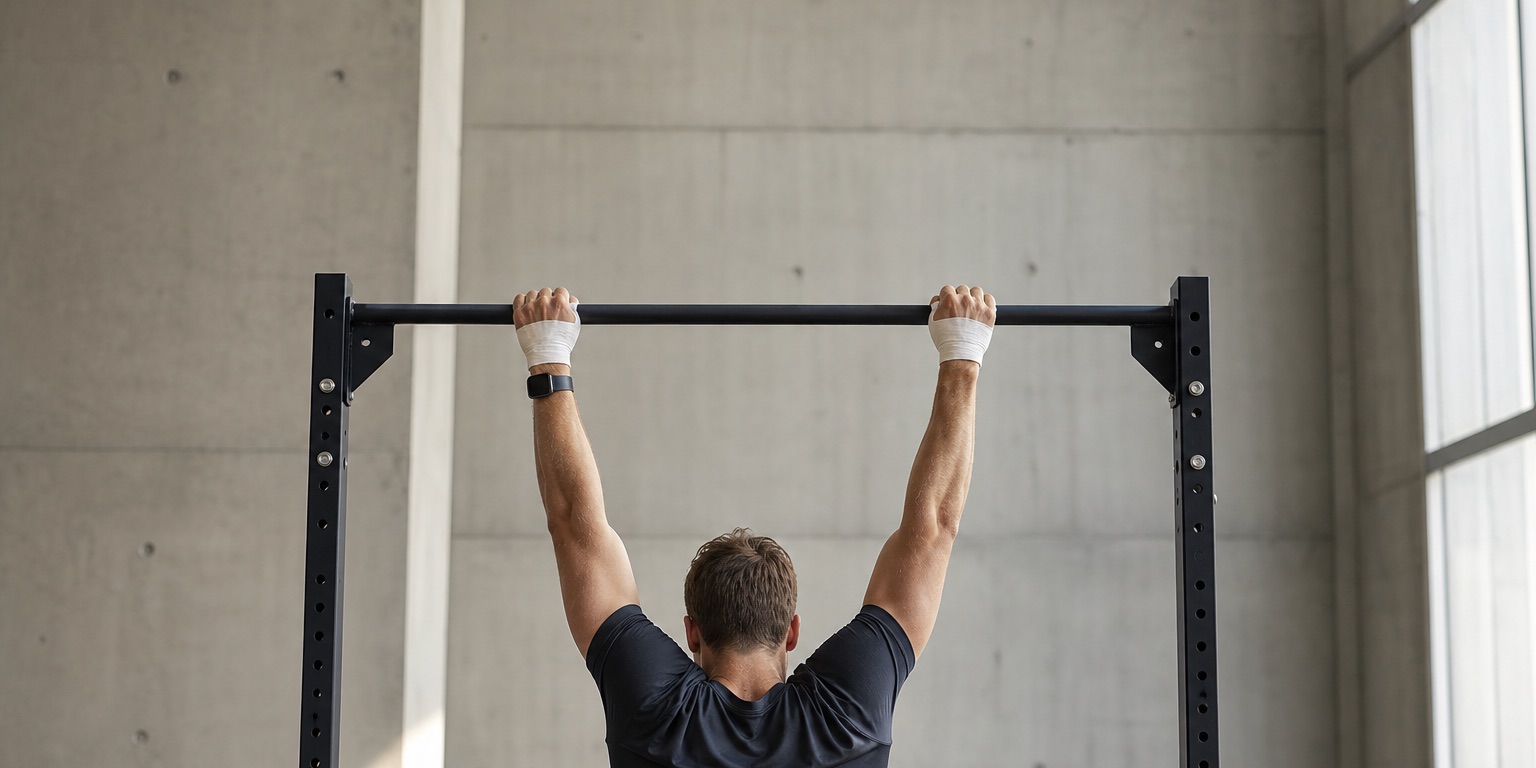
A dead hang tests how long your hands, forearms, shoulders, and trunk can support your body weight from a bar.
Why it matters
Your hands are the last link in almost everything you lift. Groceries up the stairs, a suitcase into an overhead bin, a child who wants to be carried one more block, a railing when the step is icy. When the grip gives out, the rest of the chain has nothing to do, however strong your legs are. A dead hang adds the shoulders and trunk to that picture: it asks whether you can support your own weight from a bar and stay composed while you do it.
Grip is also one of the plainest strength markers in the research on aging. The medians on this page peak in the thirties and are lower by sixty, and the drop tends to arrive sooner for people whose weeks no longer include carrying, hanging, or pulling. Hands and forearms respond to training at any age. They also lose it quickly when the loading stops.
How strong you feel is a poor guide. A good night of sleep, a coffee, or a bar with a different diameter can change the sensation without changing the capacity. One number, measured the same way on the same bar every month, does something feel cannot. It tells you whether the hangs and carries are working, whether a busy stretch cost you something, and whether a sore elbow needs attention before it turns into a reason to stop. That is the value of writing the seconds down instead of guessing.
What this test measures
Grip matters for carrying, lifting, climbing, and holding onto objects as you move. The dead hang is a useful at-home benchmark because it combines sustained hand and forearm work with shoulder stability and body control. It reports endurance in seconds without requiring specialized equipment.
Most published population research measures maximal grip force with a hand dynamometer, not hanging time. A British analysis combined 60,803 observations from 49,964 people. Median dynamometer strength peaked at 51 kilograms for men between ages 29 and 39, and 31 kilograms for women between ages 26 and 42.
Dynamometer force and dead-hang time are related ideas, but they are not interchangeable scores. Body weight, bar diameter, hand size, grip style, shoulder tolerance, and technique all influence how long a person can hang.
Do the test right now
- 1Choose a sturdy pull-up bar that you can reach and leave safely. Dry your hands and the bar. Chalk is allowed, but a towel or lifting straps are not.
- 2Place a phone stopwatch where you can see it or ask someone to time you. Take the bar with both hands and extend your arms to full length.
- 3Start the stopwatch when both feet leave the ground. Keep hanging without resting a foot, bending the arms to hold a partial pull-up, or shifting to straps.
- 4Stop when either hand lets go, your feet touch down, or your form breaks enough that you need to step off. Write down the completed time in seconds.
Use a low bar and clear the landing area. Stop if you feel pain, numbness, or shoulder instability. The goal is a repeatable measurement, not staying on the bar at any cost.
Reference bands
The published values below are selected dynamometer medians from the British life-course analysis. They provide age context for maximal handgrip force, but they do not predict a dead-hang time.
| Age | Men, median | Women, median |
|---|---|---|
| 25 | 48 kg | 30 kg |
| 40 | 50 kg | 31 kg |
| 60 | 45 kg | 27 kg |
Dodds, PLOS ONE, 2014. Values are age-specific medians measured with a dynamometer.
For a no-equipment field comparison, Gyroscope uses practical dead-hang bands. These are training guides, not published clinical norms. More than a minute is the band worth aiming for if the movement is safe and comfortable for your shoulders.
| Dead-hang time | Gyroscope practical band |
|---|---|
| Under 20 sec | Building |
| 20–45 sec | Fair |
| 45–60 sec | Good |
| Over 60 sec | Excellent |
Gyroscope practical bands for the app's dead-hang benchmark. Published dynamometer comparison: Dodds, PLOS ONE, 2014.
Grip strength is also a broad health marker. In the international PURE study, each 5-kilogram decrement in dynamometer strength was associated with a 16 percent higher hazard of death from any cause. The hazard ratio was 1.16, with a 95 percent confidence interval of 1.13–1.20. This association does not prove that a longer dead hang reduces mortality.
How to improve
Hanging time moves when the forearms get stronger and the shoulders learn to hold your weight overhead without strain. Both respond to small, regular doses of hanging and carrying, and both punish sudden jumps in volume.
- Hang often, short of failure. Two or three hangs of 15 to 30 seconds on most days, with a full rest between, beat one max effort. Stopping early lets you hang again tomorrow.
- Carry heavy things. Farmer carries with dumbbells or kettlebells, 30 to 40 meters per trip with the chest tall, train the grip under load while your trunk holds you upright. Add weight before you add distance.
- Pull. Rows, assisted pull-ups, and slow lowering from the bar build the back and rotator cuff that keep the shoulder stable in a hang. Pull the shoulder blades down slightly while you hang rather than letting the joint go slack.
- Vary the training bar, not the test bar. A thicker bar, a towel draped over the bar, or a hang with one hand doing most of the work loads the hands differently. Keep the test on the same bar with the same grip so the numbers compare.
- Give the tendons time. Grip work loads the elbow tendons, which adapt more slowly than muscle. Two hard sessions a week is plenty. An ache on the inside or outside of the elbow that lingers means back off, and if it stays, see a physiotherapist.
- Eat enough protein. Across 49 resistance-training trials with 1,863 participants, extra protein produced small additional gains in strength and lean mass. Keep a serving in each meal while you train.
Morton et al., British Journal of Sports Medicine, 2018
Retest once a month, on the same bar with the same grip, rested and with dry hands, and log the seconds in the app. The same protocol every time is what makes the line worth reading.
Track it
Log it in the app.
Download Gyroscope and run Grip Strength in about a minute. See how you compare to your peers, to the studies, and to your own baseline over time.
Download the appExplore membershipsBenchmarks are included in all premium memberships.