Gyroscope Benchmarks / Strength
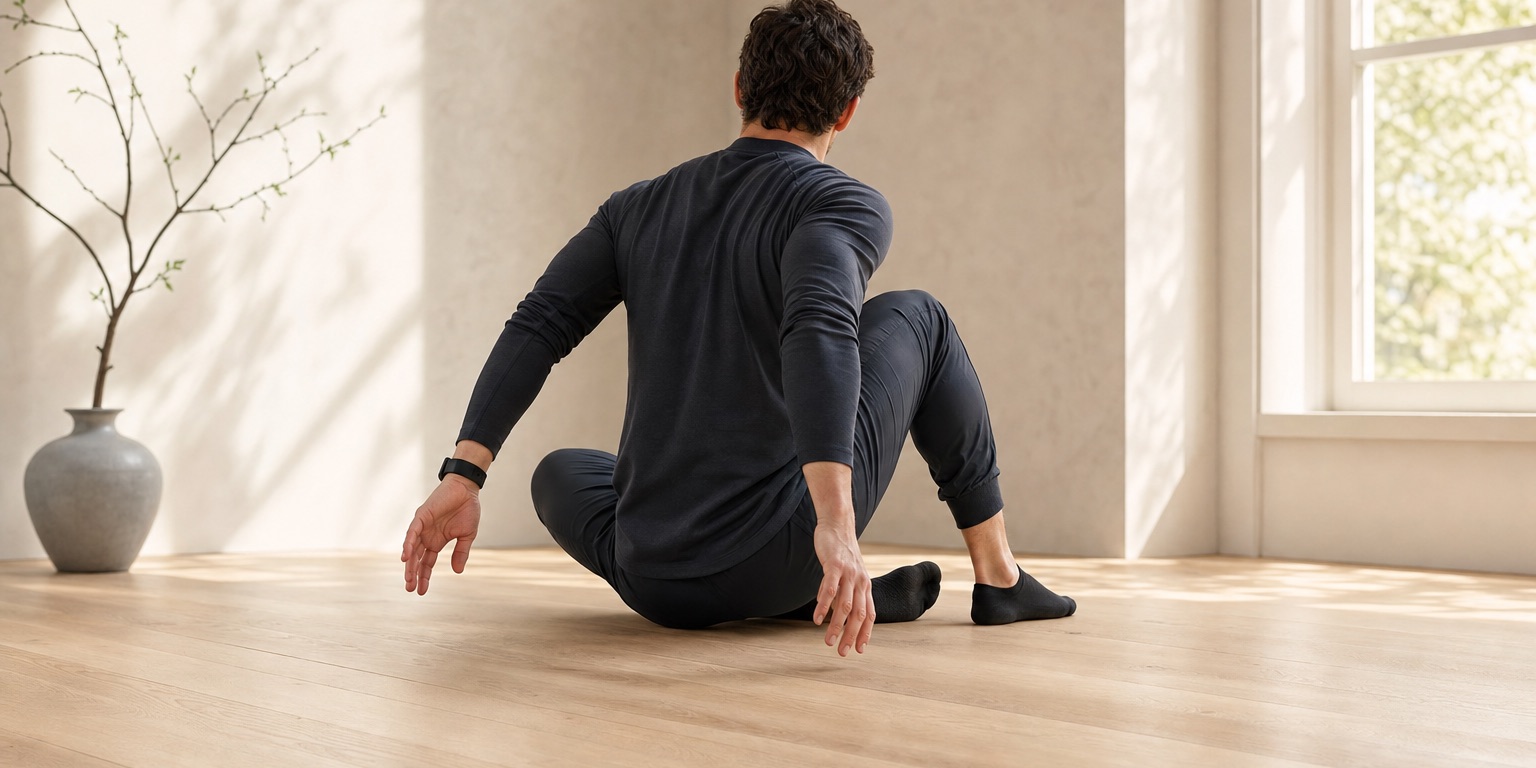
The sit-stand test: can you get up off the floor without your hands?
Sitting down and rising without support tests lower-body coordination, mobility, strength, and balance in one movement.
Why it matters
Getting down to the floor and back up is one of the plainest tests of whether your body still works as a unit. Sitting with a child, weeding a bed, standing up after a fall: all of it runs through this movement. It asks your hips and ankles to fold, your legs to produce force from a dead stop, and your balance to hold while your weight travels from the floor to your feet.
What tends to go first is not raw strength but range. Chairs, cars, and desks mean many adults spend decades without sitting on the ground, and the hips and ankles stiffen to fit the shapes they are given. The legs learn to push only through the last few inches of a stand. Then one day a hand goes to the floor before you have decided to put it there. The floor is also where falls end, and rising from one under your own power is much of what separates an inconvenience from an emergency.
How the movement feels is a poor gauge. You can float up on a good morning and brace on a knee on a tired one without registering it. Recording the same test the same way each month gives you a line instead: easily, with effort, only with support. A change of one step on that ladder shows up before daily life does, and it points to which piece, mobility, strength, or balance, to work on next.
What this test measures
Moving between standing and the floor requires hip and ankle mobility, leg strength, balance, and a coordinated path for your center of mass. The app uses a simple version: can you sit cross-legged and rise again without placing a hand, knee, or other support?
The published sitting-rising test is more detailed. In a cohort of 2,002 adults ages 51–80, 68 percent of whom were men, each direction began with 5 points. A point was deducted for each support, and a visible loss of balance cost half a point. Over a median 6.3-year follow-up, 159 participants died.
Brito, European Journal of Preventive Cardiology, 2014
Lower scores were associated with higher all-cause mortality after adjustment for age, sex, and body mass index. That does not make the test a diagnosis or prove that changing the score changes risk. It is a compact functional snapshot.
Do the test right now
- 1Clear a soft, non-slip area and stand barefoot. Keep a stable surface nearby if you are unsure, but do not use it unless needed for safety.
- 2Cross one leg in front of the other and lower into a cross-legged seat as smoothly as possible without placing a hand or knee on the floor.
- 3From the seated position, lean forward, bring your weight over your feet, and rise to standing without pushing on the floor, your leg, or nearby furniture.
- 4Record whether you completed both directions and whether it felt easy, effortful, or required support. Stop if the movement causes pain or feels unsafe.
Reference bands
The research version totals sitting and rising for a score from 0 to 10. A perfect 10 means no support and no visible imbalance. The study grouped scores as follows and used the highest group as its reference.
| Published total | Adjusted mortality hazard ratio |
|---|---|
| 8–10 | Reference |
| 6–7.5 | 1.84 |
| 3.5–5.5 | 3.44 |
| 0–3 | 5.44 |
Brito, European Journal of Preventive Cardiology, 2014
The app does not reproduce that 10-point research score. It records the simpler result and your difficulty note, using this practical ladder.
| App result | Practical read |
|---|---|
| Yes, easily | Clear unaided movement |
| Yes, with effort | Completed unaided |
| Only with support | Build the limiting capacity |
| No | Use a safer regression |
Brito, European Journal of Preventive Cardiology, 2014. Research context for Gyroscope's simplified practical ladder.
How to improve
This result moves when the limiting piece moves, and that piece is different for different people. Stiff ankles, hips that will not fold, weak quads, or a wobble on the rise each need their own work, so find yours first.
- Find the sticking point. Film one attempt. Dropping the last few inches into the seat usually means a mobility limit; tipping or stalling on the rise usually means a strength one. Train what you actually saw.
- Spend time on the floor. Sit cross-legged on the ground to read or watch something, and change position often. Time in the shape is the cheapest mobility work there is, and most adults get none of it.
- Own the bottom of the squat. Hold a deep squat with heels down for 30 seconds at a time, hands on a doorframe if you need them. Then lower slowly into the cross-legged seat with a fingertip on a chair, and use less of the chair each week.
- Build the rise. Slow chair stands with arms crossed, then from a lower seat, then split squats and step-ups. Three sets, twice a week, is enough.
- Free the ankles. Knee-to-wall drives and calf stretches, and squats with your heels on a book if they lift. The knees have to travel forward for your weight to reach your feet.
- Practice the transition itself. Once or twice a week, run the full movement with the least support you can manage, pausing for a second at the bottom and at the top. Balance improves by practicing the wobble. Pain in a knee or hip: see a physiotherapist first.
Retest once a month, on a rested day, barefoot on the same surface, both directions, and grade the effort with the same scale every time. Change the protocol and the line stops meaning anything; keep it and one step up the ladder counts.
Track it
Log it in the app.
Download Gyroscope and run Sit-Stand Test in about a minute. See how you compare to your peers, to the studies, and to your own baseline over time.
Download the appExplore membershipsBenchmarks are included in all premium memberships.