Gyroscope Benchmarks / Strength
Can you hold a deep squat?
A controlled deep squat checks how your ankle, hip, trunk, and balance work together at full depth.
Why it matters
A full squat is the shape you use to lift a child off the floor, weed a garden bed, sit on the ground at a picnic and get back up without a hand. Each of those asks your ankles to bend, your hips to fold, and your trunk to stay tall with your weight over your heels. Holding the bottom for 30 seconds tells you whether that shape belongs to you or is something you can only drop into and bounce out of.
Most adults lose it slowly and do not notice. Chairs, shoes with a raised heel, and long days of sitting shorten the calves and stiffen the ankles, so the heels lift at depth or the knees cave inward to make room. The hips tighten to match. Getting down to the floor and back up on your own is one of the plainest measures of independence later in life, and it starts with this range. Lose it at 40 and it is much harder to find again at 70.
Feel is a poor gauge here. A stiff morning or a good warm-up can change how the squat feels without changing what you can actually do. One test, same stance, same floor, barefoot, once a month, shows whether the range is holding, gaining or slipping. The app scores it against peers and against your own baseline, so a slow change shows up on the line while it is still easy to reverse.
What this test measures
Reaching a comfortable full-depth squat with heels down asks for ankle dorsiflexion, hip motion, trunk control, and balance. Holding the position adds endurance and reveals whether the shape is stable, not merely reachable for an instant.
The deep squat is also one of 7 movements in the Functional Movement Screen. A systematic review found 7 eligible injury-prediction studies and pooled 6 of them, covering 1,729 cases. The full screen was 24.7 percent sensitive and 85.7 percent specific, with an area under the curve of 0.58, only slightly better than chance for separating later injury from no injury.
Those figures apply to the entire screen, not this single squat. They support a clear distinction: a repeatable deep squat can track movement capacity, but it is weak as a stand-alone injury predictor and cannot identify structural dysfunction by itself.
Do the test right now
- 1Stand barefoot on a non-slip floor with feet about shoulder-width apart. Keep a wall or stable counter within reach if balance is uncertain.
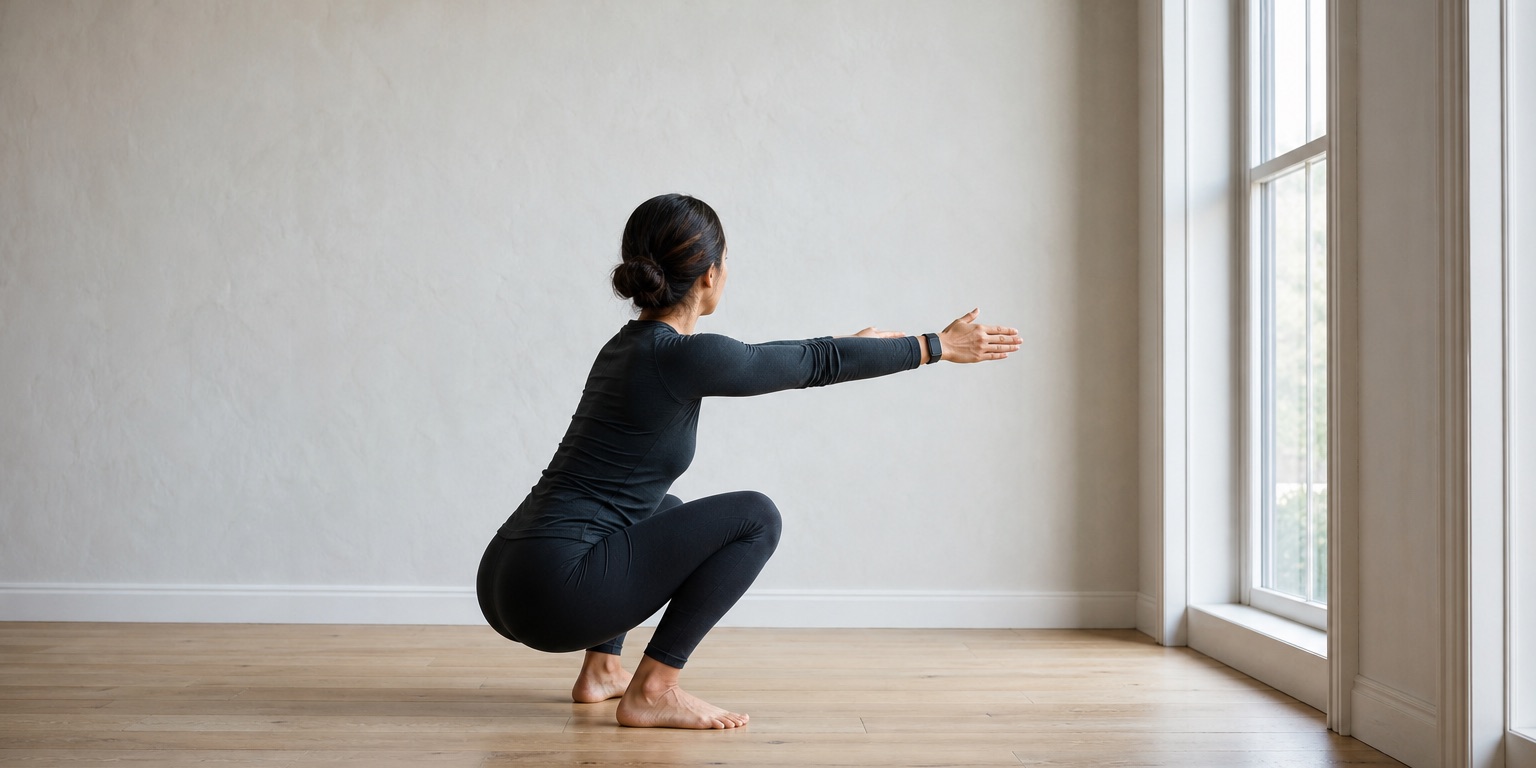
- 2Extend your arms forward and lower under control. Let the knees travel in line with the feet while keeping both heels grounded.
- 3Reach the deepest comfortable position with a controlled trunk. Start the phone timer and hold for at least 30 seconds without pain or instability.
- 4Stop if the heels lift, depth is lost, balance breaks, or pain appears. Record full depth yes or no, the completed seconds, and what limited the position.
Reference bands
There is no universal published hold-time norm for an unsupported deep squat. Gyroscope uses the practical movement bands below. They describe this exact barefoot protocol and are not clinical cutoffs.
| Result | Practical band |
|---|---|
| Full depth, heels down, 30+ s | Pass with ease |
| Full depth, under 30 s or wobbling | Partial |
| Heels lift or depth is limited | Mobility work zone |
| Pain | Stop and see a professional |
Dorrel, Sports Health, 2015. Movement-screen validity context for Gyroscope's practical squat bands.
Foot width and toe angle change the available shape, so keep them similar when retesting. A slightly different stance is not automatically wrong, and reaching depth by collapsing the knees or forcing through pain is not a better result.
How to improve
Depth comes from the joint that stops you, and the hold comes from time spent at the bottom. Find the limiter, then work on it for a few minutes most days; range responds to frequency more than effort.
- Find the limiter. Squat with your heels on a folded towel. If full depth appears at once, your ankles are the block; if not, look to the hips and trunk.
- Rock the ankles. Face a wall with one foot a hand's width away and drive that knee over the toes toward the wall, heel pinned to the floor. Ten slow reps a side, moving the foot back an inch as the wall gets easy.
- Rest at the bottom with support. Hold a doorframe, sink to full depth and let your arms take some weight. Breathe there for 30 to 60 seconds a few times a day, until it feels like a place to sit.
- Goblet squats, slow. Hold a light weight at your chest, take three seconds down and pause at the bottom. The weight in front lets you sit deeper with a tall trunk, and strength in that range makes the hold steady.
- Open the hips at depth. From the bottom, press your knees out with your elbows and shift side to side. This loosens the inner thighs and lets the pelvis drop.
- Free the upper back. A tall trunk at depth needs the upper spine to extend. Wall squats with your arms overhead, or a few minutes on a foam roller across the upper back, help the chest stay up. If any of this hurts, stop and see a physiotherapist.
Retest the same way each time: barefoot, same stance width, same floor, rested rather than after a heavy leg day, once a month. Then the line reflects your range and not the day.
Track it
Log it in the app.
Download Gyroscope and run Mobility Squat in about a minute. See how you compare to your peers, to the studies, and to your own baseline over time.
Download the appExplore membershipsBenchmarks are included in all premium memberships.