Gyroscope Benchmarks / Strength
How much should you be able to squat?
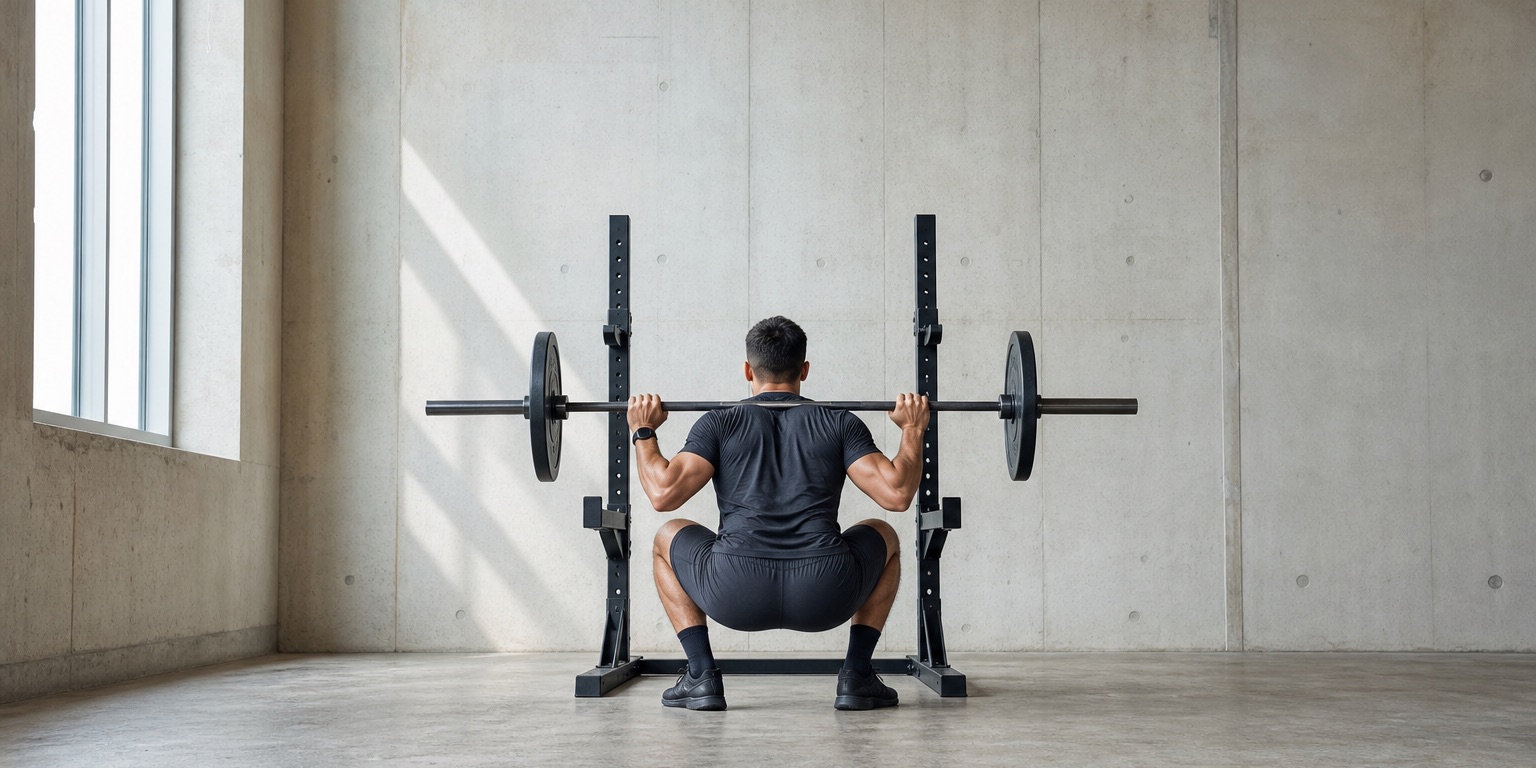
A controlled heavy squat tests lower-body strength through a repeatable range of motion.
Why it matters
Your legs do most of the lifting in an ordinary day. Standing up from a low chair, climbing stairs with the groceries, getting up off the floor, catching yourself on a slick step: each one is a squat with a different name. The muscles of the thigh and hip are also the biggest you have, so they take up more sugar from your blood, hold more of your balance, and carry more of the load when a knee or a back is having a bad week.
This strength drifts away when you stop asking for it. Muscle and force start falling in midlife and fall faster with every decade after, and the big muscles of the thigh go first. Most people do not notice it happening. Stairs get slower, the low couch becomes something to avoid, a heavy suitcase gets handed to someone else, and each of those reads as age rather than a number that could have been held.
Feel is a poor gauge for strength. A bar feels heavy on a tired day and light on a good one, and neither tells you whether you are stronger than three months ago. One heavy set, taken to the same depth with the same bar every month and converted to an estimated one-rep max relative to your body weight, gives you a single line. Watching that line rise, hold, or slip tells you what your training is doing, and whether the strength you are counting on is still there.
What this test measures
A squat asks the hips, knees, ankles, and trunk to produce and control force together. Expressing the result as an estimated one-repetition maximum relative to body weight makes changes easier to interpret than the load alone, while still depending on technique, depth, equipment, and training history.
A meta-analysis of 38 cohort studies included 1,907,580 participants and 63,087 deaths. Adults with higher knee-extension strength had a pooled all-cause mortality hazard ratio of 0.86 compared with adults with lower strength, an association described as 14 percent lower risk. Higher handgrip strength was also associated with lower mortality.
García-Hermoso, Archives of Physical Medicine and Rehabilitation, 2018
The lower-body measure in that review was knee extension, not a barbell squat. It supports strength as a useful capacity to track, but it does not turn a squat ratio into a clinical prediction or prove that a specific loading target changes health outcomes.
Do the test right now
- 1Use a rack with safety arms or an experienced spotter. Warm up through several lighter sets and choose a barbell or dumbbells you can control confidently.
- 2Squat to at least parallel depth with the feet stable, knees tracking with the toes, and trunk controlled. Use the same implement and depth when retesting.
- 3Perform one heavy set of 3–6 clean repetitions. Stop before technique changes, a repetition stalls, or the load becomes unsafe. A true maximum attempt is not needed.
- 4Log the weight and completed repetitions. The app calculates an estimated one-repetition maximum from that heavy set for your Leg Strength trend.
Reference bands
There is no universal published squat norm that transfers cleanly across sex, age, equipment, stance, depth, and training background. Gyroscope uses practical bodyweight-ratio bands for an estimated back-squat one-repetition maximum. They are training context, not requirements or medical cutoffs.
| Estimated 1RM | Practical band |
|---|---|
| Under 0.75× body weight | Building |
| 0.75–1.0× body weight | Fair |
| 1.0–1.5× body weight | Good |
| 1.5–2.0× body weight | Strong |
| Over 2.0× body weight | Elite |
García-Hermoso, Archives of Physical Medicine and Rehabilitation, 2018. Broader lower-body strength context for Gyroscope's practical squat bands.
Use your actual body weight from the same period and keep the squat variation fixed. A front squat, dumbbell squat, shallow repetition, and parallel back squat are different tests and should not share one trend line.
How to improve
Leg strength goes up when you squat regularly, add a little load over time, and give the muscle enough protein and sleep to rebuild. Two or three lower-body sessions a week, kept up for months, is what does it.
- Squat twice a week. Keep one main pattern, back squat or front squat, and practice it every session. The estimated max rises fastest when the movement is rehearsed, not only loaded. If you are new to the barbell, have a coach check your form.
- Add the smallest plate. Put more weight on the bar only when every rep of a set is clean, and hold the weight when it is not. Small steps you can repeat for a year do more than big jumps that stall in a month.
- Work sets of 3 to 8. Sets in that range build force better than sets of 15 while leaving room for full depth. Stop with a rep or two in reserve and save the near-limit effort for test day.
- Train one leg at a time. Split squats, lunges, and step-ups strengthen the weaker side, which is usually the side that gives out first under a heavy bar.
- Use pauses and slow descents. A two-second pause at the bottom, or a slow three-count on the way down, teaches control at the depth where most squats fail, and makes that depth easier to repeat when you retest.
- Eat enough protein. Across 49 resistance-training trials, extra protein produced small additional gains in strength and lean mass, so put a protein serving in most meals. If pain rather than fatigue ends a set, see a physio.
Morton et al., British Journal of Sports Medicine, 2018
Retest once a month, on a rested day, with the same bar, the same stance, and the same depth, and use your current body weight for the ratio. Change any of those and it is a different test, and the line stops meaning anything.
Track it
Log it in the app.
Download Gyroscope and run Leg Strength in about a minute. See how you compare to your peers, to the studies, and to your own baseline over time.
Download the appExplore membershipsBenchmarks are included in all premium memberships.