Gyroscope Benchmarks / Mind
Visual memory test: how many tiles can you hold?
This test measures how many spatial positions you can hold briefly and reproduce in the right order.
Why it matters
Tile Path measures a capacity you use all day without noticing it. Holding a few positions in order, briefly, is what lets you follow a route through an unfamiliar building, remember where you set the keys down while your hands were full, keep track of which burners are on, and finish a sequence of moves in a workshop or a game without checking the instructions again. Reading a map and then walking without it is spatial working memory. So is finding your car in a garage you left three hours ago.
It is also one of the first things to go when you are running on little sleep, when stress is high, or when a screen keeps pulling at your attention. Working memory tends to fade slowly with age as well, and the loss is hard to feel from inside: you do not notice the paths you can no longer hold, you notice the keys you keep losing and blame the day.
That is why one number, measured the same way, tells you more than a feeling. A span of six on a rested morning and a span of four after a week of short nights is a difference you can see, and it shows up on the chart before it shows up as a bad week. Tile Path gives you a tile count you can compare month to month, and against your own baseline, instead of an impression.
What this test measures
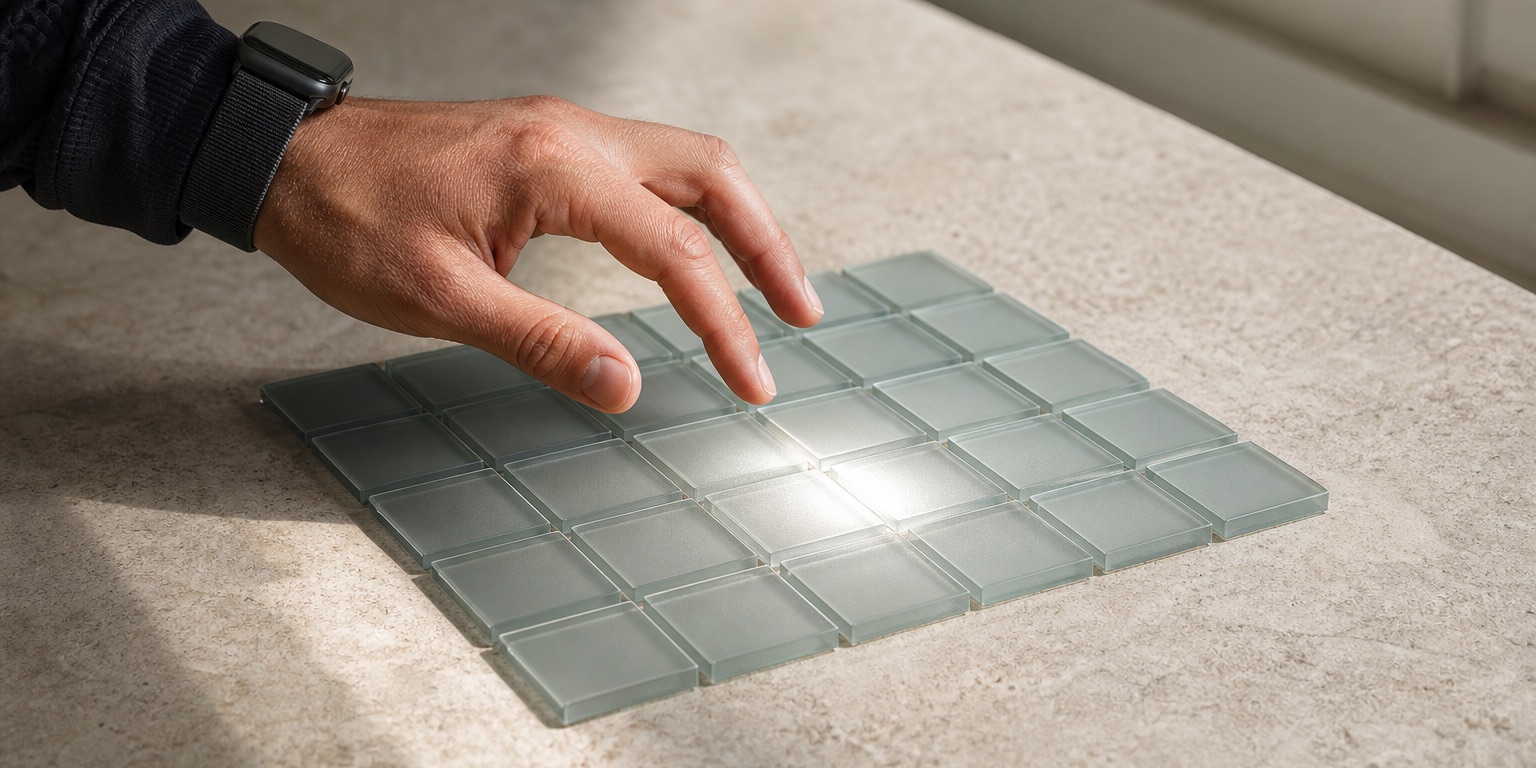
Tile Path is a digital version of the Corsi block-tapping task. Tiles light up one at a time, then you repeat the same path. Each success adds another position, turning a short sequence into an increasingly demanding visuospatial memory span.
The key result is span, the longest sequence you reproduce correctly. It reflects brief storage of spatial order, but performance also depends on attention, the exact display, the stopping rule, and familiarity with the task.
Kessels and colleagues standardized a nine-block version in 70 healthy participants and 70 people with cerebral lesions. The healthy group had a mean block span of 6.2 with a standard deviation of 1.3. Their paper also cautions against treating different procedures as interchangeable.
Do the test right now
- 1Open Tile Path in Gyroscope and place the phone where every tile is easy to see. A full run takes about 75 seconds.
- 2Watch the tiles light one by one. Do not tap until the sequence finishes.
- 3Repeat the path in the same order. A successful round adds another tile to the next sequence.
- 4Keep the longest path you reproduce correctly. One missed long path can be noise, so compare repeated runs rather than making a judgment from one attempt.
Reference bands
The standardized physical task averaged 6.2 blocks with a 1.3-block standard deviation. That is useful context, but Tile Path uses a phone display and its own sequence timing.
| Published sample | Block span |
|---|---|
| Mean | 6.2 blocks |
| Mean plus 1 SD | 7.5 blocks |
| Mean minus 1 SD | 4.9 blocks |
Kessels et al., Applied Neuropsychology, 2000. Healthy control data from Table 2.
Gyroscope's practical bands below are for repeated Tile Path runs. They are not clinical cutoffs.
| Tile Path span | Practical band |
|---|---|
| 7 or more | Strong |
| 5–6 | Typical |
| 4 or fewer | Low on repeated tries |
Kessels et al., Applied Neuropsychology, 2000. Research context for Gyroscope's practical bands.
What moves your score
Span can move with your state and with simple familiarity. Lim and Dinges reviewed 70 short-term sleep-deprivation articles containing 147 tests. Working-memory performance declined, while lapses in simple attention showed the strongest reported domain effect, Hedges's g -0.776.
Lim and Dinges, Psychological Bulletin, 2010
- Sleep loss and fatigue can weaken both attention and short-term retention.
- Practice helps you learn how to group positions into a path.
- Stress or illness can make a long sequence easier to lose.
- Screen size and sequence timing affect absolute span.
How to improve
Span moves when you stop treating the flashes as separate events and treat them as one route. The rest is conditions, and they matter more than you would guess. Ward and colleagues found that a phone on the desk, face down and silent, measurably reduced working memory and attention.
Ward et al., Journal of the Association for Consumer Research, 2017
- Chunk the path into shapes. A long sequence is easier to hold as two or three short pieces: a corner, a line across, a hop back. Decide where the breaks go while the tiles are still lighting up, not after.
- Give the route a direction. Say it under your breath as it forms: down, across, up, back. Naming the turns gives you a second copy of the path that survives a moment of doubt.
- Hold the whole grid in view. Keep your gaze near the center and let the flashes come to you. Chasing each tile with your eyes costs you the tile before it.
- Rehearse before you tap. Use the pause after the last flash to run the route once in your head, then tap at a steady pace. A rushed first tap is where most long paths fall apart.
- One screen, nothing else in reach. Run Tile Path on the phone in front of you with notifications off and any other device in another room. The test is short enough that a single buzz can cost the whole round.
- Stop while you are fresh. Three or four runs is plenty. Past that, attention fades and you start scoring tiredness instead of span.
Retest once a month, rested, with the same setup and the same stopping point. The app scores each run against peers and against your own baseline and saves it to your feed, so a line built from one protocol means something when it moves.
Track it
Log it in the app.
Download Gyroscope and run Tile Path in about a minute. See how you compare to your peers, to the studies, and to your own baseline over time.
Download the appExplore membershipsBenchmarks are included in all premium memberships.