Gyroscope Benchmarks / Mind
Visual search test: how fast do you spot the odd one out?
This test measures how quickly and accurately you find a target among visually similar distractors.
Why it matters
Finding the one thing that does not match is a skill you use all day without naming it. It is how you find your car in a full parking lot, the right bottle on a crowded shelf, a friend on a busy platform, or the one car ahead that is drifting into your lane. When search is fast, your eyes settle on the target before you can say why. When it is slow, you check candidates one at a time, and the cost is a few seconds you did not have.
Perceptual speed is one of the abilities that slows with age, and it slips on any day you are short on sleep, distracted, or worn down. The trouble is that you rarely feel the slip. In one study, two weeks of six-hour nights left people with deficits equal to two full nights without sleep, while they rated themselves only mildly impaired. Your sense of how well you are performing is a poor instrument. A timed search under fixed conditions is a better one.
Van Dongen et al., Sleep, 2003
That is what this test gives you: the same grids, the same phone, the same minute, once a month. One run says little on its own. A dozen runs across a year show whether your attention is holding, drifting, or recovering after a change you made, and they show it in numbers rather than in a feeling you cannot check.
What this test measures
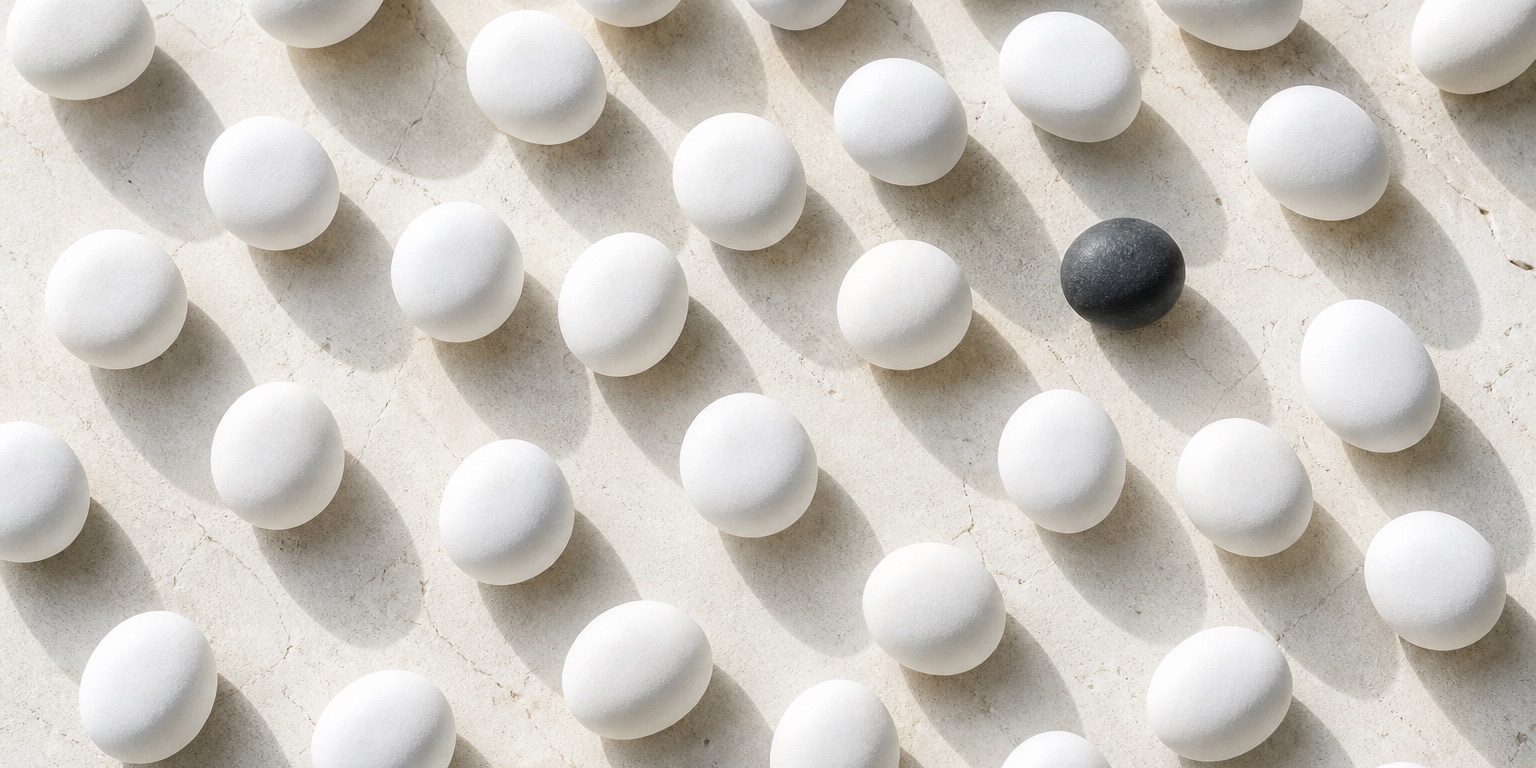
Oddball Hunt presents a grid of matching shapes with one that differs. Your job is to find and tap the odd one as quickly as possible while keeping errors low. Repeated rounds test perceptual speed and selective attention, not just one lucky find.
Search difficulty depends on what makes the target different. Treisman and Gelade's feature-integration experiments distinguished targets defined by one feature from targets defined by a conjunction of features. A single-feature target can stand out with little effect from additional distractors, while a conjunction may require focused attention to inspect candidates serially.
Treisman and Gelade, Cognitive Psychology, 1980
That is why raw reaction times do not transfer cleanly across visual-search games. Grid size, spacing, target similarity, target presence, and screen size all change the search. Oddball Hunt is best read through accuracy plus your own reaction-time trend under the same app protocol.
Do the test right now
- 1Open Oddball Hunt in Gyroscope and hold the phone at a comfortable, consistent distance. A run takes about 60 seconds.
- 2Scan each grid for the one shape that differs from the rest.
- 3Tap the odd shape once. If the difference is not immediately obvious, search systematically instead of guessing.
- 4Keep accuracy and reaction time across the full set of rounds. Do not judge the test by the fastest grid alone.
Reference bands
There is no standard visual-search norm table that survives changes in set size and target similarity. Gyroscope therefore uses practical accuracy bands for its own fixed task.
| Accuracy | Practical band |
|---|---|
| 95% or more | Locked in |
| 85–95% | Typical |
| Under 85% | Rushing or fatigued |
Treisman and Gelade, Cognitive Psychology, 1980. Research context for Gyroscope's practical bands.
Use reaction time as a secondary trend only after accuracy is stable. Faster taps with more wrong targets are not an improvement, and phone results should not be compared with a lab display that uses different stimuli.
What moves your score
Visual search draws on vigilance as rounds accumulate. A meta-analysis of short-term sleep deprivation included 70 articles and 147 tests. Lapses in simple attention showed the strongest domain effect, Hedges's g -0.776, while complex attention was also degraded.
Lim and Dinges, Psychological Bulletin, 2010
- Sleep loss and fatigue can add slow or missed searches.
- Practice teaches the task's recurring feature differences.
- Stress can encourage a fast guess before the target is confirmed.
- Screen size, brightness, and viewing distance change absolute speed.
How to improve
Two things raise this score: a search pattern you can repeat without thinking, and the habit of confirming the target before your finger moves. Speed follows from both, and it rarely arrives if you chase it directly.
- Fix the pattern. Begin at the center and sweep outward in the same path every round, so no cell is checked twice and none is skipped. A path you do not have to plan leaves your attention free for the shapes.
- Name the difference first. Before you scan, decide what could be different: orientation, size, a gap, a color. A target defined by one feature tends to jump out, so knowing what to look for turns a slow inspection into a quick one.
- Confirm, then tap. A wrong tap costs more than a slow one. When a candidate catches your eye, glance at its neighbors once before committing.
- Clear the screen. Sit where there is no glare, turn brightness up to a comfortable level, and hold the phone at the distance you always use. Small differences are the first casualty of a dim or reflective screen.
- Check your eyes. If small differences look soft at arm's length, get an eye exam. An old prescription makes every grid harder than it should be.
- Slow down in the hard rounds. When a grid does not resolve in a second, let it take three. Accuracy under 85% usually means rushing, and the fix is patience, not more speed.
Retest once a month, rested and at the same time of day, under the same light and at the same distance. Keep the protocol fixed so the line on your feed reflects your attention and not the room.
Track it
Log it in the app.
Download Gyroscope and run Oddball Hunt in about a minute. See how you compare to your peers, to the studies, and to your own baseline over time.
Download the appExplore membershipsBenchmarks are included in all premium memberships.