
Resting Heart Rate
What your heart does when you do nothing, and why it is one of the most predictive numbers your body reports.
Your heart beats about 100,000 times a day. Ten fewer beats a minute is 14,000 fewer a day and five million fewer a year. Across studies of more than a million adults, that ten-beat gap tracks with about 9% lower risk of death from any cause.
Few numbers your body reports are that easy to measure and that predictive. It is measured overnight from a watch or ring, so there is nothing to log.
What it is
Resting heart rate is how many times your heart beats a minute at complete rest. In practice, that is the lowest sustained rate overnight.
A fit heart pumps more blood with each beat, so it needs fewer beats to do the same work. That is why the number falls as you get fitter. It rises when the body is under strain: illness, alcohol, poor sleep, heat, hard training.
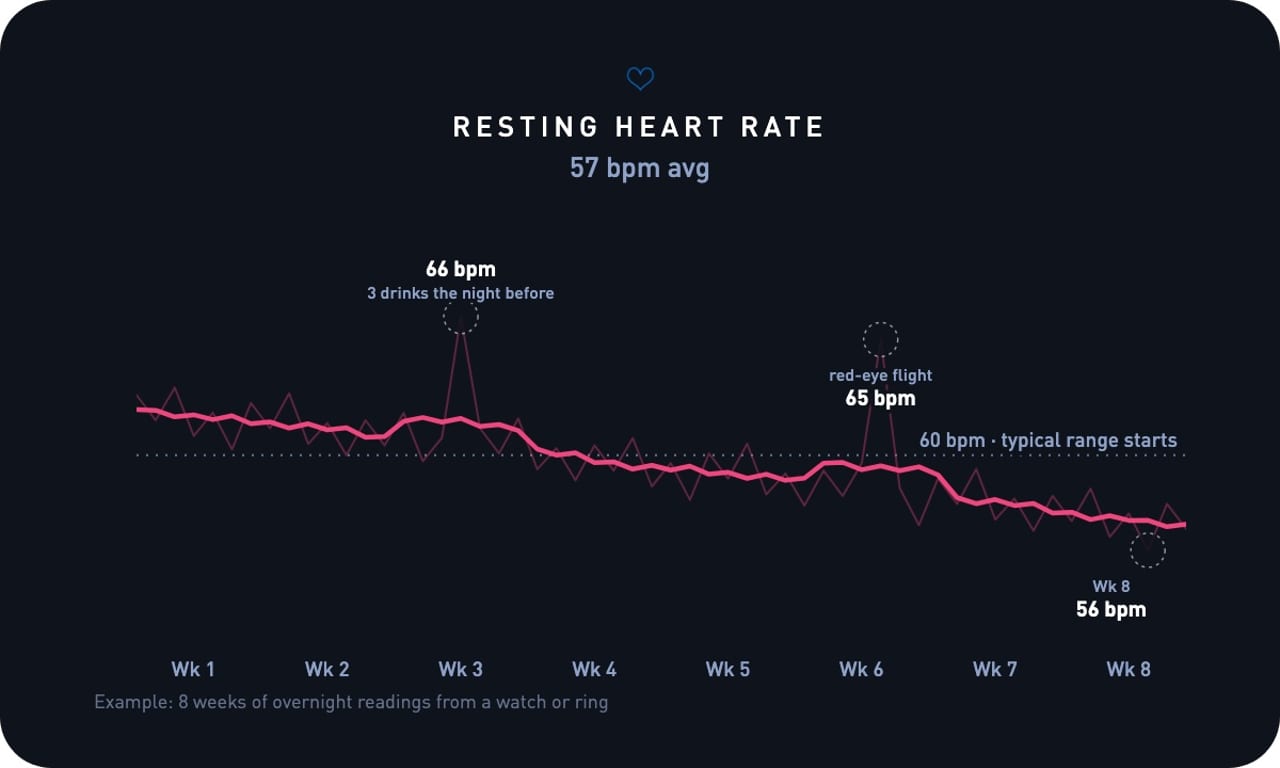
In the chart above, the thin line is each night and the bold line is the weekly average: 62 down to 57 over eight weeks, with two spikes that each have a reason. The drift is the signal. The spikes are the story of the night before.
Why it matters for your goals
If you want to lose weight
Resting heart rate is the quiet scoreboard for the habits that make fat loss work: consistent sleep, less alcohol, and regular easy cardio all push it down within weeks. When it drifts up during a diet, you are usually under-recovered, and under-recovered people eat more.
If you want more energy and focus
A high morning reading is an early warning that today is not a day for heroics. It rises a day or two before you feel a cold, after a late night, or after drinks. Seeing it lets you plan the day instead of fighting it.
If you want to live longer
Across more than a million adults, every ten beats lower tracks with about 9% lower risk of dying from any cause. It is one of the few longevity markers you can move in a month.
Where people land
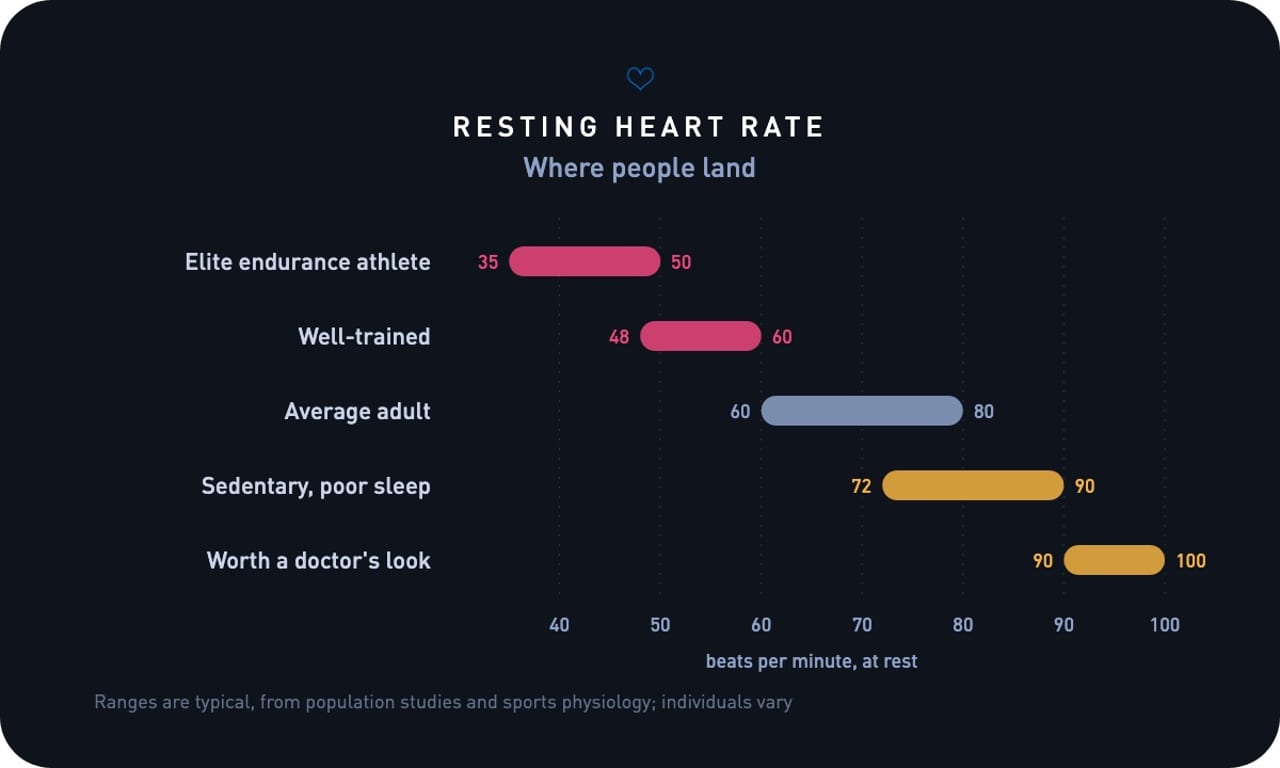
| Elite endurance athlete | 35 to 50 |
|---|---|
| Well trained | 48 to 60 |
| Average adult | 60 to 80 |
| Sedentary | 72 to 90 |
| Above 90 | worth a doctor's look |
The ranges overlap: a 58 can be a fit 50-year-old or an average 25-year-old. What matters is your own number over time. Going from 76 to 64 in a year of easy running is a real change, whichever row you started in.
What the research found
Resting heart rate has been measured in very large groups of people and followed for decades. The same pattern shows up each time.
A 2016 meta-analysis of 46 studies and about 1.2 million adults: each 10 beats-per-minute increase in resting heart rate was associated with roughly 9% higher risk of death from any cause, and 8% higher risk of cardiovascular death. (Zhang et al., CMAJ, 2016). It is a slope, not a threshold. 75 to 65 is a meaningful move even though both are normal.
In a Norwegian cohort of 29,325 adults, a rise in resting heart rate from below 70 to above 85 bpm across two measurements about ten years apart was associated with a 90% higher risk of death from ischemic heart disease than remaining below 70 bpm. (Nauman et al., JAMA, 2011). The direction of your own line over years is information by itself. That is why the trend beats any single reading.
A 2018 analysis of 4,098 nights from 246 adults found that alcohol raised heart rate and lowered HRV during the first hours of sleep at every dose measured, including low intake, and the effect grew with the amount. It held across ages and fitness levels. (Pietilä et al., JMIR Mental Health, 2018). The fastest experiment you can run: two nights with drinks, two without. Compare the mornings.
What moves it
Down, over weeks. Easy aerobic work, three or four times a week at a pace you can talk through. A consistent bedtime and wake time. Less alcohol. No caffeine after early afternoon. Losing excess weight. Staying hydrated.
Up, within a night or two. Alcohol. A cold or flu, a day or two before you feel it. A hard training block. Short sleep. Dehydration, heat, jet lag, stress. A jump of 5 to 10 beats overnight is common and almost always has one of these behind it.
This week. Pick one lever. A caffeine cutoff eight hours before bed is the easiest. Two dry nights is the fastest. Read the mornings after. Give a lasting change three or four weeks to show in the weekly average.
Everything known to move it
The literature on resting heart rate is unusually consistent. These are the levers with the best evidence, grouped by where they live in your day. Lowers is good for almost everyone; raises is the body under load.
Training
| Easy aerobic base | lowers | The largest lever. Regular zone 2 work lowers resting rate by 5 to 10 beats over months as stroke volume rises. Mandsager et al., JAMA Network Open, 2018 |
|---|---|---|
| Hard training block | raises | A few beats for a day or two after very hard sessions; a sustained rise means under-recovery. Kiviniemi et al., European Journal of Applied Physiology, 2007 |
| Strength training | lowers | Smaller effect than cardio, but it adds up with consistent sessions. |
Sleep
| Short or broken sleep | raises | A late night shows up as a higher reading the same night and the next. Van Dongen et al., Sleep, 2003 |
|---|---|---|
| Consistent bed and wake time | lowers | Regular timing lowers the night-to-night swings as much as the average. Windred et al., Sleep, 2024 |
Nutrition
| Alcohol | raises | Every dose measured raised overnight heart rate; more drinks, bigger effect. Pietilä et al., JMIR Mental Health, 2018 |
|---|---|---|
| Caffeine late in the day | raises | Through worse sleep more than a direct effect; a cutoff eight hours before bed removes it. Gardiner et al., Sleep Medicine Reviews, 2023 |
| Late large meals | raises | Digestion keeps the heart working into the first hours of sleep. Kinsey & Ormsbee, Nutrients, 2015 |
| Dehydration | raises | Lower blood volume means more beats for the same output; several beats on a hot or dry day. |
| Losing excess weight | lowers | Less tissue to supply and better fitness usually come together. |
Lifestyle and environment
| Heat and altitude | raises | Hot rooms and new altitude both push it up until you acclimatize. |
|---|---|---|
| Stress and jet lag | raises | Sympathetic load shows overnight before you feel it during the day. |
| Illness | raises | A rise of 5 to 10 beats often arrives a day or two before symptoms. |
| Slow breathing and meditation | lowers | Small but real in the moment; the overnight effect comes through better sleep. |
Supplements and medical
| Stimulants and decongestants | raises | Pre-workout, nicotine, pseudoephedrine and similar all raise it while active. |
|---|---|---|
| Beta blockers | lowers | Prescribed to lower it; the trend is still useful, but compare only to your own baseline on the medication. |
| Thyroid | mixed | An overactive thyroid raises it, an underactive one lowers it. A persistent unexplained shift is worth a blood test. |
Gyroscope runs these correlations on your own data: open the trend, tap a spike, and the coach reads the night before.
Targets to aim for
| Good | Under 60, or a steady decline from wherever you started |
|---|---|
| Great | Low 50s or below, with small night-to-night swings |
| Watch | Above 80 at rest, or a jump of 10 or more beats overnight |
| See a doctor | Staying above 90 with no clear cause, or a steady rise over weeks |
Practical ways to improve it
- Three or four easy aerobic sessions a week at a pace you can talk through. This is the single biggest lever over months.
- Keep bedtime and wake time within an hour, including weekends.
- Finish caffeine eight hours before bed and try two alcohol-free nights a week. Read the mornings after.
- Drink water through the day. Dehydration adds several beats.
- After a hard training block or a cold, take the easy day the number is asking for.
How to track it
Resting heart rate is an overnight measurement, so it needs a device you sleep in. Any watch or ring that records heart rate during sleep will do. Chest straps and gym wearables that come off at night will not give you a resting value.
If you have no wearable, the old way still works: count your pulse for 30 seconds right after waking, before you sit up, and double it. It is noisier than an overnight reading, but the trend over weeks is still real.
| Apple Watch | Automatic through Apple Health |
|---|---|
| Oura, Garmin, Fitbit | Direct integration in Settings |
| Whoop | Through Apple Health |
| No wearable | Count your pulse on waking and log it manually |
How Gyroscope tracks it
Wear your wearable to bed and Gyroscope does the rest. It takes the overnight heart rate from Apple Watch, Oura, Whoop, Garmin, or Fitbit, finds the true resting value each night, and charts it against your own baseline. If you have worn the device for a while, the history comes in with it and the trend is there on the first morning.
Your reading shows up in your Sleep Score each morning with context for your baseline: normal for you, higher than usual, or lower. On the Trends tab it sits next to sleep, HRV, and alcohol, which is where the explanation usually is. Ask the coach about a high morning and it reads those together and tells you what most likely moved it.
It needs about ten nights before the trend line is meaningful. Different devices read a few beats apart, so compare yourself over time rather than against someone on a different watch.
Works with Apple Watch, Oura, Whoop, Garmin, Fitbit.
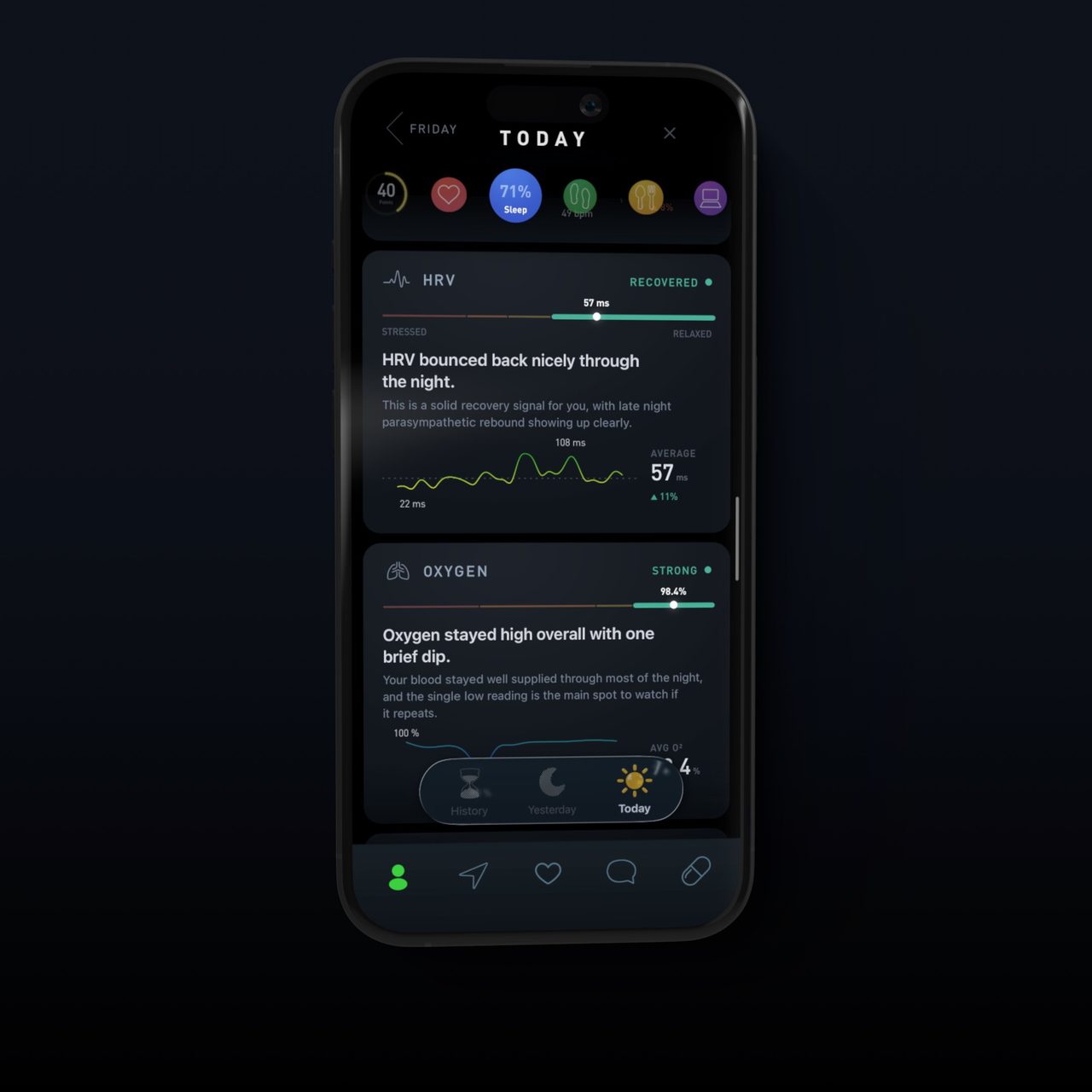
Every morning I am reviewing my sleep score in Gyroscope. I have already made several connections between my behavior and resting heart rate and peak HRV.
Timo, Gyroscope member
Questions people ask
- Do I need a wearable?
- Yes. It is an overnight measurement, so any watch or ring that records heart rate while you sleep works.
- How many nights before it means anything?
- About ten. Read the weekly average rather than last night.
- When should I talk to a doctor?
- A resting rate that stays above 90 with no clear cause, or a steady rise over weeks you cannot explain. Bring the chart.
- Is lower always better?
- Down to the 50s, generally yes. Below the 40s is normal only for trained endurance athletes, and any low rate with dizziness or fainting needs a doctor.
Track your Resting heart rate
Included in the free app. Download Gyroscope, connect your device, and the trend builds itself.
Get Gyroscope