
Last Meal Time
Did dinner push your bedtime later? A small number with a long reach.
Your body has two jobs at night: digesting and repairing. A big meal at 10pm means it is still on the first one when it should have moved to the second.
A review of nighttime eating found large mixed meals late at night associated with worse outcomes, while small snacks of roughly 150 calories were often neutral and sometimes useful. Size and timing both matter.
Last meal time is when you finished eating each day, from the meals you photograph, next to how you slept. It is one of the easiest things to change once you can see it.
What it is
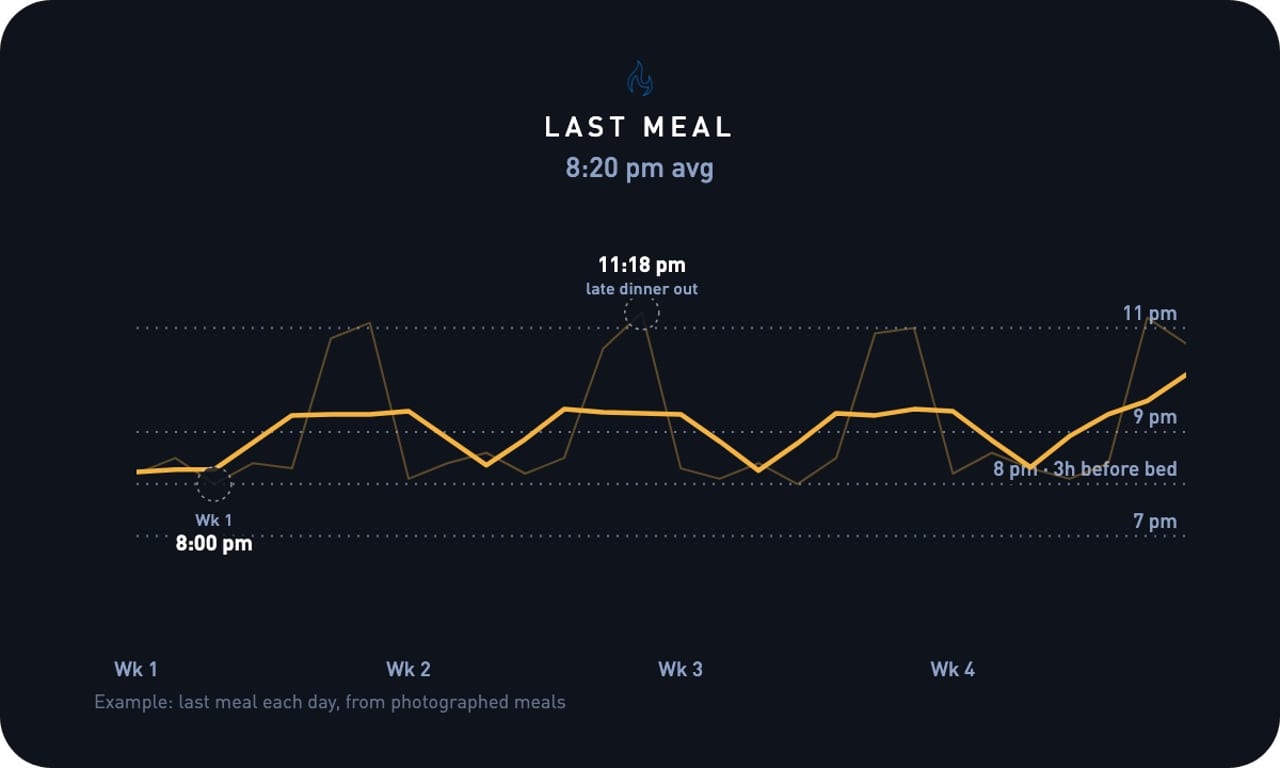
Last meal time is the clock time of the last food you logged each day. The trend is that time over weeks, with the nights read against it.
Late, large meals are linked to lighter and more broken sleep, more reflux, and a higher overnight heart rate, because your body is digesting when it would rather be repairing. A big mixed meal at 10pm is not the same as a small snack at 9. The gentle rule that fits the evidence is to finish larger meals about two to three hours before bed.
The chart above is a typical month: dinner done by 8:20 on weeknights, and two nights a week finished at 10:30 or 11 after eating out. Those are also, not coincidentally, the nights that show up worst on the sleep and resting heart rate charts.
Why it matters for your goals
If you want to lose weight
An earlier last meal closes the eating day, which is where late snacking lives. In a trial where adults simply ate within a 10-hour window for 12 weeks, without changing what they ate, they lost about 3% of body weight and 4% of waist. Finishing dinner is most of that window.
If you want to sleep better
The late dinners are the nights your sleep score and morning heart rate are worst. Moving dinner earlier by half an hour is a smaller change than most sleep advice and often a bigger one.
If you want more energy and focus
A body that finished digesting before bed wakes up ready. The morning after a late heavy meal usually reads like a mild hangover on the charts, and feels like one by mid-afternoon.
Where people land
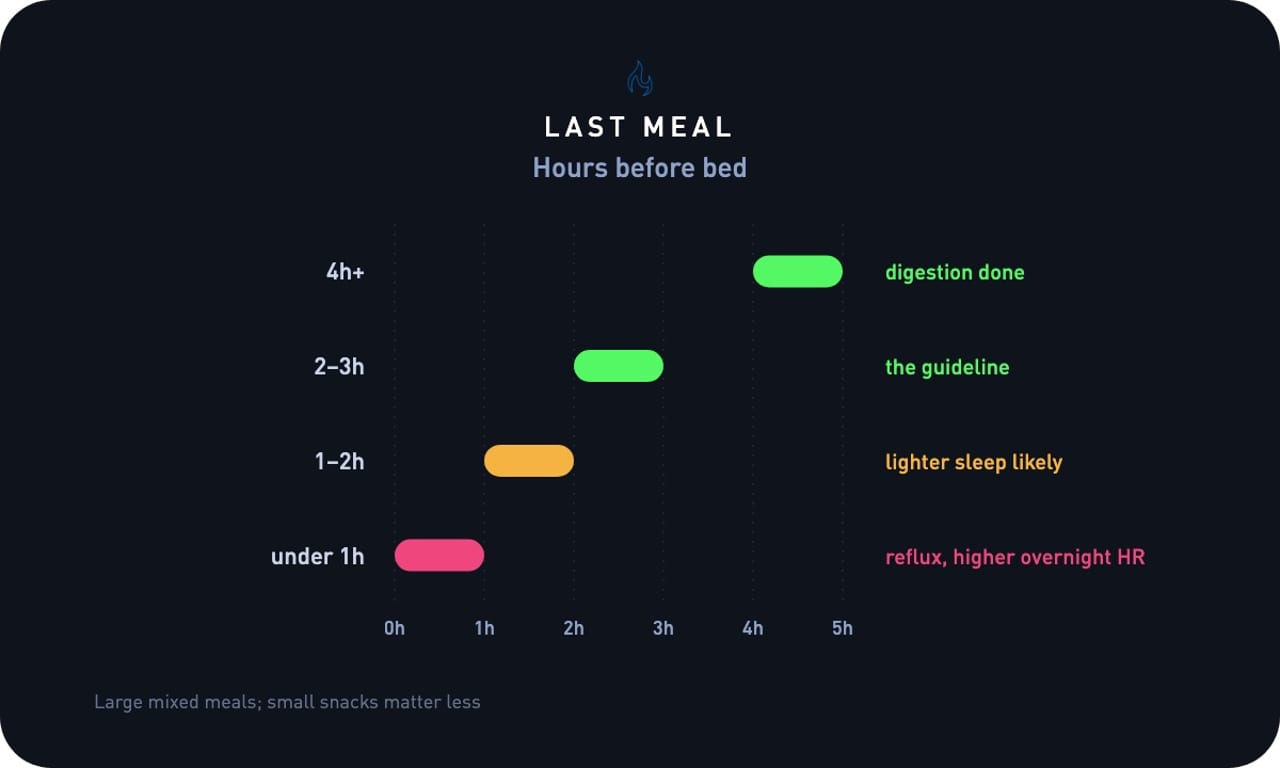
| 3 or more hours before bed | digestion mostly done before sleep |
|---|---|
| 2 to 3 hours | the gentle rule; fine for most meals |
| 1 to 2 hours | fine for a small snack, not a full dinner |
| Under an hour | the nights that show up on the sleep chart |
The gap to bedtime matters more than the clock time. A 9pm dinner before a midnight bedtime is a 3-hour gap; the same dinner before a 10pm bedtime is not.
What the research found
Meal timing has been reviewed across many groups and tested in trials where the food stayed the same and only the clock changed.
A 2015 review of nighttime eating found that large mixed meals eaten late at night were associated with worse outcomes in several groups, while small snacks of roughly 150 calories were often neutral and sometimes useful. (Kinsey & Ormsbee, Nutrients, 2015). A late small snack is not the problem. A late full dinner is. The chart shows which kind your late nights are.
In a 2020 pilot trial, 19 adults with metabolic syndrome ate within a 10-hour window for 12 weeks without other diet changes. On average they lost about 3% of body weight and 4% of waist circumference, with lower blood pressure and LDL cholesterol. (Wilkinson et al., Cell Metabolism, 2020). Finishing dinner earlier is the easy half of a 10-hour window, and the trial changed nothing else.
What moves it
Later, without deciding it. Eating out. Late meetings. A long gap between lunch and dinner so dinner runs late and large. Dessert or a snack after a finished dinner, which resets the time.
Earlier, this week. Move dinner earlier by half an hour, or make the late one smaller. A proper lunch so dinner does not have to carry the day.
How to test it. Give it three or four nights before you decide anything, then look at sleep score, time to first REM, and morning resting heart rate on the same days. If nothing changes, this is not your lever and you can stop worrying about it.
Everything known to move it
Last meal time is a clock, so lowers here means earlier and raises means later. Most of the levers are not about food at all; they are about the shape of the day that pushes dinner back.
Nutrition
| Size of the last meal | lowers | A large mixed meal late was linked to worse outcomes; a small snack of about 150 calories was often neutral. Kinsey & Ormsbee, Nutrients, 2015 |
|---|---|---|
| A proper lunch | lowers | Dinner runs late and large when lunch was skipped; a real midday meal takes the pressure off the evening. |
| Dessert or a snack after dinner | raises | Anything after a finished dinner resets the last-meal time, often by an hour or more. |
| A fixed eating window | lowers | Adults who narrowed to a 10-hour window for 12 weeks lost about 3% of body weight with no other change, and an earlier dinner is most of that window. Wilkinson et al., Cell Metabolism, 2020 |
| Drinks in the evening | raises | Alcohol tends to come with late food, and both land on the same night. |
Sleep
| Gap to bedtime | lowers | The hours between finishing and lying down matter more than the clock time; two to three hours is the gentle rule. |
|---|---|---|
| A later bedtime | raises | Going to bed later quietly gives permission for a later dinner, and the next morning pays for both. |
| Consistent sleep schedule | steadies | A regular bedtime holds dinner in place; the most regular sleepers had 20 to 48% lower mortality risk. Windred et al., Sleep, 2024 |
Training
| Evening workouts | raises | A 7pm session pushes dinner to 9; moving training earlier or eating before it fixes the time. |
|---|---|---|
| Post-workout appetite | raises | A hard late session makes the late meal larger as well as later. |
Lifestyle and environment
| Eating out | raises | Restaurant dinners finish an hour or two later than home ones and are larger; these are the nights that read worst. |
|---|---|---|
| Late meetings and commutes | raises | The workday that ends at 7 makes dinner at 9 the default unless something is prepped. |
| Long daylight and summer | raises | Evenings stretch and dinner drifts with them; winter pulls it back. |
| Logging every meal | lowers | People who kept food records six or more days a week lost about twice as much as those who rarely did; seeing the time is half the change. Hollis et al., American Journal of Preventive Medicine, 2008 |
Medical
| Reflux | lowers | Lying down with a full stomach is the classic trigger; earlier and smaller dinners are the first thing a doctor suggests. |
|---|---|---|
| Diabetes medication and shift work | mixed | Meal timing is tied to dosing and to sleep timing, so changes should go through a doctor rather than a chart. |
Gyroscope runs these correlations on your own data: tap a bad night and the last meal time is right there, so the late-dinner nights stop being a theory.
Targets to aim for
| Good | Larger meals finished 2 to 3 hours before bed on most nights |
|---|---|
| Great | A steady last-meal time within an hour, weekends included |
| Watch | Full meals within an hour of bed more than twice a week |
| Talk to a doctor | Reflux or broken sleep that persists after moving dinner earlier |
Practical ways to improve it
- Finish larger meals about two to three hours before bed. That is the whole rule.
- If dinner has to be late, make it smaller. A snack of roughly 150 calories late is often neutral; a big mixed meal is not.
- Eat a real lunch. Most late, oversized dinners start with a skipped one.
- Move dinner earlier by half an hour for a week and read the sleep score and morning heart rate on those days.
- Remember that dessert and the late snack count as the last meal, not the dinner before them.
How to track it
Last meal time comes from the meals you log, so it is only as accurate as the log. Photograph dinner and any snack after it; the latest one becomes the day's last meal time.
The sleep side comes from any watch or ring you sleep in. Without a wearable, the trend still shows your timing and you can read it against how the mornings felt.
| Meal photos in Gyroscope | Photograph dinner and late snacks; the time is logged automatically |
|---|---|
| Manual entry | Add a meal from the food tab when there is no photo |
| Apple Watch, Oura, Whoop, Garmin, Fitbit | Supply the sleep it is charted against |
| No wearable | Log meals and compare against your morning energy rating |
How Gyroscope tracks it
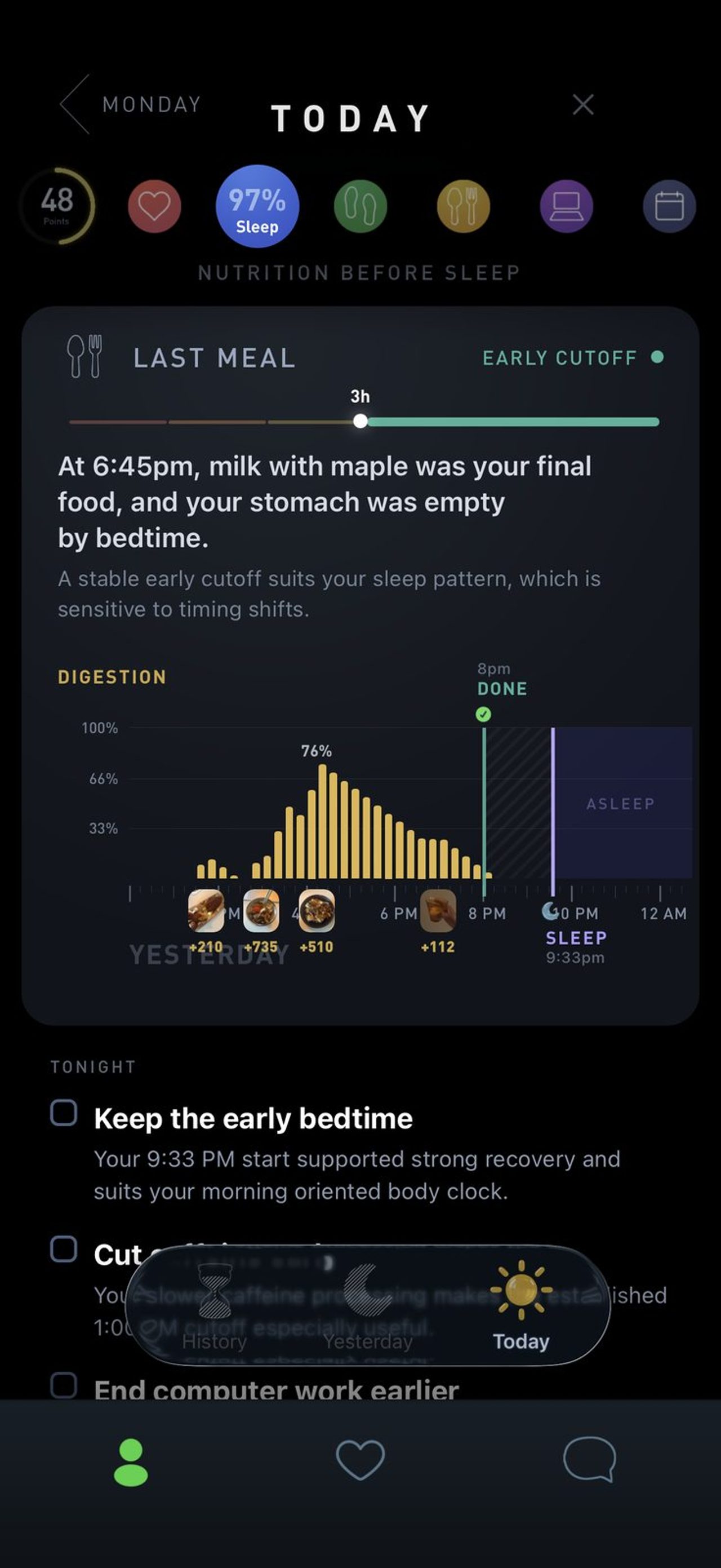
Photograph your meals and Gyroscope takes the last one each day as your last meal time. The Sleep Score screen shows it as a gap to bedtime, with a digestion curve so you can see how much of dinner was still being processed when you fell asleep.
On the Trends tab it sits next to sleep score, time to first REM, and resting heart rate. Ask the coach about a poor night and it checks the dinner time first.
Two weeks of logging is enough for the weekly line to mean something. The late outliers are usually obvious in the first week.
Works with Apple Watch, Oura, Whoop, Garmin, Fitbit.
Questions people ask
- Is a late snack as bad as a late dinner?
- No. The review of nighttime eating found small snacks of roughly 150 calories often neutral, while large mixed meals late at night were associated with worse outcomes.
- What time should I stop eating?
- It depends on your bedtime, not the clock. Aim to finish larger meals two to three hours before bed.
- I eat out late a lot. What then?
- Make the late meal smaller, skip dessert, and watch the following morning. Two late nights a week is a pattern you can see and plan around.
- Do I need a wearable?
- Not for the timing, which comes from your meal photos. A watch or ring adds the sleep and heart rate so the chart shows the effect.
Track your Last meal
This is one of the advanced trends in Gyroscope One, along with the AI coach that reads it for you every morning.
Unlock with Gyroscope OneGet the app