
Blood Pressure
The number a doctor checks first and most people check once a year. Thirty seconds at home, once a week, tells you more.
Your heart pushes blood around the body about 100,000 times a day, and the pressure in the arteries during each push is the one number most doctors check before anything else. Most people hear it once a year, in a clinic, after a walk from the car park and a wait in a chair.
A home cuff reads it in thirty seconds. Taken the same way once a week, it builds a line that a single clinic reading never gives you: which way it is going, and what moved it.
What it is
Blood pressure is two numbers in millimetres of mercury: the pressure when the heart beats (systolic, the top number) and the pressure between beats (diastolic, the bottom). 120 over 80 means 120 mmHg at the beat and 80 mmHg between.
It moves all day. It is higher in the morning, after coffee, after a stressful call, and in a clinic. It is lower after a walk, in the evening, and at home. That is why one reading means little and a weekly reading taken the same way means a lot.
Sustained high pressure makes the heart work harder and slowly damages the arteries, kidneys, and eyes, without any symptoms until late. Sustained low pressure, unless it brings dizziness, is usually a sign of fitness rather than a problem.
Why it matters for your goals
If you want to lose weight
Blood pressure is one of the first numbers to move when weight comes off, often before the scale shows much. It is also the honest read on what the weight is doing to you: a few kilos lost on a shortened eating window showed up as lower blood pressure in a 12-week trial. When your cuff reading drops during a diet, the diet is working on the part that matters.
If you want more energy and focus
High pressure has no feeling, which is the problem. Headaches, fatigue, and a foggy afternoon are more often caused by the things that raise it, short sleep, salt, alcohol, stress, than by the pressure itself. The cuff is the instrument that shows those habits adding up while you can still change them.
If you want to live longer
Blood pressure is the most treatable of the major risk factors for heart disease and stroke, and the one with the most evidence that lowering it helps. Fitness, weight, and sleep all pull it down, and fitness in particular tracks with lower mortality in every group studied.
Where people land
| Normal | Under 120 over under 80 |
|---|---|
| Elevated | 120 to 129 over under 80 |
| High, stage 1 | 130 to 139 over 80 to 89 |
| High, stage 2 | 140 or higher over 90 or higher |
| Crisis | Above 180 over above 120: seek care now |
These are the standard adult categories and they are meant for an average of several readings, not one. A single 135 after coffee and a climb up the stairs is noise. An average of 135 across four quiet mornings is a number to act on. Your own weekly average, and its direction over months, is the line to read.
What the research found
Blood pressure responds to the ordinary levers, weight, eating pattern, fitness, faster than most people expect, and the trials that measured it found it moving within weeks.
Across 123 trials and more than 600,000 people, every 10 mmHg drop in systolic blood pressure cut major cardiovascular events by about 20% and death from any cause by about 13%. (Ettehad et al., The Lancet, 2016). You do not need to reach a perfect number. Every few points lower, held for years, is protection you can measure at home.
In the SPRINT trial of 9,361 adults, aiming for a systolic pressure under 120 rather than under 140 cut major cardiovascular events by 25% and death from any cause by 27%. (The SPRINT Research Group, New England Journal of Medicine, 2015). If your readings sit in the 130s, the trial says there is still a lot to gain from getting them lower, with a doctor in the loop.
In a 2020 pilot trial, 19 adults with metabolic syndrome ate within a 10-hour window for 12 weeks without other diet changes. On average they lost about 3% of body weight and 4% of waist circumference, with lower blood pressure and LDL cholesterol. (Wilkinson et al., Cell Metabolism, 2020). Nothing was restricted except the clock, and blood pressure still fell. A weekly cuff reading shows whether the same thing is happening to you.
In a 2018 study of 122,007 adults who did a treadmill fitness test at the Cleveland Clinic, the fittest group had the lowest mortality, and the risk associated with low fitness was comparable to or greater than smoking, diabetes, or heart disease. (Mandsager et al., JAMA Network Open, 2018). Fitness lowers blood pressure and lowers the risk that high blood pressure carries. Easy aerobic work is the lever that moves both.
What moves it
Down, over weeks. Losing excess weight. Easy aerobic work most days. Less salt and more potassium-rich food: vegetables, beans, fruit. Fewer drinks. Seven hours of sleep. A shorter eating window. Medication, when a doctor prescribes it.
Up, within the hour. Coffee. A full bladder. Talking during the reading. Crossed legs, an unsupported arm, a cuff over a sleeve. A stressful day, a short night, a cold, pain. The clinic itself, which is why home readings are lower and more useful.
This week. Take a reading four quiet mornings, the same way each time, and average them. That average is your baseline. Then pick one lever, salt or alcohol or a daily walk, and compare the next month's average against it.
Everything known to move it
Blood pressure is moved by more ordinary things than almost any other number, some within the hour and some over months. Lowers is good for nearly everyone; the fast raises are mostly measurement noise to keep out of your average.
Training
| Easy aerobic work most days | lowers | Fitness lowers blood pressure and lowers the risk that high blood pressure carries; this is the lever that moves both. Mandsager et al., JAMA Network Open, 2018 |
|---|---|---|
| Strength training | lowers | A smaller but consistent effect; it also raises the reading for an hour or two afterward, so do not measure right after. |
| Breaking up sitting | lowers | Short walks through a desk day keep the daytime average lower than one workout alone. |
Sleep
| Short sleep | raises | Regular short sleepers carry higher cardiovascular risk, and a short night reads higher the next morning. |
|---|---|---|
| Regular sleep timing | lowers | Irregular schedules carry higher cardiovascular risk even when the total is fine. |
| Untreated sleep apnea | raises | Nights spent low on oxygen push morning pressure up; a persistently high morning reading with loud snoring is worth a sleep study. |
Nutrition
| Salt | raises | The best-known dietary lever; most of it arrives in restaurant and packaged food rather than the shaker. |
|---|---|---|
| Potassium-rich food | lowers | Vegetables, beans and fruit offset sodium; this is most of why the classic blood pressure diets work. |
| Alcohol | raises | Raises it the next morning and, with regular drinking, over the long run too. |
| A shorter eating window | lowers | Ten hours of eating, nothing else changed, lowered blood pressure in twelve weeks. Wilkinson et al., Cell Metabolism, 2020 |
| Losing excess weight | lowers | One of the largest lifestyle effects; the reading tends to fall alongside the weekly weight line. |
| Fiber | lowers | Higher fiber intake was associated with lower cardiovascular mortality across 64 cohorts. Ramezani et al., Clinical Nutrition, 2024 |
Lifestyle and environment
| Caffeine | raises | A temporary rise for an hour or two after a coffee; take readings before it, not after. |
|---|---|---|
| Stress and pain | raises | A hard day, a cold or an injury all show in the reading; a quiet morning is the baseline. |
| The reading itself | raises | Talking, a full bladder, crossed legs, an unsupported arm or a cuff over a sleeve all add points that are not real. |
| Cold weather | raises | Readings run higher in winter as blood vessels narrow; compare seasons with that in mind. |
Supplements and medical
| Decongestants and stimulants | raises | Pseudoephedrine, nicotine and pre-workout all push it up while they are active. |
|---|---|---|
| Common painkillers | raises | Regular use of ibuprofen and similar anti-inflammatories can raise it; worth mentioning to a doctor if you take them often. |
| Prescribed medication | lowers | Every 10 mmHg lower cut major cardiovascular events by about a fifth, and a lower target did better still. Talk to a doctor about where yours should sit. Ettehad et al., The Lancet, 2016 |
Gyroscope runs these correlations on your own data: log the cuff reading, and the trend lines it up against sleep, alcohol, weight and activity from the same week.
Targets to aim for
| Good | A home average under 130 over 80, holding or drifting down |
|---|---|
| Great | A home average under 120 over 80 with no dizziness |
| Watch | A home average of 130 to 139 over 80 to 89, or a steady climb over months |
| See a doctor | A home average of 140 over 90 or higher, any reading above 180 over 120, or low pressure with faintness |
Practical ways to improve it
- Walk or cycle at an easy pace most days. Regular aerobic work is the strongest non-drug lever on blood pressure.
- Cut the salt you add and the packaged food that adds it for you; eat more potassium-rich food like vegetables, beans, and fruit.
- Keep alcohol to a few nights a week. It raises pressure overnight and the effect adds up.
- Lose excess weight if you have it. Pressure falls with the first few kilos.
- Sleep seven hours with a consistent wake time. Short nights show up on the cuff the next morning.
How to track it
Blood pressure is a manual measurement. No watch or ring reads it, so it needs a cuff. An upper-arm cuff is the honest one; wrist cuffs are convenient but noisier. Take it seated, back supported, feet flat, arm at heart level, after five quiet minutes and before coffee, and take two readings a minute apart.
Connected cuffs from Withings and Omron send each reading to Apple Health on their own, and Gyroscope picks it up from there. Any other cuff works too: type the two numbers into the app after you take them. Once a week is enough for a trend; daily for a month is the way to build a baseline or test a change.
| Withings, Omron connected cuffs | Synced to Apple Health, read automatically |
|---|---|
| Any other cuff | Log the two numbers in the app |
| Pharmacy or clinic reading | Log it manually, and note it was not at home |
| No cuff | A basic upper-arm cuff costs less than a month of coffee; there is no wearable substitute |
How Gyroscope tracks it
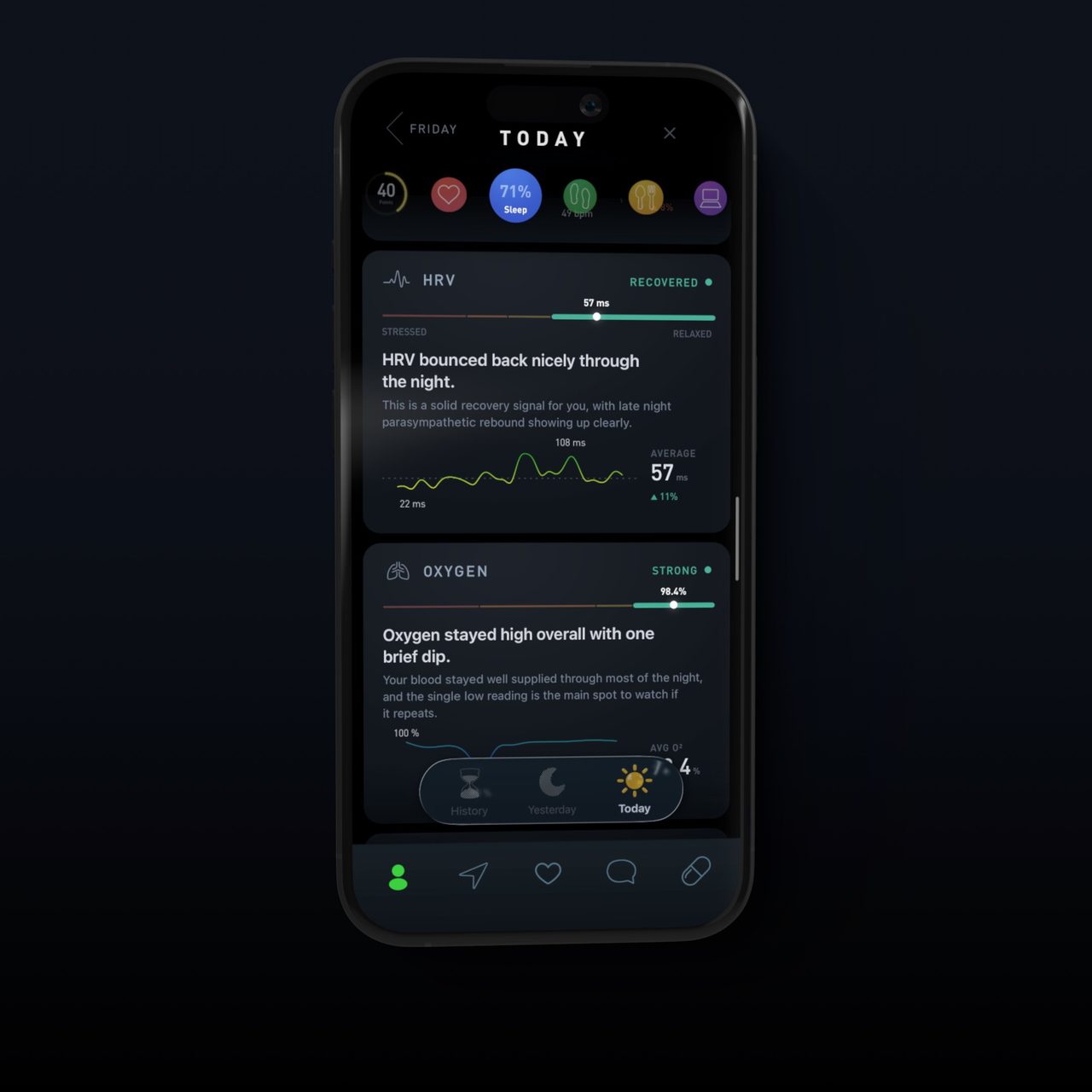
Log a reading in the app or let a connected cuff send it through Apple Health, and Gyroscope charts systolic and diastolic together against the standard bands and your own average. The category is shown next to each reading so a single high morning is in context rather than an alarm.
Blood pressure lives on the Trends tab beside resting heart rate, HRV, and alcohol, which is where the explanation for a high week usually sits. The coach reads it with your weight, sleep, and drinks, and can tell you whether last month's drop lines up with the walks or the dry nights.
It needs four or five readings taken the same way before the average means anything, and a month of weekly readings before a trend does. Note clinic readings separately; they run higher than home and should not be mixed into the same average.
Works with Withings, Omron, Apple Health, Manual.
Questions people ask
- Which number matters more?
- Both are used, but for most adults the top number, systolic, is the one that rises with age and carries most of the risk. The categories use whichever number is higher.
- Can my watch measure it?
- Not meaningfully. No current watch or ring gives a reading you should act on. A cuff is the instrument, and a connected cuff makes it automatic.
- Why is my home reading lower than the doctor's?
- Because the clinic raises it: the walk in, the wait, the white coat. Home readings taken quietly are the better picture of your real pressure, which is why doctors ask for them.
- How often should I measure?
- Once a week, same time, same way, is enough for a trend. Daily for a month when you are setting a baseline, testing a change, or starting a medication.
Track your Blood pressure
Included in the free app. Download Gyroscope, connect your device, and the trend builds itself.
Get Gyroscope