
Sleep Timing
When you sleep, not just how much. The weekly two-hour shift your body experiences as a flight across time zones.
In a 2024 study of about 61,000 adults, the people with the most regular sleep schedules had 20 to 48% lower risk of death over follow-up than the least regular. Regularity predicted it more strongly than sleep duration did.
That is a surprising result if you grew up counting hours. It means the same seven hours can be a very different night depending on when it happens, and whether it happened at the same time yesterday.
Regularity is something you can only see across many nights, which is why Sleep Timing is a trend: your bedtime and wake time each night, side by side, over weeks.
What it is
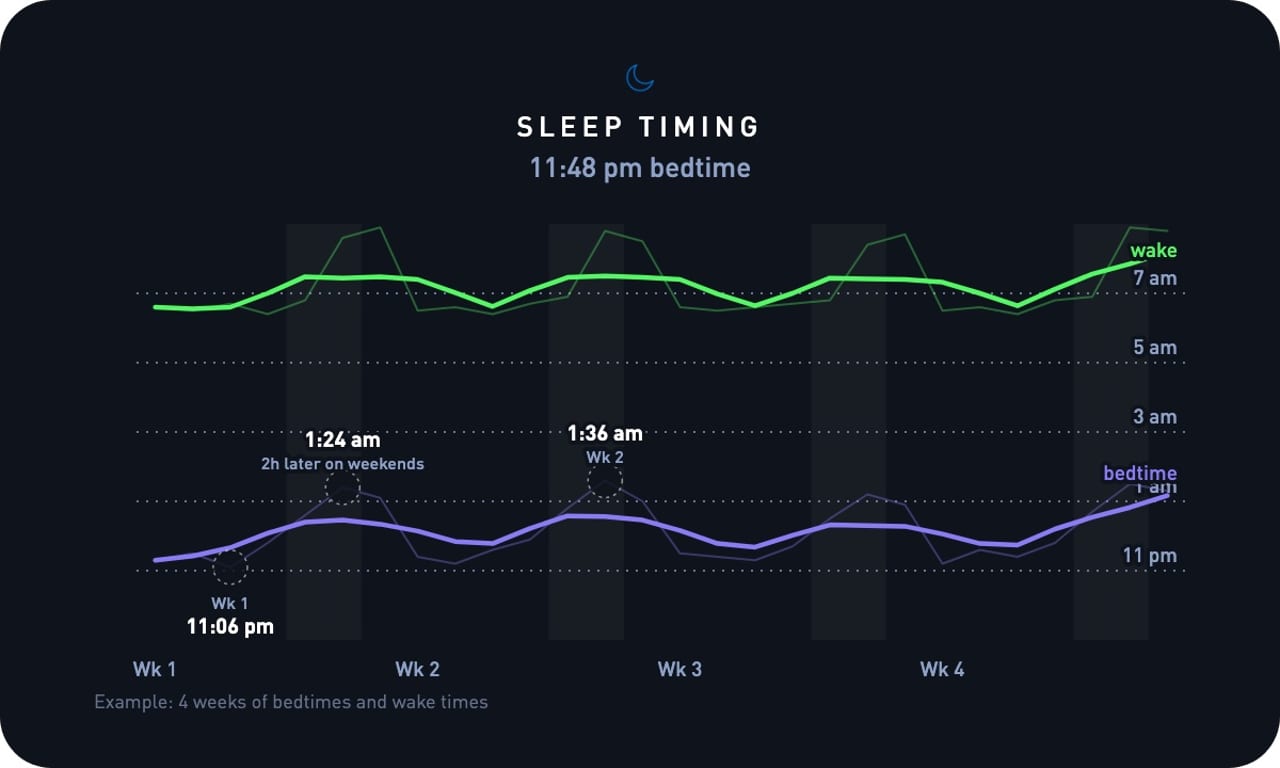
Sleep timing is two numbers a night: when you fell asleep and when you woke up. Charted over weeks, they form two lines, and the shape of those lines is the trend.
The chart above is a very common pattern. Weeknights: asleep around 11:30, up around 6:30. Friday and Saturday: asleep after 1, up after 8:30. Same total hours, roughly, but the whole schedule shifts by two hours and back every week.
The tell in your own data is the gap between the weekday cluster and the weekend cluster. Under an hour is fine. Two hours or more, every week, is the pattern worth fixing.
Why it matters for your goals
If you want to lose weight
A schedule that shifts two hours every weekend does the same thing to appetite as a short night: the Sunday bedtime runs late, Monday is short, and the afternoon cravings follow. Keeping the wake time steady is the cheapest way to protect the weeknights that fat loss depends on.
If you want more energy and focus
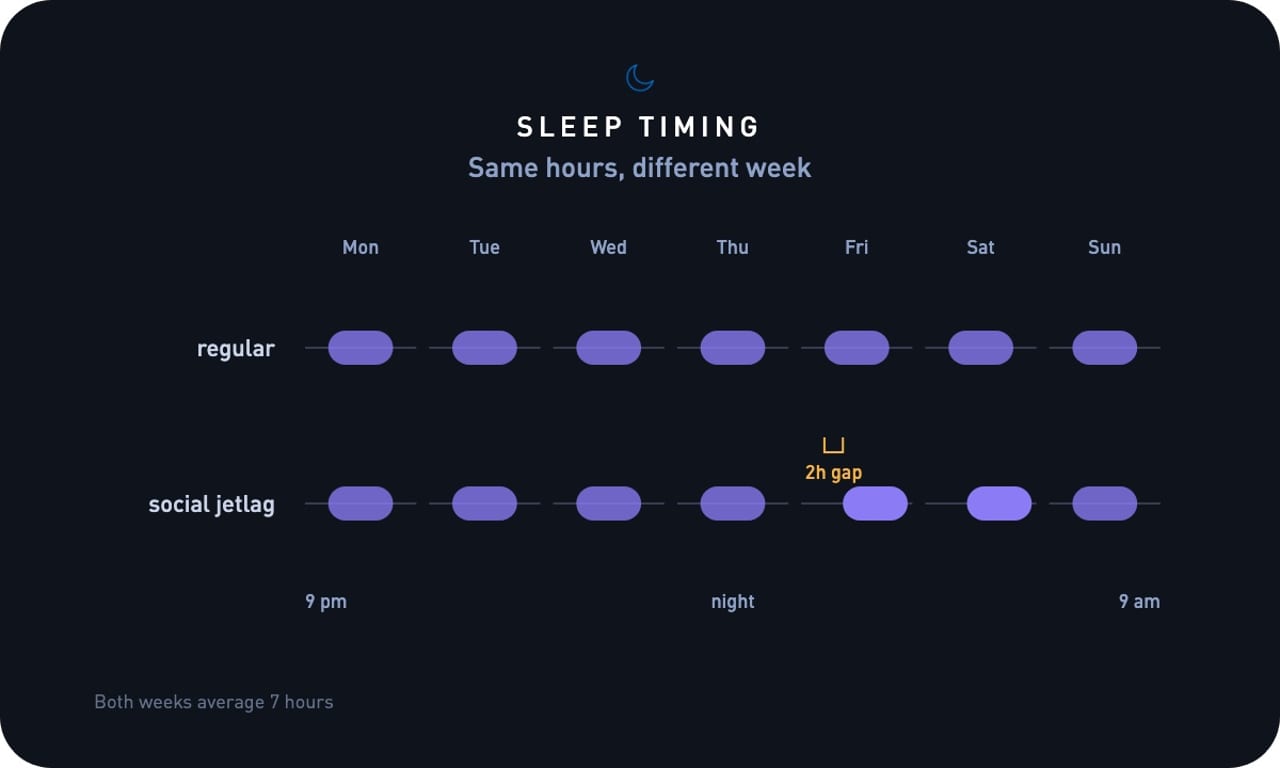
Researchers call the weekly shift social jetlag, because your body experiences it much like flying two time zones west on Friday and east on Sunday. The rough Monday is not a mystery; it is the return flight. Under an hour of shift and Monday feels like Thursday.
If you want to live longer
Across 61,000 adults, a regular schedule tracked with 20 to 48% lower risk of death than an irregular one, and beat sleep duration as a predictor. A fixed wake time is one of the few longevity levers that costs nothing.
If you train
The gap between weekday and weekend clusters tends to show up as a slower-than-expected recovery in resting heart rate. If your hard sessions land on Monday, the Sunday bedtime is part of the training plan.
Where people land
| Weekend shift under 1 hour | regular; the body barely notices |
|---|---|
| Shift of 1 to 2 hours | common; shows up as a slower Monday |
| Shift of 2 hours or more, weekly | social jetlag; the pattern the regularity studies flag |
Both weeks in the chart average seven hours. The difference is entirely in the timing. Your own number is the size of your weekday-to-weekend gap, and the goal is to shrink it, not to hit anyone else's bedtime.
What the research found
Sleep regularity only became measurable at scale once people started sleeping in wearables. The first large studies are recent, and they point the same way.
In a 2024 UK Biobank study of about 61,000 adults, people with the most regular sleep schedules had 20 to 48% lower risk of death over follow-up than the least regular, and regularity predicted mortality more strongly than sleep duration did. (Windred et al., Sleep, 2024). Keeping the wake time within an hour, seven days a week, is a bigger lever than adding an hour on Saturday.
A 2010 meta-analysis of 16 studies covering about 1.38 million people found that regular short sleepers had roughly 12% higher risk of death over follow-up, and long sleepers about 30% higher, compared with people sleeping around seven to eight hours. (Cappuccio et al., Sleep, 2010). Hours still matter at the extremes. Fix the timing first and the hours usually settle into the middle of the range on their own.
What moves it
More regular, over weeks. A fixed wake time, seven days a week, within about an hour. Morning light within the first hour of waking. A consistent evening routine. Shifting the weekend by one hour instead of two.
Less regular, within a night. A late night out. Alcohol, which delays and fragments sleep. A late coffee. Travel across time zones. Screens in bed: phone use after lights-out is linked to later bedtimes and shorter sleep. Shift work.
This week. Anchor the wake time first and let bedtime follow. If you are going to shift on the weekend, shift by one hour. Give it three weeks before judging the effect.
Everything known to move it
Sleep timing is mostly a body-clock story. Light, meals, caffeine and the weekend are the levers that move it, and almost all of them are free.
Sleep
| Fixed wake time, seven days a week | steadies | The anchor. Across 61,000 adults the most regular schedules tracked with 20 to 48% lower risk of death than the least regular. Windred et al., Sleep, 2024 |
|---|---|---|
| Two-hour weekend shift | mixed | Each weekend moves the clock like a flight east, and the first half of the week is spent flying back. |
| Sleeping in after a late night | mixed | Recovers the hours but shifts the next bedtime later; a one-hour lie-in keeps the shift small. |
| Phone in bed | mixed | Phone use after lights-out was linked to later bedtimes and shorter sleep. Exelmans and Van den Bulck, Social Science and Medicine, 2016 |
Lifestyle and environment
| Morning light | steadies | The strongest signal the body clock has. Light in the first hour of waking pulls the next bedtime earlier. |
|---|---|---|
| Bright light late in the evening | mixed | Four hours of screen reading before bed delayed sleep and suppressed melatonin compared with a printed book. Chang et al., PNAS, 2015 |
| Travel across time zones | mixed | Shifts the clock about an hour a day toward the new zone; eastward is harder than westward. |
| Shift work | mixed | The largest and least avoidable shifter; keeping the same schedule on days off limits the damage. |
| A consistent evening routine | steadies | The same wind-down at the same hour becomes a cue the body learns within a few weeks. |
Nutrition
| Caffeine after early afternoon | mixed | Pushes bedtime later; a standard coffee needs about 8.8 hours on average not to shorten the night. Gardiner et al., Sleep Medicine Reviews, 2023 |
|---|---|---|
| Alcohol in the evening | mixed | Delays the night out and fragments the early morning, so both ends of the night move. Ebrahim et al., Alcoholism: Clinical and Experimental Research, 2013 |
| Late dinner | mixed | Meal timing is a clock signal of its own; a late large meal pushes bedtime later. Kinsey & Ormsbee, Nutrients, 2015 |
| Breakfast at a consistent hour | steadies | The first meal tells the clock the day has started, the same way morning light does. |
Training
| Morning exercise | steadies | Movement and daylight together are a stronger morning anchor than either alone. |
|---|---|---|
| Hard training late at night | mixed | Raises core temperature and alertness into the first hour in bed, which pushes sleep onset later. |
Supplements and medical
| Melatonin | steadies | The one supplement with a real timing effect; used after travel it helps the clock move to the new zone. Follow the label. |
|---|---|---|
| Nicotine and stimulants | mixed | Evening use delays sleep onset; the schedule drifts later with it. |
| Delayed sleep phase | mixed | Some people run late by biology, not habit. A schedule you cannot hold despite trying is worth raising with a doctor. |
Gyroscope runs these correlations on your own data: open the trend, tap a late bedtime, and the coach reads what moved it.
Targets to aim for
| Good | Wake time within an hour across all seven days |
|---|---|
| Great | Bedtime and wake time both within about 30 minutes most nights, weekends included |
| Watch | A two-hour weekend shift every week, or a bedtime drifting later across the month |
| See a doctor | A schedule you cannot hold despite trying, with persistent daytime sleepiness. Bring the chart; it is the useful thing to show. |
Practical ways to improve it
- Pick one wake time you can keep on Saturday and set it every day. Bedtime follows within a couple of weeks.
- Get outside within the first hour of waking. Morning light is the strongest signal your body clock has.
- If you go out on Friday, shift by one hour, not two. One hour is a late night; two is a time zone.
- Phone out of the bed. Phone use after lights-out is linked to later bedtimes, shorter sleep, and more daytime fatigue.
- Finish caffeine by early afternoon and keep dinner early. Both quietly push bedtime later.
How to track it
Any watch or ring you sleep in records sleep onset and wake time automatically. The phone alone can estimate it: if it sits on the nightstand, Gyroscope reads the last use at night and the first in the morning, which is rough but good enough to see a weekend shift.
With no device, log two times a day: lights out and up. Timing is the one sleep trend where a manual log is nearly as good as a wearable, because the question is when, not how well.
| Apple Watch | Automatic through Apple Health |
|---|---|
| Oura, Garmin, Fitbit, Withings | Direct integration in Settings |
| Whoop and most other wearables | Through Apple Health |
| Phone only | Estimated from phone use, no setup |
| No device | Log lights-out and wake time manually |
How Gyroscope tracks it
Wear your device to bed and the two times arrive each morning. Gyroscope reads sleep onset and wake from Apple Watch, Oura, Whoop, Garmin, Fitbit, or Withings and charts both against your usual. The first morning after you connect, it already shows your history.
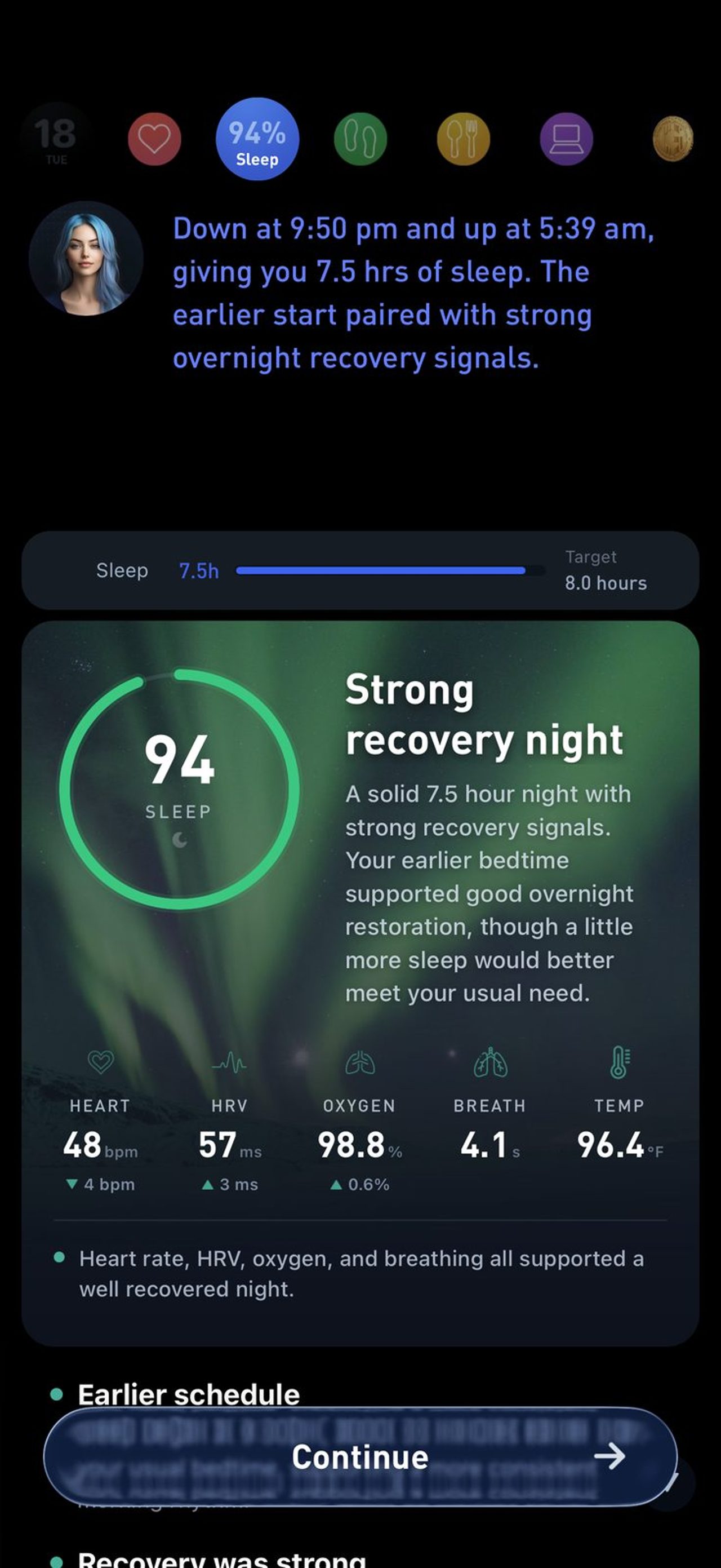
Each day the Sleep Score notes the timing in plain words: 11 minutes later than usual, or an earlier start that paired with strong recovery. On the Trends tab, Sleep Timing sits next to duration, resting heart rate, and alcohol, so the late Friday and the slow Monday are on the same screen. Ask the coach why Monday felt rough and it reads the weekend shift first.
The weekday and weekend clusters become visible after two weeks. Give a schedule change three weeks before judging it.
Works with Apple Watch, Oura, Whoop, Garmin, Fitbit, Withings.
Questions people ask
- Does bedtime or wake time matter more?
- Wake time. It is the anchor for your body clock and the easier one to control. Fix it and bedtime tends to settle on its own within a couple of weeks.
- Is a late schedule bad if it is consistent?
- Consistency is the bigger lever. A steady 1 am to 8 am is more regular than a schedule that swings between 11 pm and 1 am, and the regularity studies favor the steady one.
- What counts as social jetlag?
- A weekday-to-weekend shift of two hours or more in the middle of your sleep. Under an hour is normal variation.
- How long before a change shows up?
- About three weeks. The trend needs two weeks to show the clusters clearly, and your body needs about that long to settle into a new wake time.
Track your Sleep timing
This is one of the advanced trends in Gyroscope One, along with the AI coach that reads it for you every morning.
Unlock with Gyroscope OneGet the app