
Fasting Window
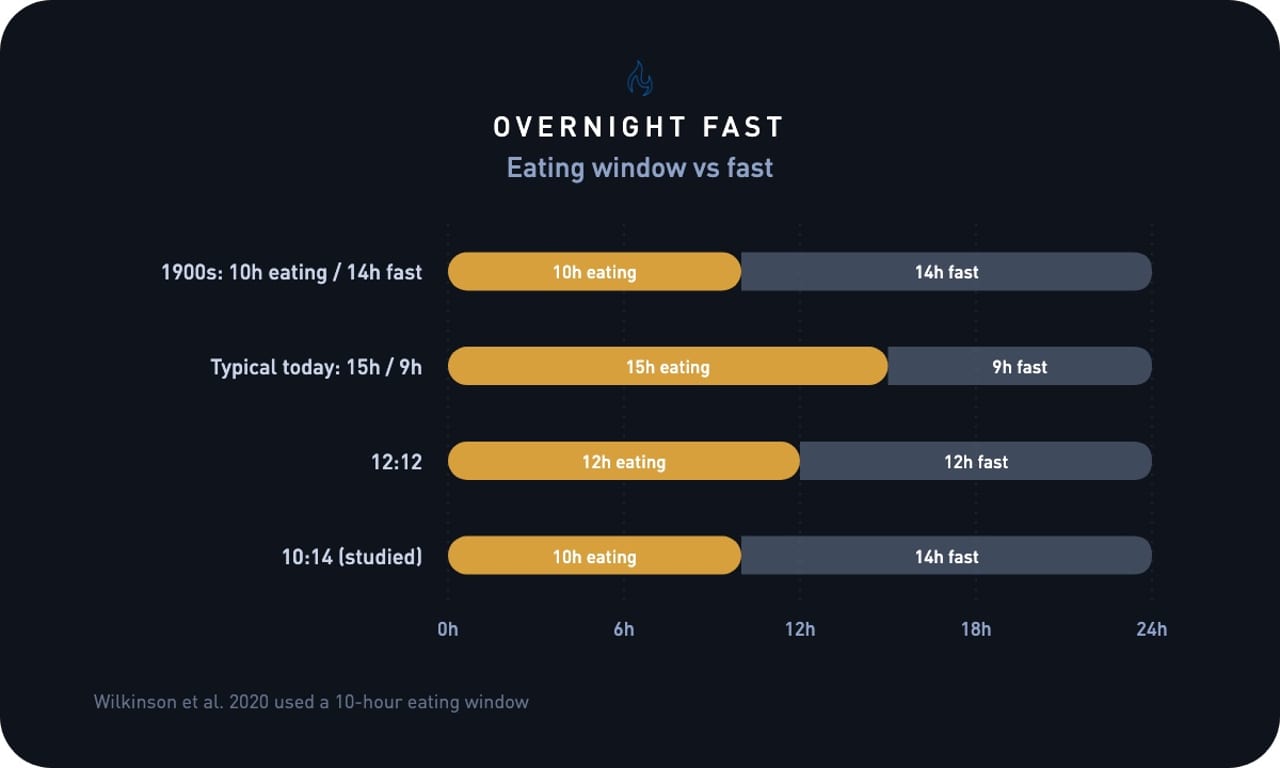
The gap between last bite and first. Most people's is 9 or 10 hours; a century ago it was 14.
Before electric light most people ate inside a 10 to 12 hour stretch, because that is when there was light to cook by. Refrigerators and streetlights stretched it to 15 or 16 hours for a lot of us. Most people's overnight fast today is 9 or 10 hours; a century ago it was 14, for no reason other than there was no light to eat by.
In a pilot trial, adults with metabolic syndrome ate within a 10-hour window for 12 weeks without changing what they ate. On average they lost about 3% of body weight and 4% of waist circumference, with lower blood pressure and LDL cholesterol.
The fasting window is the hours between your last meal one day and your first the next, from the meals you photograph. It is the flip side of last meal time, and the more useful of the two, because it captures both ends of the day in one number.
What it is
The overnight fast is the number of hours between the last food you logged one day and the first the next morning. A dinner finished at 8pm and a breakfast at 8am is a 12-hour fast, and a 12-hour eating window.
Time-restricted eating is just the idea of pulling the window back in. The studies that exist mostly used a 10-hour eating window, meaning a 14-hour overnight fast, and changed nothing about what was eaten.
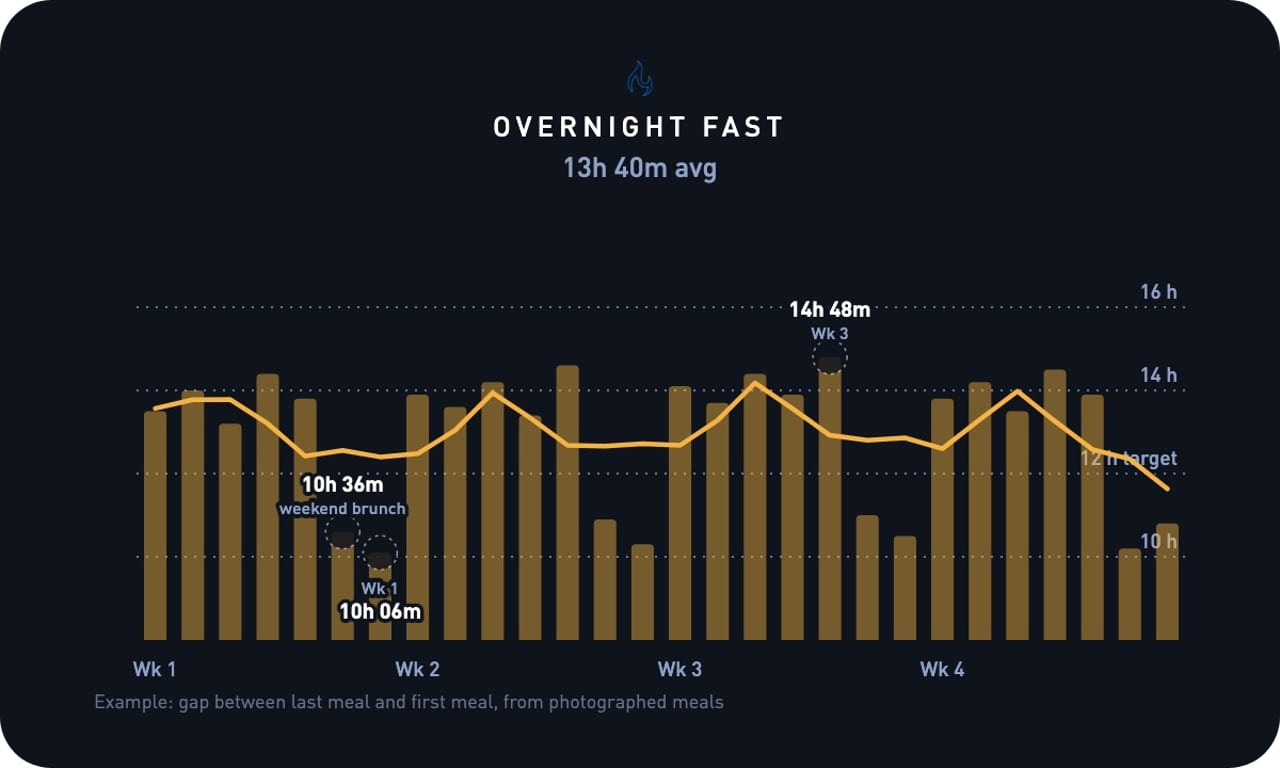
The chart above is a normal month: 13.5 to 14.5 hours on weekdays, dropping to 10 or 11 on weekends when brunch runs late and dinner does too. Most people are surprised how much of the week's total is decided on Saturday and Sunday.
Why it matters for your goals
If you want to lose weight
A longer overnight fast closes the eating day, and late evening is where most extra calories live. The 10-hour-window trial lost about 3% of body weight in 12 weeks with no other diet change. It is not magic; it is fewer hours in which to eat.
If you want to sleep better
A long fast usually means dinner finished early, and an early, finished dinner is one of the cleanest sleep levers there is. The nights after a short fast, where dinner ran late and breakfast came early, tend to read worst on the sleep chart.
If you want more energy and focus
A steady window trains the body to expect food at the same times, which is what makes mornings feel even instead of ravenous. The weekend dip on the chart is why Monday often feels off.
Where people land
| 9 to 10 hours | where most people land today |
|---|---|
| 12 hours | an easy first target, 8pm to 8am |
| 14 hours | the 10-hour eating window used in the trials |
| 16 hours or more | popular, but less studied than 14; check with a doctor if on medication |
Weekends decide the weekly average. A 14-hour weekday fast with 10-hour weekends averages under 13. Consistency beats the occasional heroic day.
What the research found
Time-restricted eating has been tested in small, careful trials where the food stayed the same and only the window changed.
In a 2020 pilot trial, 19 adults with metabolic syndrome ate within a 10-hour window for 12 weeks without other diet changes. On average they lost about 3% of body weight and 4% of waist circumference, with lower blood pressure and LDL cholesterol. (Wilkinson et al., Cell Metabolism, 2020). A 10-hour eating window, nothing else, over 12 weeks. The trend tells you whether you are actually inside one.
A 2015 review of nighttime eating found that large mixed meals eaten late at night were associated with worse outcomes in several groups, while small snacks of roughly 150 calories were often neutral and sometimes useful. (Kinsey & Ormsbee, Nutrients, 2015). The end of the window matters more than the start. A big late dinner shortens the fast and costs the night.
What moves it
Shorter, without deciding it. Late dinners out. A snack after dinner. Early breakfast on a work day after a late night. Weekends where brunch is late and dinner is later.
Longer, this week. Finish dinner earlier, or skip the after-dinner snack. Push breakfast a little later if mornings allow. Keep the weekend window close to the weekday one.
The one-week experiment. Pick a 12-hour overnight fast, say 8pm to 8am, and hold it for a week, weekends included. Do not change what you eat, only when. At the end compare sleep, morning energy, and digestion with the previous week. If you are pregnant, diabetic, or on medication with food, ask a doctor first.
Everything known to move it
The overnight fast is an hours count, so raises means a longer fast and lowers means a shorter one. Both ends of the day move it, and the weekend moves it most.
Nutrition
| Finishing dinner earlier | raises | The easy half of the window. Adults who ate inside 10 hours for 12 weeks lost about 3% of body weight and 4% of waist with no other change. Wilkinson et al., Cell Metabolism, 2020 |
|---|---|---|
| Pushing breakfast later | raises | The other half; an hour on the morning side is often easier than an hour on the evening side. |
| After-dinner snacks | lowers | A snack at 10pm cuts two hours off the fast even when dinner ended at 8. |
| A big late dinner | lowers | Shortens the fast and costs the night; large mixed meals late were linked with worse outcomes while small snacks were often neutral. Kinsey & Ormsbee, Nutrients, 2015 |
| Caloric drinks in the evening | lowers | Wine, beer, juice and milky coffee all count as eating; the fast starts after the last one. |
| Seeing the window | raises | More than half of adults who logged every bite ate across 15 hours or more; just seeing the window narrowed it. Gill and Panda, Cell Metabolism, 2015 |
Sleep
| Sleeping longer | raises | Most of the fast is asleep; a full night lengthens it by itself. |
|---|---|---|
| Short sleep | lowers | Two nights of four hours raised hunger ratings by about 24%, and a hungry morning ends the fast early. Spiegel et al., Annals of Internal Medicine, 2004 |
| Consistent schedule | steadies | A regular bedtime and wake time keeps both ends of the window in place across the week. Windred et al., Sleep, 2024 |
Training
| Early morning training | mixed | Fasted easy sessions extend the window; hard early sessions usually need food and shorten it. |
|---|---|---|
| Evening sessions | lowers | Late training means late dinner, which is the most common reason a weekday fast comes in short. |
Lifestyle and environment
| Weekend brunch and late dinners | lowers | Late brunch plus later dinner shortens the fast from both ends; weekends decide the weekly average. |
|---|---|---|
| Eating out | lowers | Restaurant dinners finish later and go longer, and dessert resets the clock. |
| Travel across time zones | mixed | The window moves with the clock; holding meal times to the new zone helps the body shift. |
Medical
| Diabetes, pregnancy and medication with food | mixed | Fasting length interacts with dosing and blood sugar; ask a doctor before extending the window. |
|---|---|---|
| Windows beyond 16 hours | mixed | Popular but less studied than 14; not a lever to push without a reason and a doctor. |
Gyroscope runs these correlations on your own data: the fasting window is read from the meals you photograph, and the coach can show which nights a short fast cost you.
Targets to aim for
| Good | 12 hours or more on most nights |
|---|---|
| Great | Around 14 hours, weekends within an hour of weekdays |
| Watch | Under 10 hours most nights, or a weekend drop of 4 or more hours |
| Talk to a doctor | Before going past 14 hours if you are pregnant, diabetic, or on medication taken with food |
Practical ways to improve it
- Start at 12 hours. It is a bedtime snack and an early breakfast away for most people, and easy to hold.
- Fix the evening end first. Finishing dinner earlier does more for the window than skipping breakfast.
- Hold it on weekends. A late brunch and a late dinner erase the weekday progress.
- Change the timing only. The trials kept the food the same, and so should your first week.
- Read the week, not the day. One long fast after a short one averages to nothing.
How to track it
The window is computed from the meals you log, so the first and last meal of each day need to be in the log. Photograph breakfast and dinner and any snack after it, and the number is automatic.
No wearable is needed for the window itself. A watch or ring adds the sleep and heart rate the window is read against.
| Meal photos in Gyroscope | Photograph the first and last food of the day; the window is computed for you |
|---|---|
| Manual entry | Add a meal from the food tab when there is no photo |
| Apple Watch, Oura, Whoop, Garmin, Fitbit | Supply the sleep it is charted against |
| No wearable | The window still works from meals alone |
How Gyroscope tracks it
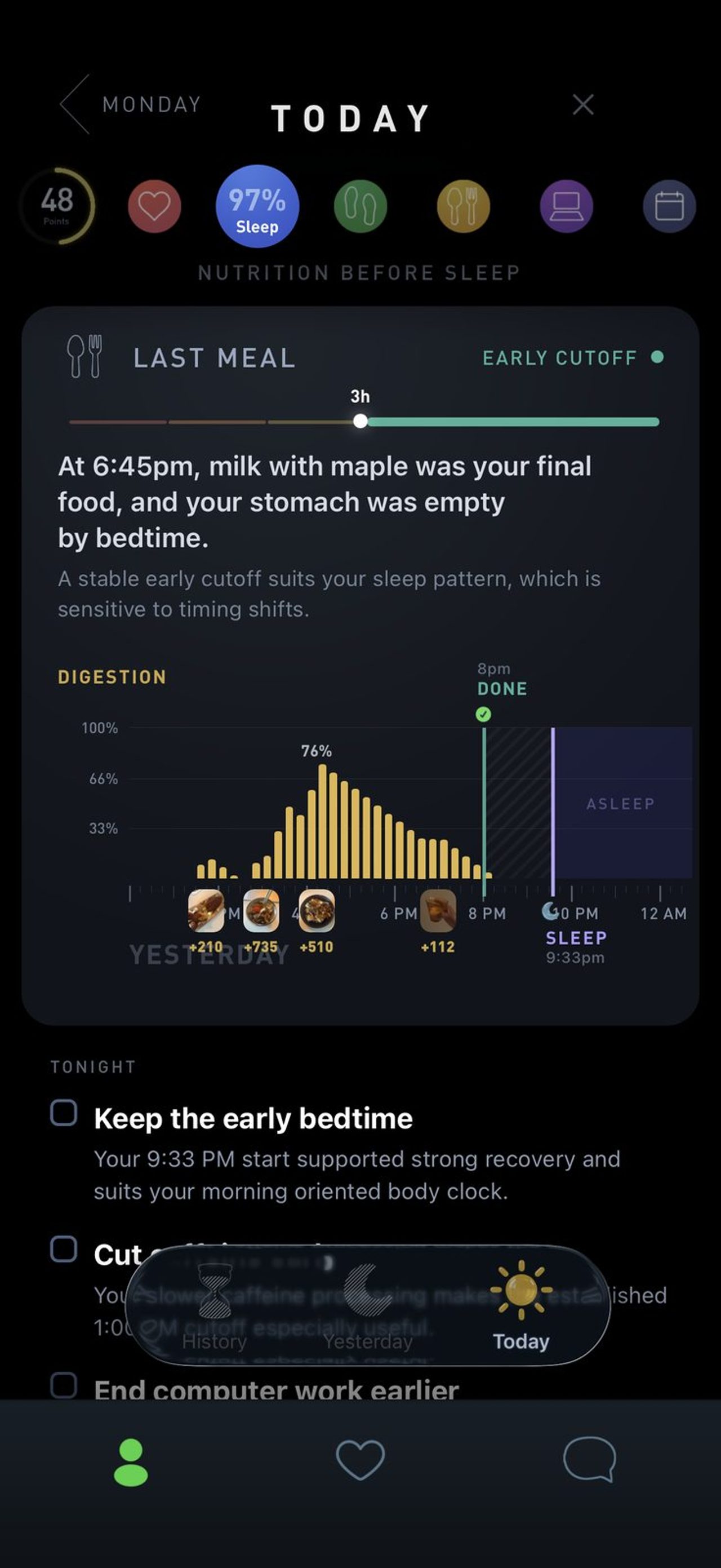
Photograph your meals and Gyroscope measures the hours from the last one to the next morning's first. The Sleep Score screen shows the gap from dinner to bedtime; the Trends tab shows the whole window, night by night and week by week.
It sits next to last meal time, sleep score, and resting heart rate. Ask the coach whether the window is working and it reads those together rather than quoting a rule.
One week of complete logging is enough to see your real window. The weekend dip usually shows up by the second weekend.
Works with Apple Watch, Oura, Whoop, Garmin, Fitbit.
Questions people ask
- Do I have to skip breakfast?
- No. The trials used a 10-hour eating window, which fits breakfast and dinner. Finishing dinner earlier does more for the window than skipping a meal.
- What window did the research use?
- Mostly a 10-hour eating window, so a 14-hour overnight fast, with no change to the food itself.
- Is it safe for me?
- A 12-hour fast is ordinary for most adults. If you are pregnant, diabetic, or take medication with food, ask a doctor before going longer.
- Does coffee break the fast?
- Black coffee and water are usually treated as inside the fast. Anything with calories counts as the first meal and is logged as one.
Track your Overnight fast
This is one of the advanced trends in Gyroscope One, along with the AI coach that reads it for you every morning.
Unlock with Gyroscope OneGet the app