
VO2 Max
The fitness number that predicts the most, and the one a watch now estimates from an ordinary run.
In a study of 122,007 people who did a treadmill test, being unfit carried risk comparable to or greater than smoking. The number that study measured is VO2 max: the most oxygen your body can use per minute during hard effort.
It used to need a lab, a mask, and a treadmill run to exhaustion. A watch now estimates it from an ordinary run or brisk walk, one point a month, from the training you already do.
What it is
VO2 max is the most oxygen your body can use per minute during hard effort, in millilitres per kilogram of body weight. In plain terms, engine size. It depends on your heart's output, how much oxygen your blood carries, and how well your muscles use it.
A reasonably active adult often sits in the high 30s to low 40s, a competitive amateur endurance athlete in the 50s, and elite racers in the 70s and 80s. It is age-adjusted, so a 55-year-old at 40 is doing better than a 25-year-old at 40.
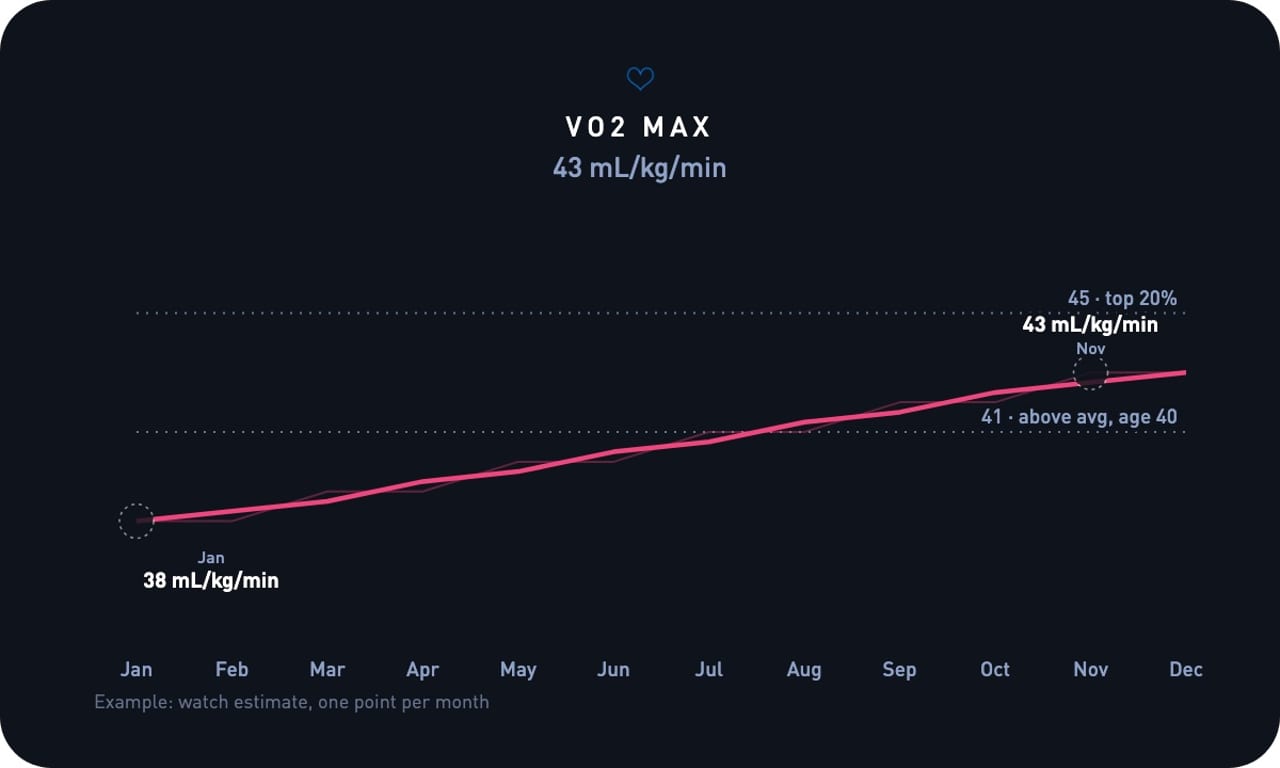
The chart above is a year of a watch estimate rising from 38 to 43. That is what a realistic year of steady training looks like: not dramatic, one or two points a quarter. The dashed lines are where "above average" and "top 20%" sit for a 40-year-old.
Why it matters for your goals
If you want to lose weight
VO2 max is per kilogram of you, so it rises as fat comes off and as your engine grows. It is the number that tells you whether a diet is making you fitter or just lighter. Paired with easy aerobic work, it is the cleanest signal that the weight leaving is the right kind.
If you want more energy and focus
A bigger aerobic engine means everyday life uses a smaller share of it. Stairs, a long day, a bad night: everything costs less when your ceiling is higher. Most people who raise their VO2 max over a year notice the afternoons before they notice the number.
If you want to live longer
Fitness is one of the few longevity numbers almost entirely in your control. In the Cleveland Clinic study, the fittest group had the lowest mortality at every age, and there was no level of fitness past which more stopped helping.
If you train
VO2 max is the ceiling your endurance sits under. It moves over months, not weeks, and the watch estimate has real error, so the useful read is the direction over a season. One or two points a quarter is what a realistic training year looks like.
Where people land
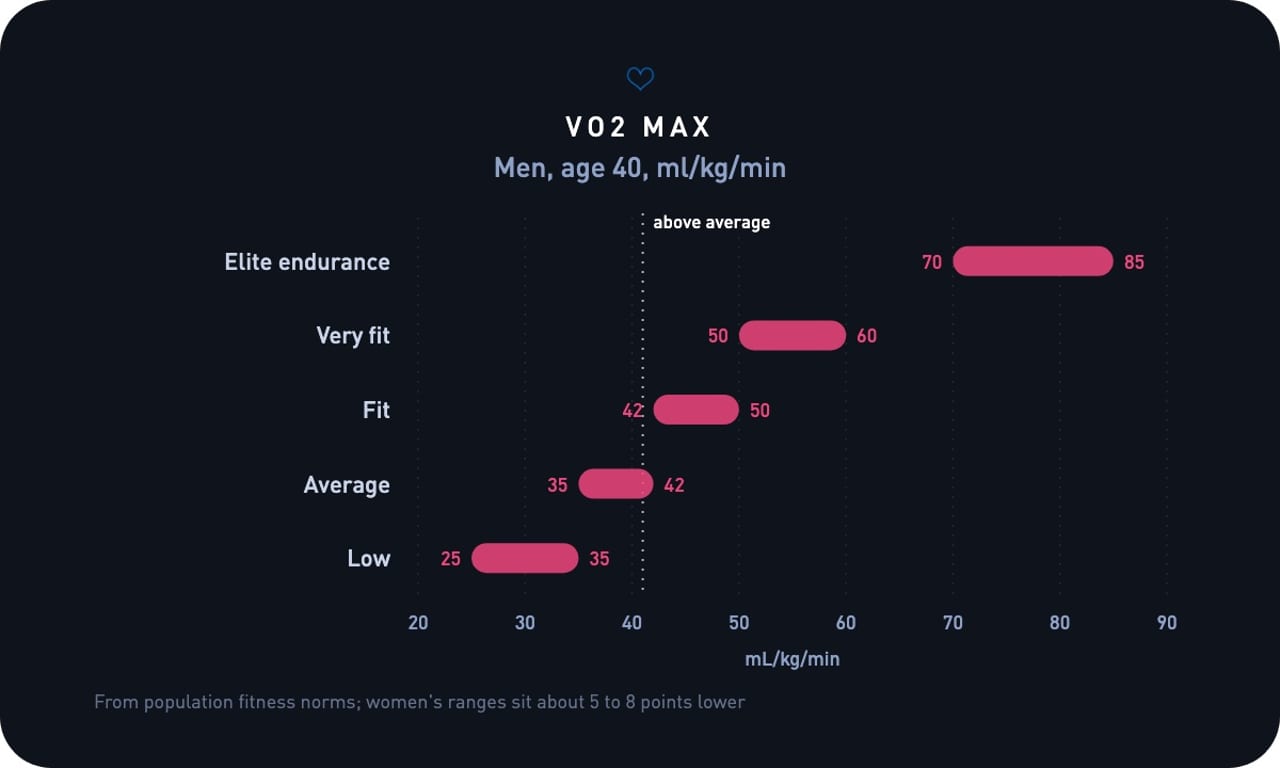
| Low | 25 to 35 |
|---|---|
| Average | 35 to 42 |
| Fit | 42 to 50 |
| Very fit | 50 to 60 |
| Elite endurance | 70 to 85 |
These are population norms for men around age 40; women's ranges sit about 5 to 8 points lower, and every band shifts down with age. The watch estimate is not a lab test, so the row you land in is approximate. Your own line over a year is what to read: 38 to 43 is a real change whichever row it started in.
What the research found
VO2 max is the fitness measure with the strongest link to how long people live, and the evidence comes from very large groups followed for years.
In a 2018 study of 122,007 adults who did a treadmill fitness test at the Cleveland Clinic, the fittest group had the lowest mortality, and the risk associated with low fitness was comparable to or greater than smoking, diabetes, or heart disease. (Mandsager et al., JAMA Network Open, 2018). Fitness is one of the few longevity numbers almost entirely in your control, and the watch estimate is good enough to track the direction.
In a four-week trial of 26 men, training guided by daily HRV measurements improved maximal running speed more than a predefined schedule, while the difference in peak oxygen uptake gains between groups was not significant. (Kiviniemi et al., European Journal of Applied Physiology, 2007). The runners who improved their oxygen uptake most were the ones who let that morning's recovery pick the day's intensity. VO2 max rises on the easy days as much as the hard ones.
What moves it
Up, over months. Two or three easy sessions a week you can hold a conversation through, plus one harder session with intervals of a few minutes. Strength work supports it. Losing excess weight raises it directly, since it is measured per kilogram.
Down, over months. Stopping training; it fades within weeks of a layoff. Gaining weight. Illness or injury that breaks a block. Age pulls it down slowly, which is why holding steady in your 50s is itself a win.
This week. Nothing you do this week will show in the number. Add one easy run or brisk walk with the watch on so the estimate updates, and judge the line in a year.
Everything known to move it
VO2 max moves slowly and in only a few directions, which makes the list shorter than most. Raises is good; anything that breaks a training block or adds weight pulls it down.
Training
| Easy aerobic volume | raises | Two or three conversational-pace sessions a week is where most of the gain comes from, and the fittest group in a large cohort had the lowest mortality. Mandsager et al., JAMA Network Open, 2018 |
|---|---|---|
| Intervals of a few minutes | raises | One hard session a week with repeats near your limit raises the ceiling faster than easy work alone. |
| Recovery-guided intensity | raises | Runners who let the morning HRV pick the day improved peak oxygen uptake more than a fixed plan. Kiviniemi et al., European Journal of Applied Physiology, 2007 |
| Strength training | raises | Supports running economy and keeps the legs in the game; a small direct effect on the number itself. |
| Stopping training | lowers | It fades within weeks of a layoff; a missed month shows in the estimate. |
| Overtraining | lowers | A block that outruns recovery stalls the number; falling HRV and rising resting heart rate are the early warning. |
Sleep
| Short sleep | lowers | Adaptation to training happens during sleep; a week of short nights blunts the return on the same sessions. |
|---|
Nutrition
| Losing excess weight | raises | Measured per kilogram, so fat lost raises the number directly with no change in fitness. |
|---|---|---|
| Gaining weight | lowers | The same lungs and heart divided by more kilograms. |
| Iron status | mixed | Low iron limits oxygen carrying and caps the number, especially in women and endurance athletes; a blood test settles it. |
| Alcohol | lowers | Through worse sleep and recovery rather than a direct effect on the lungs. |
Lifestyle and environment
| Altitude training | raises | Weeks at altitude raise red cell mass; the watch estimate will read low while you are up there and higher when you come down. |
|---|---|---|
| Heat | lowers | Hot runs read as a lower estimate on the watch because the heart works harder for the same pace; it recovers as you acclimatize. |
| Illness and injury | lowers | Anything that breaks a block costs fitness; the longer the gap, the more to rebuild. |
| Age | lowers | Pulls it down slowly every decade, which is why holding steady in your 50s is a win. |
Supplements and medical
| Nicotine and smoking | lowers | Reduces oxygen delivery; quitting is one of the larger single gains available. |
|---|---|---|
| Beta blockers | lowers | Cap heart rate, so watch estimates built on pace and heart rate will read wrong; compare only to your own baseline on the medication. |
Gyroscope runs these correlations on your own data: the VO2 max trend sits next to training load, sleep and weight so a stall has a visible cause.
Targets to aim for
| Good | Above average for your age and sex, or a line that rises over a year |
|---|---|
| Great | In the fit band or above, holding or climbing year over year |
| Watch | A line drifting down over two or three quarters with no change in training |
| See a doctor | A sudden drop alongside chest symptoms, unusual breathlessness, or a resting heart rate that has also climbed |
Practical ways to improve it
- Build a base first: two or three easy sessions a week at a pace you can talk through. This is where most of the gain comes from.
- Add one hard session a week once the base is there: intervals of three to five minutes at an effort you could not talk through, with equal rest.
- Lift twice a week. Strength work supports the aerobic gain and keeps the legs that carry it.
- Lose excess weight if you have it. VO2 max is per kilogram, so fat loss raises it without any extra training.
- Keep the watch on for outdoor runs and brisk walks with GPS and heart rate; that is what the estimate is built from.
How to track it
VO2 max is a watch estimate, built from heart rate against pace during outdoor runs and brisk walks. It needs a device with GPS and an optical heart rate sensor, worn during the activity. Rings do not estimate it, and indoor sessions without pace usually do not update it.
If you have no watch, the estimate from an occasional treadmill test or a lab test can be logged by hand, and a chest strap with a phone running app gives a comparable estimate on some platforms. Either way it is one point a month at most; this is a slow number.
| Apple Watch | Automatic through Apple Health after outdoor walks and runs |
|---|---|
| Garmin, Fitbit | Direct integration in Settings |
| Polar, Coros, most others | Through Apple Health |
| No watch | Log a lab or treadmill test result manually |
How Gyroscope tracks it
Train with the watch on and Gyroscope reads the estimate from Apple Watch, Garmin, or Fitbit, keeps the monthly value, and charts it against reference lines for your age and sex so the point has context. Existing history comes in with the device, so a year of training often shows on the first day.
It lives on the Trends tab next to resting heart rate, HRV, and steps, which together are the picture of your fitness. The coach reads it with your training and recovery and can tell you whether the line is moving because of training, weight, or a layoff.
It moves over months, not weeks, and the watch estimate has real error, so read the direction over a year rather than the last point.
Works with Apple Watch, Garmin, Fitbit.
Questions people ask
- How accurate is the watch estimate?
- It has real error, a few points either way, and it only updates after outdoor runs or brisk walks with good heart rate data. The absolute number is approximate; the direction over a year is reliable.
- Why does it not change?
- Because it should not, week to week. One or two points a quarter is a good year of training. If it has been flat for a year while you train consistently, add a weekly hard session.
- Do I need to run?
- No. A brisk walk outdoors with the watch on is enough for the estimate, and easy cycling or rowing builds the engine just as well even if the watch does not read it from those.
- What is a good VO2 max for my age?
- Above average for your age and sex is the first target; the fit band is a good second one. For a 40-year-old man, average is 35 to 42 and fit is 42 to 50. Women's bands sit 5 to 8 points lower and everyone's shift down with age.
Track your VO2 max
This is one of the advanced trends in Gyroscope One, along with the AI coach that reads it for you every morning.
Unlock with Gyroscope OneGet the app