
Nutrient Density
A daily score for what your food was made of, beyond calories. Calories say how much; this says what.
You can hit calories and protein and still run low on fiber and potassium for months, and nothing on the scale will tell you.
Across 64 cohorts covering more than 3.5 million people, higher fiber intake was associated with lower all-cause, cardiovascular, and cancer mortality. Fiber is the nutrient most people are furthest from, and the one a score catches first.
Nutrient density reads every meal you photograph for the small stuff, fiber, potassium, magnesium, iron, vitamin C and the rest, and rolls it into one daily score with a grade.
What it is
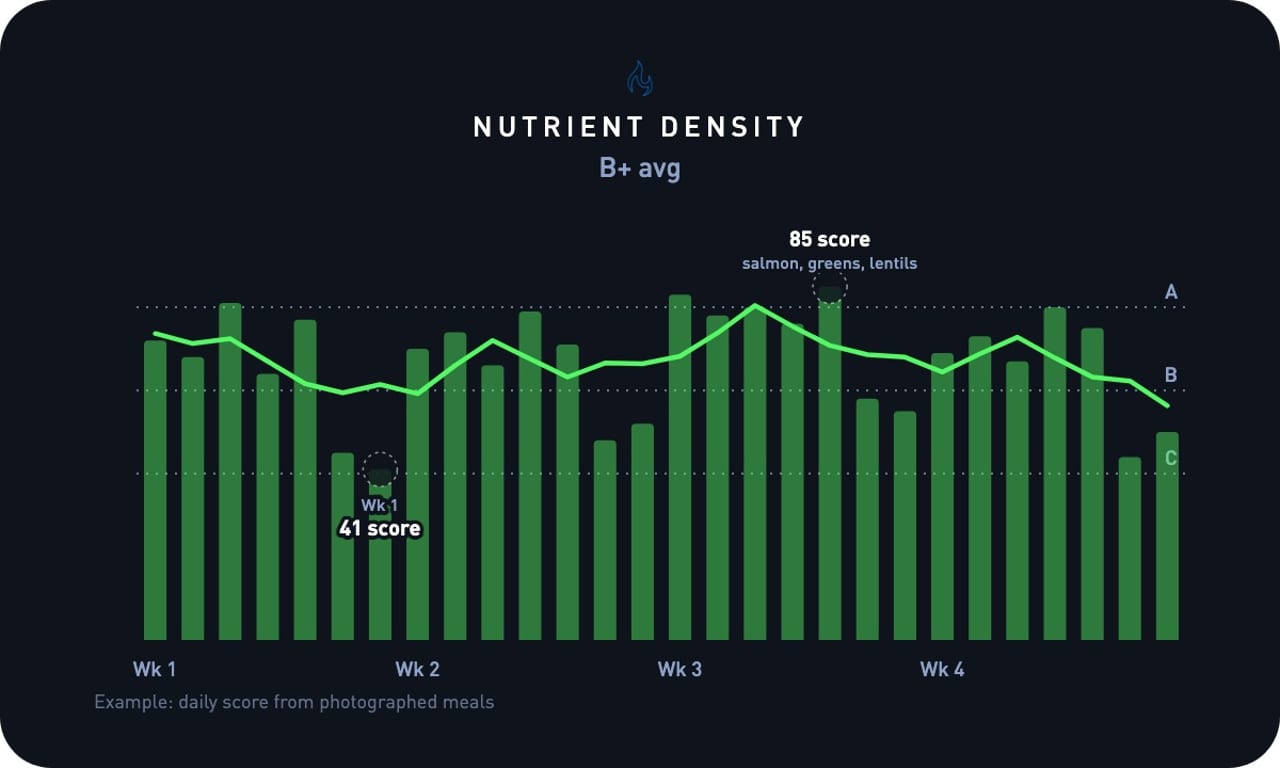
The score is a 0 to 100 estimate of how well the day's photographed meals covered the nutrients that calories do not measure: fiber, potassium, magnesium, iron, vitamin C, and the rest. It comes with a letter grade so the week reads at a glance.
It is only as complete as the log; a day you did not photograph lunch will read low. Read the weekly shape, not any one day.
The chart above is a typical month: B-range on weekdays, C on weekends. The 85 in week three was salmon, greens, and lentils, which is roughly what an A day looks like. It is not exotic; it is fiber and color.
Why it matters for your goals
If you want to lose weight
Dense food is filling food. In an inpatient trial, people offered an ultra-processed menu ate about 508 more calories a day than the same people on a matched unprocessed one. The days your score is high are usually the days you ate less without trying.
If you want to live longer
Fiber is the part of the score with the deepest evidence: across 3.5 million people, more fiber went with lower all-cause, cardiovascular, and cancer mortality. Beans, whole grains, and vegetables move both the score and that number.
If you want more energy and focus
Low potassium, magnesium, and iron days do not announce themselves; they feel like a flat afternoon. The score makes the pattern visible weeks before you would have guessed it was the food.
Where people land
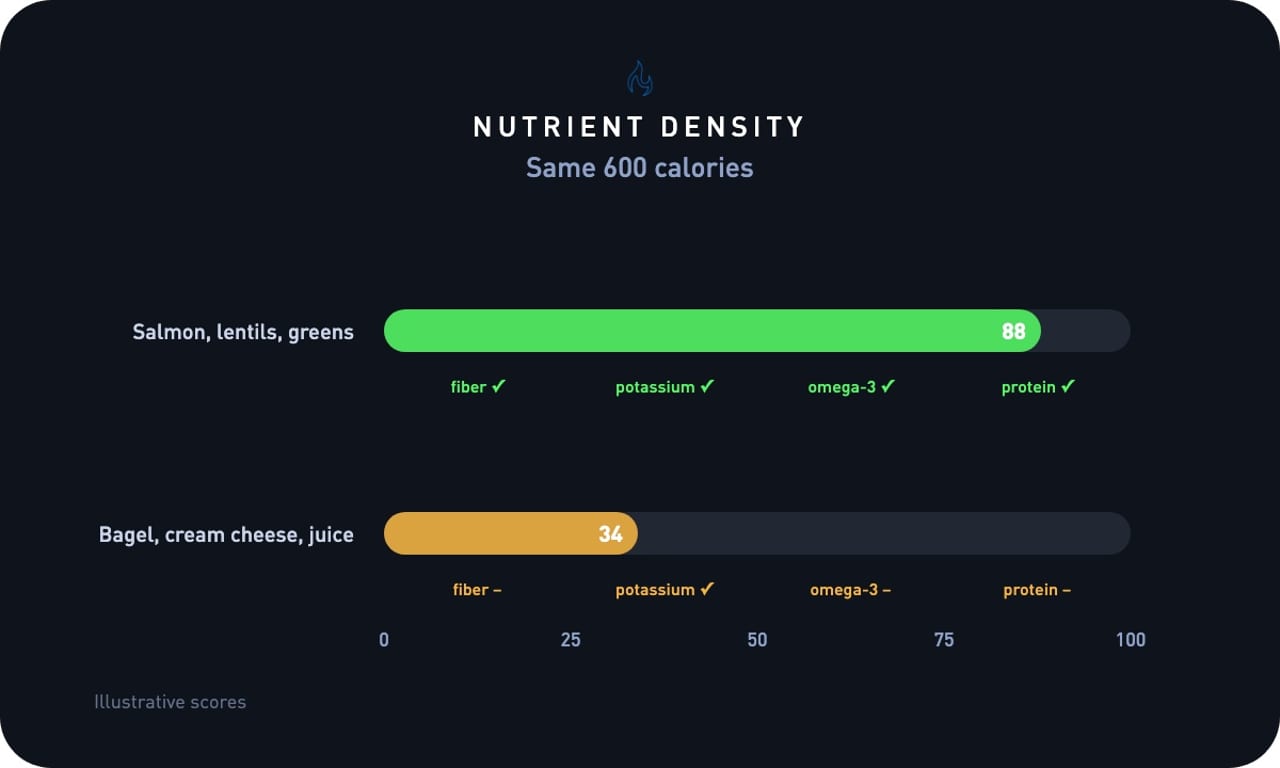
| A day | in the 80s or above: salmon, greens, lentils, whole grains, fruit |
|---|---|
| B day | a typical good weekday with vegetables at one or two meals |
| C day | where weekends and takeout usually land |
| Below that | an unlogged meal or a day of refined food |
Most people sit in the B range on weekdays and drop a grade at the weekend. Lifting the weekend by one grade does more for the weekly average than chasing an A on Tuesday.
What the research found
The parts of the score have been followed in very large cohorts, and the eating behavior behind it tested in a tightly controlled trial.
A 2024 meta-analysis of 64 prospective cohorts covering more than 3.5 million people associated higher fiber intake with lower all-cause, cardiovascular, and cancer mortality. (Ramezani et al., Clinical Nutrition, 2024). Fiber is the single biggest lever in the score and the one with the longest follow-up behind it.
In a 2019 NIH inpatient trial, 20 adults offered an ultra-processed menu ate about 508 more calories a day than the same people on a matched unprocessed menu, and gained weight over the two weeks. (Hall et al., Cell Metabolism, 2019). The same person, two menus, 508 calories a day apart. Dense food is the one you stop eating sooner.
In a trial of 1,685 adults, people who kept food records six or more days a week lost about twice as much weight as people who kept them one day a week or less. (Hollis et al., American Journal of Preventive Medicine, 2008). The score only works on logged days, and logging itself is most of the benefit.
What moves it
Down, without noticing. Takeout weekends. Skipped lunches replaced with snacks. Refined grains at every meal. Days with no fruit or vegetables until dinner.
Up, this week. Beans or lentils a few times a week. A fruit with breakfast. Vegetables at lunch, not just dinner. Swap one refined grain for a whole one.
How to read it. Ask the coach which nutrient you keep running low on; it can name it from your log. Then fix that one thing for a week and watch the weekly average.
Everything known to move it
The score rises with fiber and color and falls with refined calories, so raises means a denser day and lowers means a thinner one. Most of the movement is in two or three foods and two days of the week.
Nutrition
| Fiber | raises | The single biggest part of the score; across 64 cohorts and 3.5 million people, more fiber went with lower all-cause, cardiovascular and cancer mortality. Ramezani et al., Clinical Nutrition, 2024 |
|---|---|---|
| Beans and lentils | raises | Fiber, potassium, magnesium and iron in one food; a few times a week lifts the weekly average a grade. |
| Vegetables at lunch, not only dinner | raises | A second vegetable meal a day is the most common difference between a B day and an A day. |
| Fruit with breakfast | raises | Potassium, vitamin C and fiber at the meal that usually has none. |
| Whole grains instead of refined | raises | Same calories, several more nutrients; one swap a day is enough to see. |
| Ultra-processed food | lowers | Few micronutrients per calorie, and people ate about 508 more calories a day on an ultra-processed menu than on a matched unprocessed one. Hall et al., Cell Metabolism, 2019 |
| Takeout and restaurant days | lowers | Refined grains, little fiber, and portions that crowd out the vegetables. |
| Skipped lunch replaced by snacks | lowers | A snack day reads like a refined day because it is one. |
| Logging every meal | steadies | An unphotographed lunch reads as a low day; people who kept records most days lost about twice as much weight as those who rarely did. Hollis et al., American Journal of Preventive Medicine, 2008 |
Sleep
| Short sleep | lowers | Two nights of four hours raised hunger by about 24% with cravings for sweets and starch, which are the foods that score lowest. Spiegel et al., Annals of Internal Medicine, 2004 |
|---|
Training
| Hard training days | mixed | Appetite goes up, and the score depends on whether it is met with fruit and grains or with packaged snacks. |
|---|
Lifestyle and environment
| Weekends | lowers | Most people drop a grade on Saturday and Sunday; lifting the weekend does more than chasing an A on Tuesday. |
|---|---|---|
| Travel | lowers | Airports and hotels are refined-food environments; packing fruit and nuts holds the line. |
| Cooking at home | raises | Home meals contain more vegetables and whole foods than the same meal bought out. |
Supplements and medical
| Multivitamins and magnesium | mixed | They cover some nutrients the score tracks but not fiber, which carries the most evidence; they are a backstop, not a substitute. |
|---|---|---|
| Iron and vitamin deficiencies | mixed | A persistently low score on iron or potassium days is worth a blood test rather than guessing. |
Gyroscope runs these correlations on your own data: ask the coach which nutrient you keep running low on and it can name it from your photographed meals.
Targets to aim for
| Good | B average across the week, with logged meals on most days |
|---|---|
| Great | A days more than once a week, and weekends within a grade of weekdays |
| Watch | A weekly average in the C range for more than two weeks |
| Talk to a doctor | Persistent fatigue or symptoms that suggest a real deficiency; the score is a log estimate, not a blood test |
Practical ways to improve it
- Add beans or lentils to two or three meals a week. It is the fastest way to raise fiber.
- Put a fruit with breakfast and a vegetable with lunch. Most low days have nothing green before 6pm.
- Swap one refined grain a day for a whole one.
- Photograph everything, including snacks. An unlogged meal reads as a low day, and a logged week is worth more than any single score.
- Fix the weekend first. It is usually a full grade below the weekdays.
How to track it
Nutrient density is computed from meal photos. Each photo is read for its micronutrients and fiber, and the day is scored. No wearable is involved.
The score is an estimate from what you logged, not a measurement of your blood. It is best used as a weekly habit check and a pointer to the nutrient you keep missing.
| Meal photos in Gyroscope | Photograph every meal and snack; nutrients are estimated automatically |
|---|---|
| Manual entry | Adjust a meal or add one from the food tab when the photo missed something |
| Apple Health nutrition | Food logged in other apps can feed in through Apple Health |
| No phone camera | Log meals by description from the food tab |
How Gyroscope tracks it
Photograph your meals and Gyroscope estimates the micronutrients and fiber in each, then scores the day from 0 to 100 with a grade. The Trends tab shows the month with A, B, and C bands so the weekends are obvious.
It sits next to macro split and energy balance. Ask the coach which nutrient you keep running low on and it names it from your log, with the foods that would fix it.
A week of complete logging gives a real weekly average. A month shows whether a change stuck.
Works with iPhone camera, Apple Health.
Questions people ask
- What is a good score?
- A steady B average with the occasional A. The 85 in the sample chart was salmon, greens, and lentils; that is what an A day looks like.
- Why is my score low on a day I ate well?
- Usually a missing meal. The score only sees what was photographed, so an unlogged lunch reads as a low day.
- Which nutrient matters most?
- Fiber has the deepest evidence, across 3.5 million people, and it is the one most people are furthest from. Ask the coach which one you personally keep missing.
- Do I need a wearable?
- No. Nutrient density comes entirely from logged meals.
Track your Nutrient density
This is one of the advanced trends in Gyroscope One, along with the AI coach that reads it for you every morning.
Unlock with Gyroscope OneGet the app