
Mind Benchmarks
Almost everyone tracks their body. Almost no one tracks the thing running it.
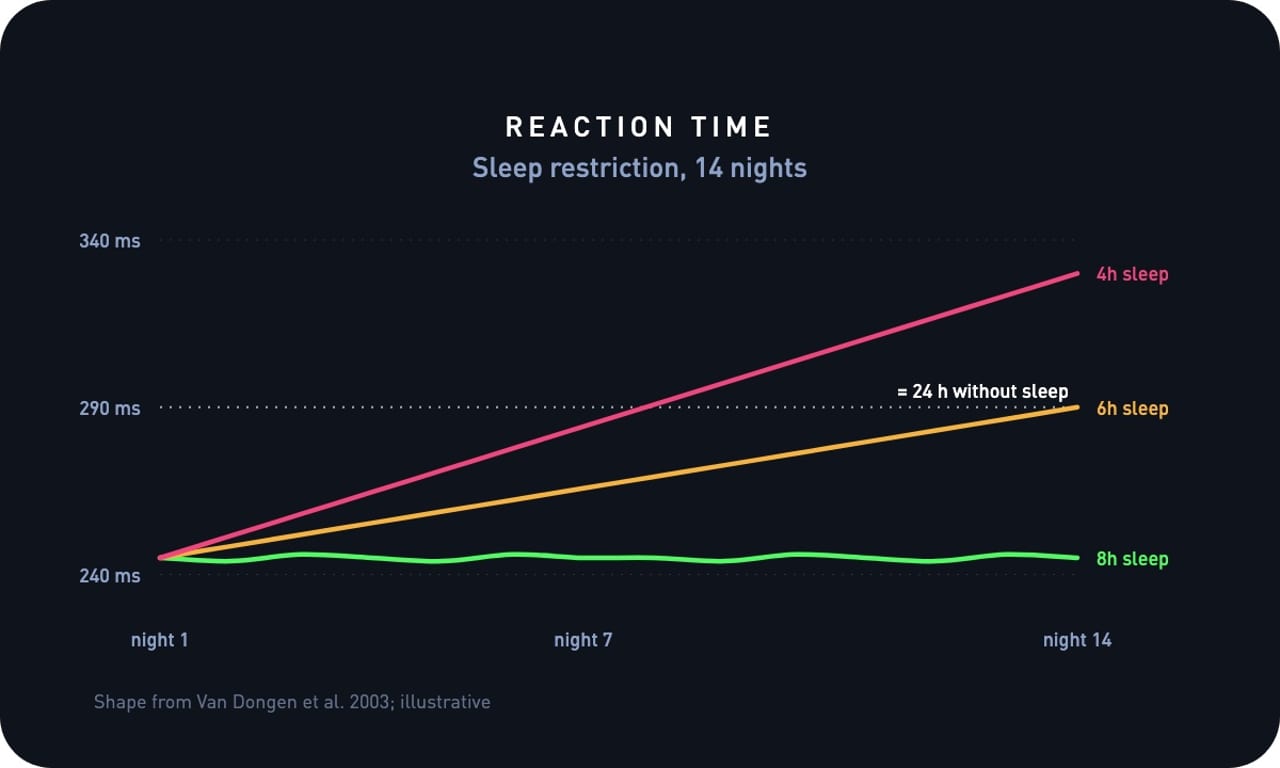
Reaction time is about 240 to 270 milliseconds for most adults. After one short night it slows measurably, before you would describe yourself as tired. After two weeks of six-hour nights, people in a controlled study performed as badly as people who had skipped two full nights of sleep, while rating themselves only slightly sleepy.
That gap between how sharp you feel and how sharp you are is the reason to benchmark your mind. A thirty-second test each morning closes it.
What it is
Mind benchmarks track Speed, Focus, Memory, Control and Stability. Each quality combines the latest component scores from its contributing games. Speed is the simplest and the most sensitive: a reaction-time test where most adults land between 240 and 270 milliseconds.
None of these are fixed traits. They move day to day with sleep, caffeine, alcohol, illness, and training load, and the daily number swings a lot. The trend across a month is the point.
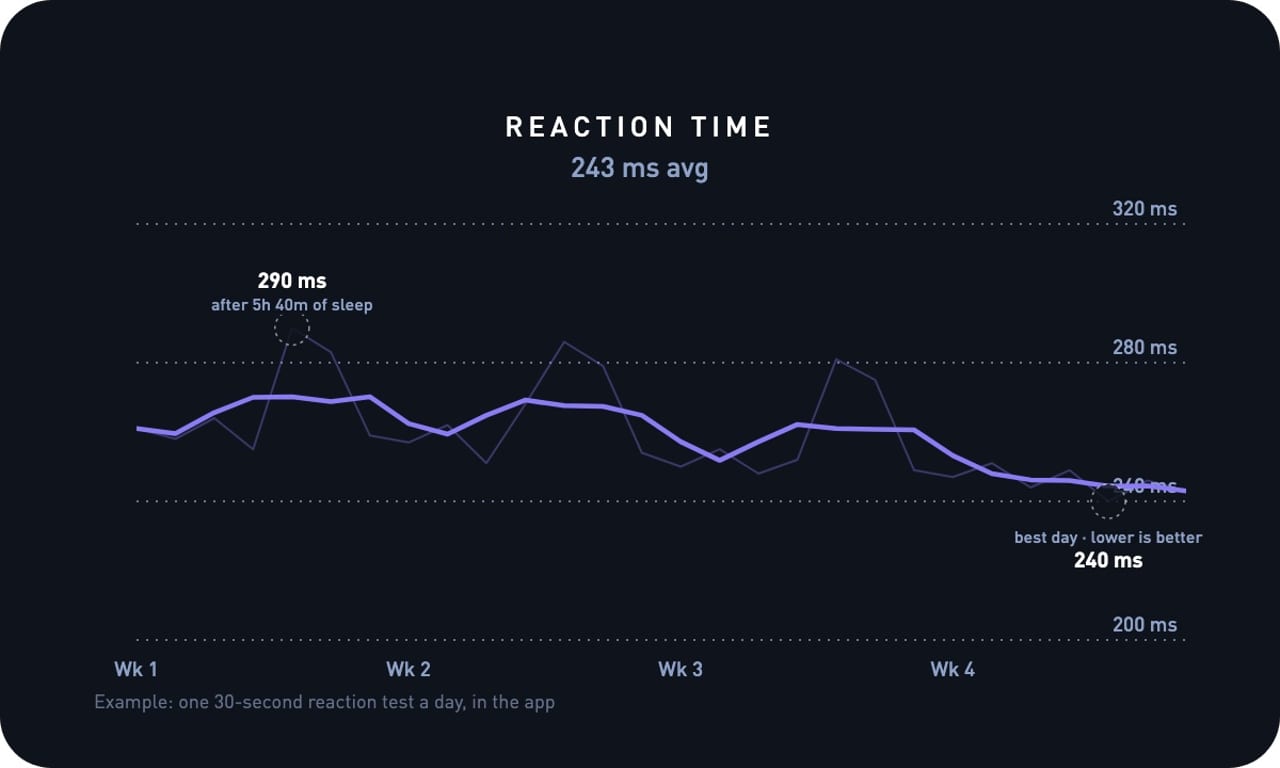
The chart above is a month of one 30-second reaction test a day: most days in the 240s and 250s, and 290 the morning after five hours forty of sleep. The slow days each have a reason in the sleep chart next to them.
Why it matters for your goals
If you want more energy and focus
The benchmarks are the direct measurement of focus. A slow morning next to the sleep chart shows whether last night cost you, and a month of them shows which habits cost you most: the late coffee, the second drink, the run of short nights. You stop guessing whether the short night mattered and see it in a number.
If you want to live longer
Speed, memory, and control are the functions that decline with age, and the ones that respond to sleep, movement, and fewer drinks. A baseline in your thirties is worth having in your fifties, and the trend over years is the one no single doctor visit can give you.
If you are training
A slowed reaction time is an early sign of under-recovery, and it often shows before resting heart rate does. A hard block that is slowing your mornings is a block that needs an easy day.
Where people land
| Most adults, reaction time | 240 to 270 ms |
|---|---|
| After one short night | Slower by tens of milliseconds, before you feel it |
| Two weeks of six-hour nights | About as slow as after two nights of no sleep at all |
Reaction time varies with age and with the device you test on, so the number is not worth comparing with anyone else. Your own baseline, on the same test at the same time of day, is what the slow days are measured against.
What the research found
The link between sleep and the benchmarks is one of the best-measured results in sleep science, and the cost of a nearby phone has been measured in the lab too.
In a controlled study of 48 adults, restricting time in bed to 4 or 6 hours per night for two weeks produced accumulating cognitive performance deficits. Participants did not fully recognize how much their performance had declined. (Van Dongen et al., Sleep, 2003). You will rate yourself fine long after the number says otherwise. The test catches what you cannot feel.
A phone sitting on the desk, face down and silent, measurably reduced working memory and attention compared with leaving it in another room. (Ward et al., Journal of the Association for Consumer Research, 2017). If a morning score is low with a good night behind it, check where the phone was during the test.
400mg of caffeine taken six hours before bed cut measured sleep by about an hour, and participants did not notice the difference themselves. (Drake et al., Journal of Clinical Sleep Medicine, 2013). A late coffee costs about an hour of sleep you did not notice losing, and the reaction test the next morning is where it shows.
What moves it
Up, over weeks. Seven or more hours of sleep at a consistent time. Caffeine finished by early afternoon. Fewer drinks. Regular aerobic exercise. Testing at the same time each morning, which makes the trend readable.
Down, within a day. A short night. Alcohol the evening before. Illness, even before symptoms. A hard training day. Testing at a different time of day, or right after waking, or with the phone buzzing beside you.
This week. Run the test at the same time each morning, before coffee, for seven days. Then look at the slowest two mornings and the nights before them. That comparison is the whole reason the benchmark exists.
Everything known to move it
Reaction time is the most sensitive number in the app, which is why it moves with almost everything. These are the levers with the best evidence. Lowers means faster, which is good; raises is the brain under load.
Training
| Aerobic fitness | lowers | Fitter people test faster and hold the score later into the day; the effect builds over months. |
|---|---|---|
| Hard session the day before | raises | A slow morning after a very hard day is normal; a slow week means under-recovery. |
Sleep
| Short night | raises | The largest lever. The score slows while you still rate yourself fine. Van Dongen et al., Sleep, 2003 |
|---|---|---|
| A run of six-hour nights | raises | Two weeks of six-hour nights produced deficits equal to two full nights without sleep. Van Dongen et al., Sleep, 2003 |
| Testing right after waking | raises | Sleep inertia slows the first half hour; test at the same point in the morning every day. |
| Consistent bed and wake time | steadies | Regular timing makes the trend readable by removing the day-to-day noise. |
Nutrition
| Caffeine late in the day | raises | About an hour of sleep lost without noticing, and the next morning test is where it shows. Drake et al., Journal of Clinical Sleep Medicine, 2013 |
|---|---|---|
| Alcohol the evening before | raises | Less REM in the first half of the night, and a slower morning. Ebrahim et al., Alcoholism: Clinical and Experimental Research, 2013 |
| Heavy midday meal | raises | The early afternoon dip is real and bigger after a large lunch; it is a reason to test in the morning. |
Supplements
| Caffeine in the morning | lowers | Faster for a few hours, which is why the test is best run before the first coffee if you want a clean baseline. |
|---|---|---|
| Sedating antihistamines and sleep aids | raises | Slower the next morning, sometimes into the afternoon. |
| Nicotine | mixed | Briefly faster, then slower as it wears off, and worse sleep behind it. |
Lifestyle and environment
| Phone on the desk | raises | Face down and silent still measurably reduced working memory and attention compared with another room. Ward et al., Journal of the Association for Consumer Research, 2017 |
|---|---|---|
| Interruptions during the test | raises | A notification mid-test costs more than the seconds it takes; it took people about 23 minutes to fully return to a task. Mark, Gudith and Klocke, CHI, 2008 |
| Illness | raises | A slow morning with a good night behind it is sometimes a cold arriving a day early. |
Gyroscope runs these correlations on your own data: open the trend, tap a slow morning, and the coach reads the night before.
Targets to aim for
| Good | Tested most mornings at the same time, with a baseline after two weeks |
|---|---|
| Great | Reaction time steady within your own range, with the slow days explained by the night before |
| Watch | A slow slide over a month with no change in sleep, or slow days with no clear cause |
| See a doctor | A sustained decline you cannot explain, especially with memory or control scores falling too |
Practical ways to improve it
- Test at the same time each morning, before coffee. Timing consistency is what makes the number comparable.
- Finish caffeine eight hours before bed. The reaction test is where a late coffee shows up.
- Try two alcohol-free nights a week and compare the mornings after.
- Put the phone in another room for the test and for your deepest hour of work.
- Do not chase a best score. The trend across a month is the point, and the daily number swings a lot.
How to track it
The benchmarks come from tests in the Gyroscope app, so there is no device to buy and nothing to connect. Each test takes under a minute; the reaction test takes thirty seconds.
The only setup that matters is consistency: the same test, the same time of day, ideally the same device. A test on a laptop and a test on a phone will not read the same, so pick one.
| Gyroscope app | Open the Mind tab and run the test; scores chart themselves |
|---|---|
| Reminder | Set a morning prompt so the test lands at the same time each day |
| No app | Any online reaction-time test, same device and same time each morning, with the number logged by hand |
How Gyroscope tracks it
Run the test each morning and Gyroscope charts every benchmark against your own baseline, with the sleep line from the night before underneath. A 30-second reaction test is enough for the Speed score; the others take a little longer and can be run less often.
On the Trends tab the benchmarks sit next to sleep, caffeine, alcohol, and phone time, which is where the explanation for a slow morning usually is. Ask the coach about a bad week and it reads those together.
It needs a couple of weeks of same-time tests before the baseline is set, and a month before the slow days stand out clearly from the noise.
Works with Any phone.
Questions people ask
- How long does the test take?
- The reaction test is thirty seconds. The full set is a few minutes, and you can run the full set weekly and the reaction test daily.
- What is a normal reaction time?
- Most adults land between 240 and 270 milliseconds. The number depends on age and on the device, so read your own trend rather than the table.
- Why was this morning so slow?
- Check the night before first: a short night, drinks, or a late coffee. Then the phone: testing with it next to you costs attention.
- Can I improve my scores?
- Yes, mostly by removing what slows them: more consistent sleep, earlier caffeine, fewer drinks, regular exercise. Practice on the test itself improves the score a little at first and then stops.
Track your Mind benchmarks
This is one of the advanced trends in Gyroscope One, along with the AI coach that reads it for you every morning.
Unlock with Gyroscope OneGet the app