
Mood and Energy
A five-second rating, twice a day, that sounds too simple to matter until you see a month of it.
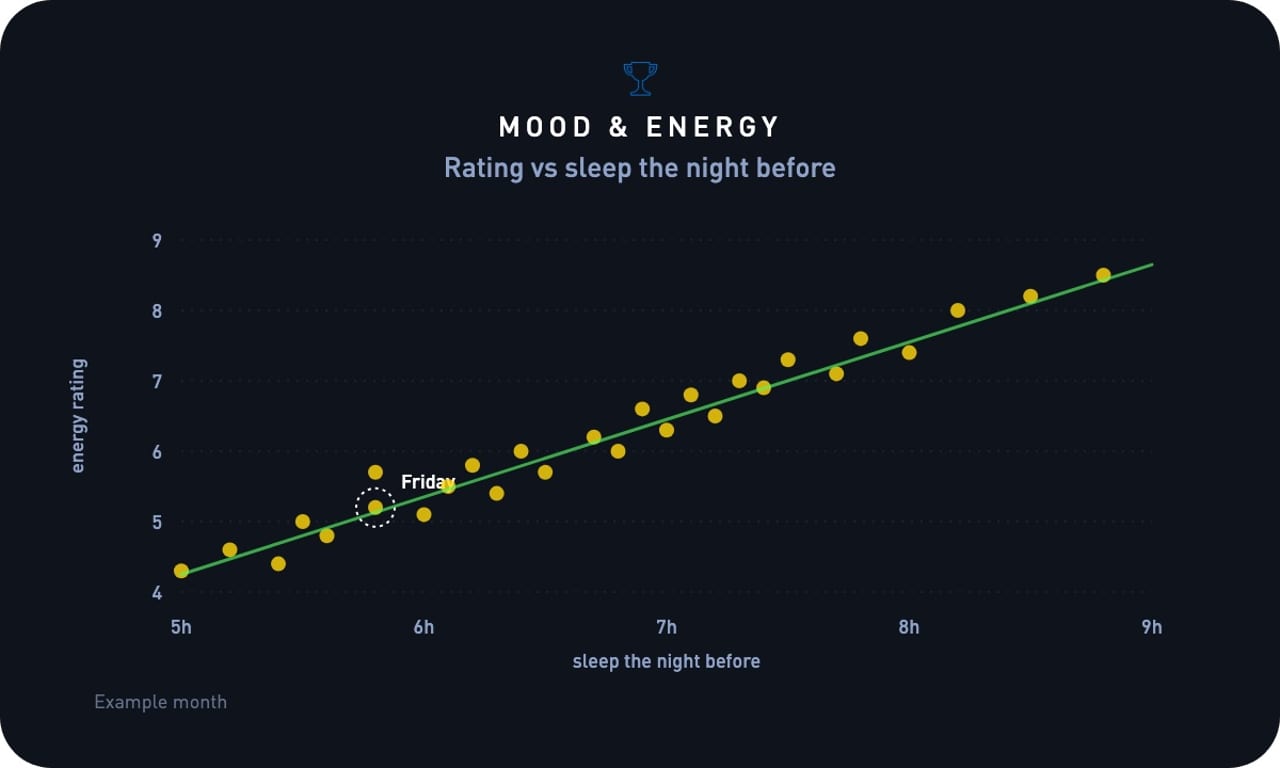
Ask someone how they feel and you get a shrug. Ask them the same question every morning for a month, on a scale of one to ten, and you get a chart where nearly every dip in energy sits on top of a short night.
Mood and energy are the two numbers that predict how your day will go, and they are the only ones on this site that no device can measure. You rate them. It takes five seconds, and the pattern is worth more than most of the numbers your watch collects.
What it is
Two ratings, each out of ten: how your mood is and how much energy you have. Rated at the same times each day, morning and evening, and charted together next to sleep.
Subjective is not the same as unreliable when it is collected the same way every day. The number on any one day is mostly noise. The pattern across a month is a measurement.
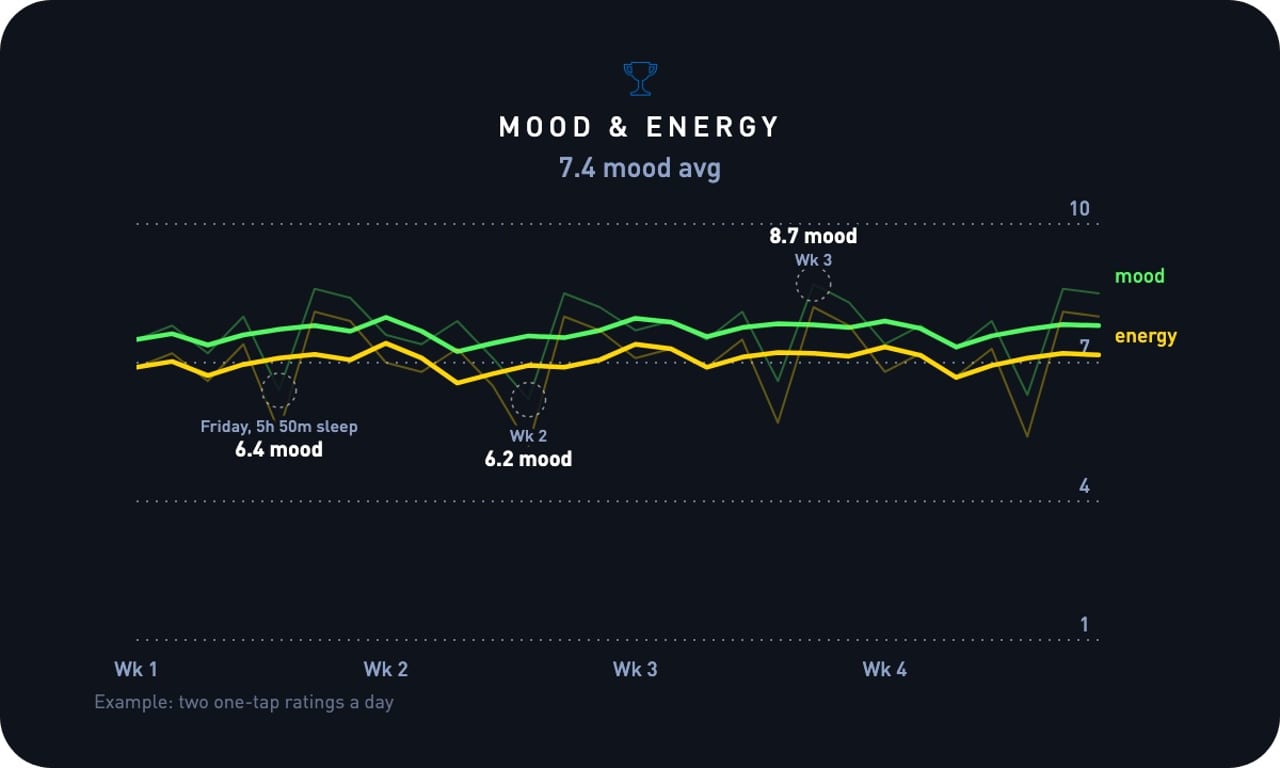
The chart above is a month of both. Mood mostly 7 to 8, energy a point lower, and both dropping on the same day each week: Friday, after five hours fifty of sleep on Thursday. One low day is a day. A weekly pattern next to short sleep is something to change.
Why it matters for your goals
If you want more energy and focus
This is the direct measurement. Rating energy every morning for a month turns "I have been tired lately" into a chart with a shape, and the shape almost always points at something: the same short night each week, a run of late drinks, a training block that went on too long. You fix the cause, and the line shows whether it worked.
If you want to lose weight
A low-energy day is a day you eat more and move less, and it is usually downstream of a bad night. Seeing the energy line next to sleep and food shows which days the diet slipped and why, which is the first step to not repeating them.
If you are training
Sports scientists have known this for a while: a simple daily self-rating tracks training load and recovery at least as well as the lab measures, and often responds sooner. A falling energy line during a hard block is the signal to take the easy day before the body forces one.
Where people land
| Typical mood rating | 7 to 8 on an ordinary day |
|---|---|
| Typical energy rating | About a point below mood |
| After a short night | Both drop together, energy first |
There is no population scale for a feeling. An honest 6 for one person is an honest 8 for another, so the only useful comparison is your own line against your own baseline, and the night before.
What the research found
Self-ratings have been tested against the objective measures, and short sleep has been tested against how people think they feel.
A 2016 systematic review of 56 studies found that simple self-reported wellness measures reflected changes in training load with better sensitivity and consistency than the common objective measures like heart rate and HRV. (Saw et al., British Journal of Sports Medicine, 2016). A rating collected the same way every day is a real measurement, and it often catches the slump before heart rate and HRV do.
In a controlled study of 48 adults, restricting time in bed to 4 or 6 hours per night for two weeks produced accumulating cognitive performance deficits. Participants did not fully recognize how much their performance had declined. (Van Dongen et al., Sleep, 2003). You will rate yourself fine long after the chart says otherwise. That is why the ratings go next to the sleep line rather than standing alone.
Limiting social media to 30 minutes a day for three weeks significantly reduced loneliness and depression. (Hunt et al., Journal of Social and Clinical Psychology, 2018). One app and one limit, for one week, is an experiment your mood line can actually read.
What moves it
Up, over weeks. Seven or more hours of sleep at a consistent time. Daily movement, especially outdoors in the morning. Less alcohol. Less time in social feeds. Regular meals. A training load you recover from.
Down, within a day. A short night. Drinks the evening before. A hard session without a rest day after it. Illness coming on. A day that was all screens and no daylight.
This week. Rate both at the same times, morning and evening, for seven days, including the ordinary days. Then look only at the lowest two and what happened the night before each. That is usually the whole diagnosis.
Everything known to move it
Mood and energy answer to the same inputs as everything else in the app, with a lag of about a day. These are the levers with the most evidence, grouped by where they live. Raises is good here; lowers is what a bad night looks like the next afternoon.
Training
| Regular aerobic exercise | raises | The most reliable daily lift, and it shows in the evening rating more than the morning one. |
|---|---|---|
| Morning walk outdoors | raises | Movement plus daylight early in the day lifts energy through the afternoon and sets up an earlier night. |
| Hard block without a rest day | lowers | A run of hard sessions drags the ratings down before heart rate or HRV react; that is what the rating is for. Saw et al., British Journal of Sports Medicine, 2016 |
Sleep
| Short night | lowers | The biggest single-day lever, and the one you under-report: the rating drops, but less than the performance does. Van Dongen et al., Sleep, 2003 |
|---|---|---|
| Consistent bed and wake time | steadies | Regular timing flattens the swings between days more than it moves the average. |
| Phone in bed after lights out | lowers | Later bedtime, shorter sleep, and more fatigue the next day. Exelmans and Van den Bulck, Social Science and Medicine, 2016 |
Nutrition
| Alcohol the evening before | lowers | The night feels fine and reads worse; the morning rating is usually where it shows. Ebrahim et al., Alcoholism: Clinical and Experimental Research, 2013 |
|---|---|---|
| Regular meals | steadies | Skipped or very late meals show up as an afternoon energy dip and an irritable evening. |
Supplements
| Caffeine | mixed | Lifts the afternoon and costs the night when taken late, so the next day starts lower. Drake et al., Journal of Clinical Sleep Medicine, 2013 |
|---|---|---|
| Nicotine | mixed | A short lift followed by a dip, and worse sleep when used in the evening. |
Lifestyle and environment
| Time in social feeds | lowers | Capping social apps at 30 minutes a day reduced loneliness and depression within three weeks. Hunt et al., Journal of Social and Clinical Psychology, 2018 |
|---|---|---|
| Daylight | raises | A day that was all screens and no daylight reads as a low energy day, especially in winter. |
| Illness coming on | lowers | The rating often drops a day before symptoms; read it next to resting heart rate. |
| End-of-day reflection | raises | A few written lines at the end of the day improved next-day performance in the office, and the evening rating is a good place to do it. Di Stefano, Gino, Pisano and Staats, Harvard Business School, 2014 |
Medical
| Thyroid, iron, and mood conditions | mixed | A low line that holds for weeks with good sleep behind it is worth a blood test and a conversation with a doctor. |
|---|
Gyroscope runs these correlations on your own data: open the trend, tap a low day, and the coach reads the night before.
Targets to aim for
| Good | Ratings logged most days, at the same times, with the honest number |
|---|---|
| Great | Energy holding within a point of your usual, and the dips each have a reason |
| Watch | The same dip on the same day every week, or a slow slide over a month |
| See a doctor | Mood staying low for two weeks or more, or energy that sleep no longer restores |
Practical ways to improve it
- Rate at the same times every day, morning and evening. Timing consistency is what makes the chart readable.
- Aim for a true score, not a good one. A month of sevens you did not mean hides every pattern.
- Keep logging on ordinary days. The middle entries are what make the dips stand out.
- When energy drops, check last night first. Most dips sit on top of a short or late night.
- Run one experiment at a time, for a week: an alcohol-free week, a social media limit, a morning walk. Then compare the line.
How to track it
No device can measure this one. Mood and energy are rated by you, in the app, ideally twice a day. The whole setup is deciding on two fixed times and keeping them.
If you do not want to open the app, a note in any journal with a number out of ten works, and you can enter a backlog later. What matters is the same question at the same time, every day.
| Gyroscope app | Tap the mood check-in, rate mood and energy out of ten, done |
|---|---|
| Reminders | Turn on the morning and evening prompts so the times stay fixed |
| No app | Two numbers a day in any notebook, entered later |
How Gyroscope tracks it
Check in once in the morning and once in the evening. Gyroscope charts mood and energy together against your own baseline, and puts the sleep line from the night before right underneath, which is where most of the explanation is.
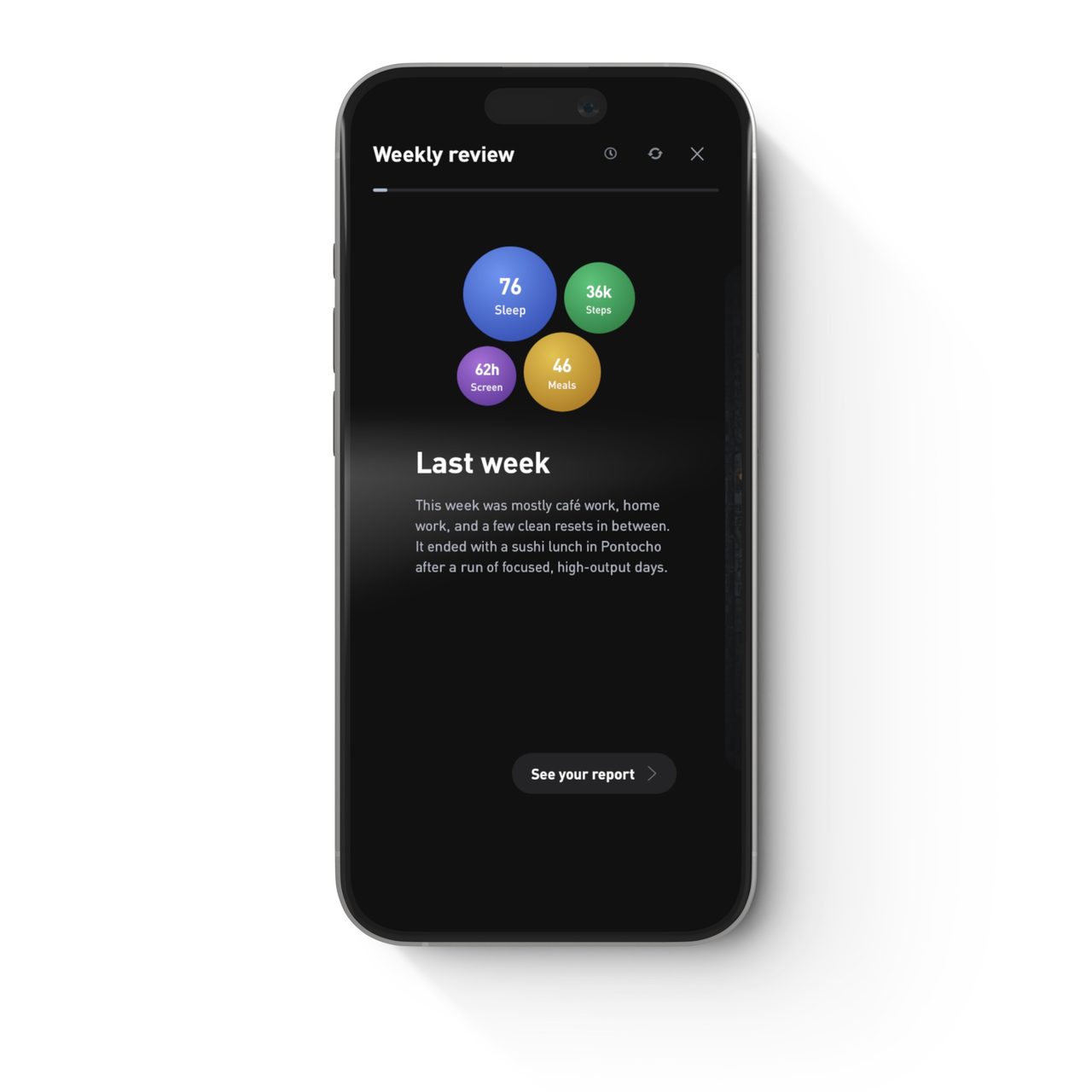
On the Trends tab the pair sits next to sleep, alcohol, phone time, and workouts. Ask the coach about a low week and it reads all of those together and tells you what most likely moved it. The Weekly Review calls out the lowest day and what preceded it.
It needs about two weeks of check-ins before the pattern is readable, and a month before a weekly rhythm shows up.
Works with Any phone.
Questions people ask
- Is a self-rating really data?
- Yes, when it is collected the same way every day. A review of 56 studies found simple daily wellness ratings tracked training load at least as well as heart rate and HRV.
- What if I forget a day?
- Skip it. A missing day is better than a guessed one; the chart is built from the honest entries around it.
- Why does my energy drop on the same day every week?
- Look at the night before it. In most charts a weekly dip sits on top of a weekly short night, a late training session, or a regular drinks evening.
- Should I try to raise the score?
- No. Try to raise the causes: sleep, movement, daylight, fewer drinks. The score follows, and a chased score tells you nothing.
Track your Mood and energy
This is one of the advanced trends in Gyroscope One, along with the AI coach that reads it for you every morning.
Unlock with Gyroscope OneGet the app