Gyroscope Benchmarks / Mind
Planning test: how many moves ahead can you think?
This test measures whether you can hold a goal, obey movement rules, and choose an efficient sequence before acting.
Why it matters
Planning is the part of thinking that runs before you act. Packing a car so the last bag in is the first one you need, cooking three dishes that finish at the same time, routing a day of errands so you never cross town twice: each of these is a tower puzzle with the disks renamed. You hold the goal in mind, you respect the constraints, and you pick an order that does not cost you a step you later have to undo.
That ability rides on working memory and attention, and both are easily taxed. Short sleep, a stretch of stress, a lingering cold, or a week of interrupted days shows up here early, usually as moves you make and then take back. With age the raw speed of planning tends to slow, and most people compensate by leaning on routine, which works right up until the routine does not fit the problem in front of you.
You cannot feel planning quality from the inside. A day you solve by trial and error feels much like a day you saw the whole route at once, because the tower still gets built. Excess moves above the optimum, counted the same way on the same kind of layout each month, give you a number that does not care how the session felt. A flat line says the capacity is holding. A slow drift upward says something upstream deserves a look, before it costs you somewhere that matters more than a tower.
What this test measures
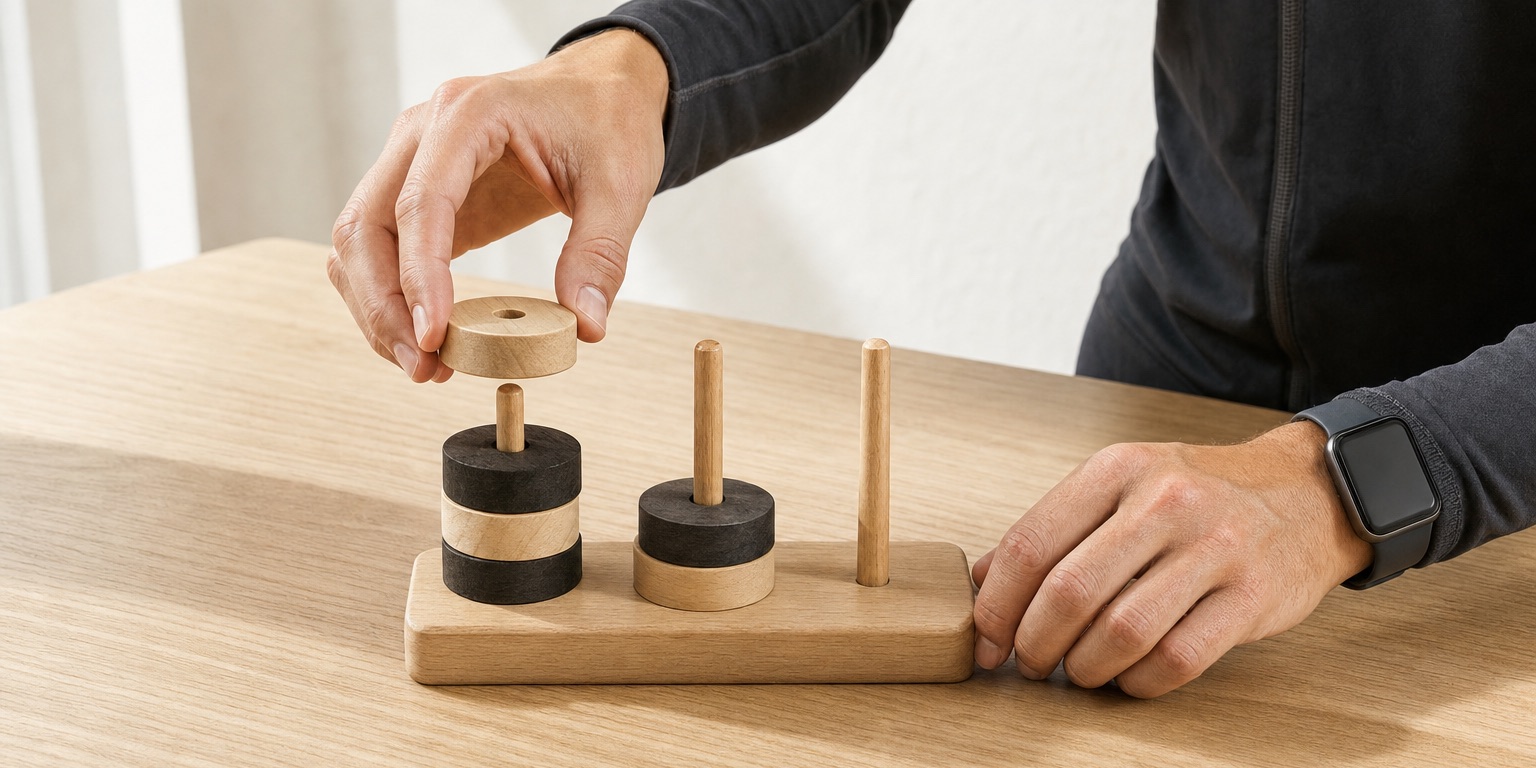
Tower Plan asks you to rebuild a tower to match a target layout. You move one disk at a time, only the top disk on a peg, and never place a larger disk on a smaller one. A clean solution requires you to work backward from the goal before committing the first move.
The useful markers are excess moves above the known optimum, rule violations, and the pause before the first move. A longer initial pause can be productive when it replaces trial-and-error moves, but total time must be read with the solution quality.
Shallice introduced the Tower of London as a task deliberately loaded on planning demands. The original paper linked performance on this non-routine problem with a model in which planning can be impaired separately from familiar routine action.
Shallice, Philosophical Transactions of the Royal Society B, 1982
Tower Plan is inspired by that paradigm, not a clinical version of it. Puzzle layouts, allowed moves, scoring, and input method all affect results.
Do the test right now
- 1Open Tower Plan in Gyroscope and study both the starting layout and target. A run takes about 90 seconds.
- 2Before moving, identify which disk must end up at the bottom of each peg and plan the first few steps.
- 3Move one disk at a time. Move only the top disk on a peg, and never place a larger disk on a smaller one.
- 4Finish the layout, then keep excess moves above optimal, any rule violations, and the time before your first move.
Reference bands
Tower tasks differ too much for one universal completion-time norm. Gyroscope uses practical bands tied to each puzzle's known optimal move count.
| Solution | Practical band |
|---|---|
| Optimal moves | Clean plan |
| 1–2 excess moves | Typical |
| 3 or more excess moves | Trial and error building |
| Any rule violation | Rule control broke |
Shallice, Philosophical Transactions of the Royal Society B, 1982. Planning-task context for Gyroscope's practical bands.
A very short first-move pause plus several excess moves can signal an impulsive strategy. A short pause with an optimal solution can simply mean the plan was seen quickly. Read these markers together.
What moves your score
Planning depends on attention and working memory as well as puzzle familiarity. Lim and Dinges reviewed 70 short-term sleep-deprivation articles containing 147 tests. Working memory and complex attention were degraded, while lapses in simple attention showed the largest domain effect, Hedges's g -0.776.
Lim and Dinges, Psychological Bulletin, 2010
- Sleep loss and fatigue can make a multi-step plan harder to hold.
- Practice teaches recurring puzzle structures and legal moves.
- Stress can shorten the planning pause and add trial-and-error moves.
- Illness or distraction can increase rule violations.
How to improve
Two things bring your excess-move count down: planning before the first move becomes a habit, and the conditions you test in stop borrowing working memory from the puzzle. The first takes a few sessions, the second is mostly the room you sit in.
- Name the end state first. Before you touch anything, say which disk must sit at the bottom of each peg. Every solution begins by freeing those disks, so the bottoms fix the order of the whole plan.
- Count the moves you expect. Rehearse the route and put a number on it. If you use more, you know where the plan broke and what to rehearse next month.
- Give every parking move a reason. An empty peg holds a disk that is in the way. If you cannot say which disk the move clears a path for, it is a guess.
- Stop after a surprise. One unplanned move tends to attract two more. When a disk ends up where you did not intend, take your hands off, rebuild the plan from the layout as it stands, then continue.
- Slow the first move on purpose. A pause of a second or two paired with excess moves means you are solving with your hands. Spend the pause on the route, not the clock.
- Practice away from the screen. Three coins and three circles on paper make a tower you can carry anywhere, and working backward from a target for a few minutes teaches the recurring shapes.
Retest once a month on the same kind of layout, same input method, after a normal night, with your phone in another room, so a change on the line is a change in you and not in the setup. Ward and colleagues found that a phone on the desk, face down and silent, measurably reduced working memory and attention, which is what this test spends. A drop that holds for several months is worth mentioning to a doctor.
Ward et al., Journal of the Association for Consumer Research, 2017
Track it
Log it in the app.
Download Gyroscope and run Tower Plan in about a minute. See how you compare to your peers, to the studies, and to your own baseline over time.
Download the appExplore membershipsBenchmarks are included in all premium memberships.