Gyroscope Benchmarks / Strength
How many pull-ups should you be able to do?
A strict pull-up set tests upper-body pulling endurance and relative strength against your own body weight.
Why it matters
Pulling is the half of upper-body strength that daily life asks for most and trains least. Lifting a suitcase into an overhead bin, climbing out of a pool, hauling yourself over a ledge on a hike, carrying a child on one arm while you open a door with the other: each of those runs through the lats, the biceps, the grip and the trunk, the same chain a strict pull-up loads. Pushing gets trained by accident, at desks and doorways. Pulling only gets trained on purpose.
The count also tells you about your weight, not just your back. A pull-up is strength divided by body mass, so it falls when either side of that ratio moves the wrong way: muscle lost during a layoff, fat gained over a slow winter, or both at once in the decades when adults tend to lose muscle and gain weight without noticing. Grip goes with it, and grip is the strength measure most strongly tied to long-term health in the study below.
Feeling strong is unreliable. A good night of sleep, a coffee and a new gym, and you feel capable of more than you can do. A count of strict repetitions, dead hang to chin over the bar, on the same bar on a rested morning once a month, is not fooled by any of that. It rises only when you can do more, and because the test never changes, a drop of two is information rather than a mood.
What this test measures
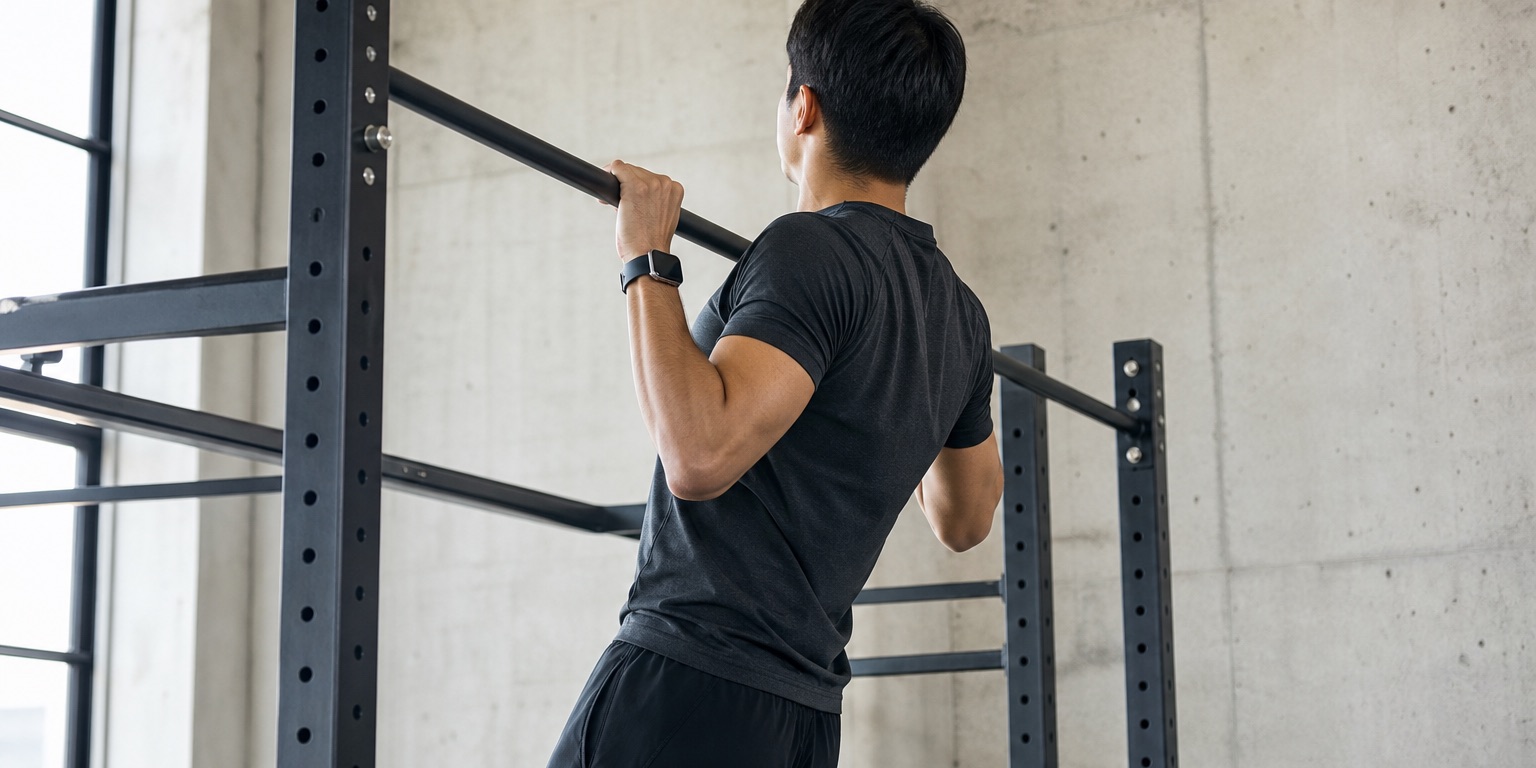
A pull-up asks the back, arms, shoulders, hands, and trunk to move and control your full body. Because body weight is the resistance, the result reflects relative strength and muscular endurance. Strict range matters: a repetition begins at a dead hang and ends only after the chin passes the bar.
No pull-up count has been shown to predict health outcomes on its own. The broader evidence does show that strength matters. A meta-analysis combined 38 cohort studies with 1,907,580 participants and 63,087 deaths. Higher handgrip strength was associated with lower all-cause mortality than lower strength, with a pooled hazard ratio of 0.69. Higher knee-extension strength was associated with a hazard ratio of 0.86.
García-Hermoso, Archives of Physical Medicine and Rehabilitation, 2018
Those findings concern handgrip and knee-extension tests, not pull-ups, and they are observational associations rather than proof that a particular repetition count changes risk. Use the pull-up as a repeatable measure of your own pulling capacity.
Do the test right now
- 1Warm up your shoulders, elbows, and hands. Use a sturdy bar with clear space below it, and place your phone where you can record the result after the set.
- 2Grip the bar with both hands and begin from a dead hang with straight arms. Keep your body quiet and your feet off the floor.
- 3Pull until your chin is fully over the bar, then lower under control until your elbows are straight again. Do not swing, kip, or shorten the bottom position.
- 4Continue as one unbroken set. Stop when you cannot clear the bar or control the descent. Keep only completed strict repetitions.
Reference bands
There is no strong published norm table for strict pull-ups across the general adult population. Grip, body size, sex, training history, and the exact bar protocol all change the count. Gyroscope uses the practical bands below for a consistent strict-form test, not as medical or population cutoffs.
| Strict repetitions | Practical band |
|---|---|
| 0 | Building |
| 1–4 | Developing |
| 5–9 | Solid |
| 10–14 | Strong |
| 15+ | Elite |
García-Hermoso, Archives of Physical Medicine and Rehabilitation, 2018. Broader strength context for Gyroscope's practical pull-up bands.
Starting at zero is common for people who have not trained the movement. An assisted repetition is useful training, but it does not count in this benchmark. Compare like with like by keeping grip, bar, range, and form rules stable.
How to improve
Pull-up counts rise when you get stronger relative to your body weight and when you practice the exact movement often enough for it to become efficient. Both respond to the same thing: full-range work two or three times a week, most of it well short of failure.
- Practice the full path with help. Band-assisted pull-ups or an assisted machine let you do sets of five to eight from a dead hang to chin over the bar. Reduce the help a little each week rather than jumping to body weight.
- Lower slowly. Step or jump to the top and take four to six seconds to reach straight arms. Negatives build strength through the part of the range you cannot yet pull through.
- Row and hang between sessions. Inverted rows and dumbbell rows build the back and arms. Dead hangs of 20 to 40 seconds build the grip, which is usually what fails first.
- Stop sets before form breaks. Finish each training set one or two repetitions short of failure. Kipped and half repetitions train a different movement and will not count on test day.
- Mind the other side of the ratio. Every pound you carry is on the bar, so losing extra body fat raises the count with no change in strength. Keep lifting while you lose it, so the loss is fat rather than muscle.
- Let tendons catch up. Elbows and shoulders adapt more slowly than muscle. If one aches for more than a few days, see a physiotherapist before adding volume.
Binmahfoz et al., BMJ Open Sport & Exercise Medicine, 2025
Retest once a month, on the same bar with the same grip, rested and before the rest of your training. Keeping the protocol identical is what makes each month comparable with the last, so the line in your feed shows strength changing and nothing else.
Track it
Log it in the app.
Download Gyroscope and run Pull Strength in about a minute. See how you compare to your peers, to the studies, and to your own baseline over time.
Download the appExplore membershipsBenchmarks are included in all premium memberships.