Gyroscope Benchmarks / Strength
How many push-ups should you be able to do?
A strict push-up set measures upper-body pushing strength and muscular endurance using only your body weight.
Why it matters
Pushing strength is the strength you use to get up off the floor, to shove a stuck door, to catch yourself when you trip, to lift a suitcase into an overhead bin. The push-up tests the whole chain at once: chest, shoulders, triceps, and a trunk that has to hold you straight while your arms do the work. A set of strict push-ups is a small, hard question put to that chain, and the answer is one number you can compare month to month.
Left alone, this capacity drifts down. Muscle that is not asked to work shrinks, and the loss speeds up with each decade. Desk years round the shoulders forward and shorten the range you can press through. The decline is slow enough to hide. You still feel strong most days, and then a set to failure shows a count ten lower than it was two years ago.
That is why the measured number beats the feeling. How strong you feel depends on sleep, mood, and the last thing you lifted. A strict set to form failure, done the same way every month, strips that out. It tells you whether your training is working, whether a heavy month at work cost you something, and whether the shoulder that has been nagging is changing what you can produce. In the app the score is saved to your feed, compared with peers and with your own baseline, and the coach reads it alongside everything else you track.
What this test measures
Push-ups ask your chest, shoulders, triceps, and trunk to produce repeated force while the body stays rigid. Because form changes the work dramatically, a smaller set of strict repetitions is more comparable than a larger set with a shortened range of motion.
In a cohort of 1,104 occupationally active male firefighters with a mean age of 39.6 years, 37 cardiovascular events occurred over 8,601 person-years. Men who completed at least 41 push-ups had an incident-rate ratio of 0.04 compared with men who completed 10 or fewer, described by the authors as a 96 percent lower event incidence.
That association does not show that doing push-ups prevents cardiovascular events. The study involved active adult men in one occupation, the higher-capacity group was younger, and the authors said the result should not be treated as an independent prediction of risk.
Do the test right now
- 1Warm up your shoulders and wrists, then place your phone where its counter or notes screen is easy to reach after the set.
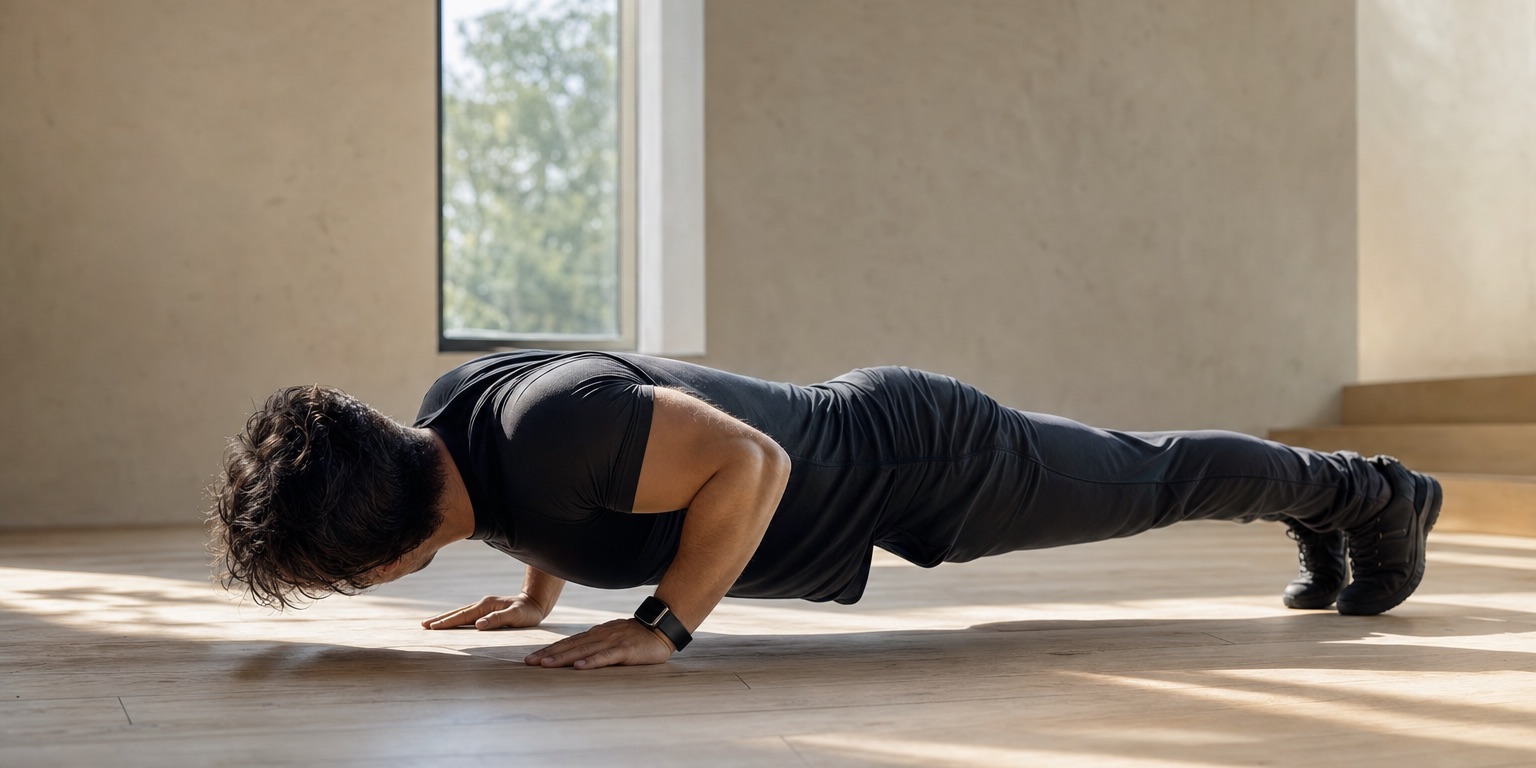
- 2Start in a straight line from head to heels, with hands planted firmly. Lower until your chest touches the floor.
- 3Press to full elbow lockout. Keep your trunk rigid and count only repetitions that meet both the chest-to-floor and lockout rules.
- 4Continue as one unbroken set to form failure. Do not rest at the top longer than a breath. Write down the completed strict repetitions and discard the unfinished repetition.
Reference bands
Published adult push-up norms depend on the protocol. The ACSM good bands below use standard push-ups for men and modified knee push-ups for women, so the women's column is not directly comparable with the strict full-body test above.
| Age | Men, good | Women, good modified |
|---|---|---|
| 20–29 | 45–54 | 34–48 |
| 30–39 | 35–44 | 25–39 |
| 40–49 | 30–39 | 20–34 |
| 50–59 | 25–34 | 15–29 |
| 60+ | 20–29 | 5–19 |
ACSM's Guidelines for Exercise Testing and Prescription, 11th edition, Wolters Kluwer, 2021
The firefighter study used a metronome set at 80 beats per minute and stopped the test when a participant reached 80 repetitions, missed at least 3 beats, or stopped. Its highlighted comparison is useful context for men, but it is not an age-by-sex norm.
| Study band | Events | Rate per 100,000 person-years |
|---|---|---|
| 0–10 push-ups | 8 | 1,757 |
| 41+ push-ups | 1 | 79 |
How to improve
Your count rises when two things happen: the pressing muscles get stronger, and you learn to repeat clean repetitions without the hips sagging or the elbows flaring. Training both, a few times a week, is enough for most adults.
- Train it three times a week. Push-ups recover quickly. Two or three sessions of several sets, each stopped two or three repetitions short of failure, add up faster than one heroic set on a Sunday.
- Use an incline to buy range. If chest-to-floor repetitions are out of reach, press off a bench, a counter, or a wall, and lower the surface every week or two. A full-range repetition on a step beats a half repetition on the floor.
- Practice the lowering half. From the top, take three seconds to reach the floor, then use your knees to come back up if you need to. The slow descent builds strength for the repetition you cannot yet press.
- Add a loaded press. A dumbbell or barbell bench press, or push-ups with a plate on your back, raises the ceiling your body-weight repetitions sit under. Shoulder pain means see a physio first.
- Hold the plank. Many sets end because the hips sag, not because the arms quit. Planks and hollow holds keep you rigid through the last ten repetitions.
- Eat protein and sleep. A serving of protein with each meal supports the muscle you are building, and hard sets need full nights of sleep to turn into strength.
Morton et al., British Journal of Sports Medicine, 2018
Retest once a month, on a rested day, with the same chest-to-floor and lockout rules, and stop the count the moment form changes. A number taken the same way each time is the only one worth comparing.
Track it
Log it in the app.
Download Gyroscope and run Push Strength in about a minute. See how you compare to your peers, to the studies, and to your own baseline over time.
Download the appExplore membershipsBenchmarks are included in all premium memberships.